
Views: 261 Author: Welons Prefab Houses Publish Time: 2026-08-17 Origin: Site


Content Menu
● How We Selected Manufacturers
>> 3. CIMC Modular Building Systems
>> 4. Hangxiao Steel Structure
>> 6. Nantong Huasha Movable House
>> 7. K-Home
>> 10. Suzhou Tiandi Color Steel Manufacturing
● Capacity, MOQ, and Certification Comparison
● Technical Requirements for Triangular Prefab Houses
>> Steel and corrosion protection
● Buyer's Guide: How to Verify a Supplier
>> 1. Verify the factory, not only the trading company
>> 2. Check certificates directly
>> 3. Use a staged sample process
>> 4. Control logistics from the beginning
>> Steel thickness substitution
>> Unclear fire-performance claims
>> Attractive rendering, weak waterproofing
>> Incomplete electrical systems
● FAQ
>> 1. How can I check whether a supplier's ISO certificate is still valid?
>> 2. Does CE marking mean a triangular prefab house is approved for every European country?
>> 3. What documents should be included in a triangular prefab house order?
>> 4. How should I compare quotations from different Chinese factories?
>> 5. Can a triangular prefab house be shipped fully assembled?
China has become an important sourcing base for triangular prefab houses, A-frame cabins, light-steel modular homes, and container-based buildings. Its advantage is not simply lower manufacturing cost; it is the combination of steel supply chains, panel production, welding capacity, modular assembly experience, export packaging knowledge, and increasingly mature overseas-project delivery capabilities.
For professional buyers, the right supplier is rarely the company with the lowest quotation. A reliable triangular prefab house manufacturer should be evaluated by its engineering capability, structural-material traceability, production consistency, packaging method, export experience, drawing-control process, and ability to support installation after shipment.
China's prefab-building exports reportedly rose from about USD 1.47 billion in 2015 to approximately USD 4.34 billion in 2025, with major destinations including the United States, Indonesia, Malaysia, Russia, and Australia. This reflects growing overseas demand for modular accommodation, tourism cabins, work camps, and rapid-deployment buildings.

This list is designed for procurement managers, project contractors, resort developers, distributors, and private-label buyers seeking triangular prefab house suppliers in China.
The companies below were selected based on publicly available information and practical procurement criteria:
- Manufacturing relevance to modular housing, light-steel buildings, container houses, or triangular/A-frame structures
- Product-engineering capability, including structural design, insulation options, roof systems, and prefabricated assembly
- Documented quality-management or market-access credentials
- Export suitability, including packaging, logistics coordination, overseas project experience, or international standards
- Customization capacity for layout, cladding, windows, bathrooms, electrical systems, branding, and OEM projects
- Ability to serve different purchasing models, from small tourism-cabin orders to large workforce-accommodation projects
- Transparency of company history, technical information, certifications, and production positioning
A key caveat: "triangular prefab house" is a relatively specialized product category. Some listed companies are dedicated A-frame or cabin suppliers, while others are larger modular-building manufacturers that can develop triangular or non-standard units through project engineering. Buyers should request model-specific drawings and structural calculations rather than assume that a company's container-house certification automatically covers an A-frame product.
China's modular-building ecosystem is distributed across several industrial regions:
- Guangdong is strong in export-oriented manufacturing, steel fabrication, aluminum windows, electrical components, interior finishing, and port logistics.
- Zhejiang has mature light-steel, building-material, and structural-engineering supply chains.
- Jiangsu supports steel structures, sandwich panels, prefabricated camps, and large-scale project fabrication.
- Henan and nearby central regions offer competitive production costs for container housing, portable buildings, and steel-frame systems.
- Tianjin and northern industrial clusters are particularly relevant to flat-pack modular buildings and engineering camps.
China remains the world's largest construction market, and the prefabrication sector is supported by the broader shift toward lower-waste and industrialized construction methods. One market estimate valued China's prefabricated-building market at USD 65.18 billion in 2025 and forecast growth to USD 97.86 billion by 2031.
| Manufacturer | Founded | Primary focus | Suitable buyer profile | Publicly stated certifications / compliance signals |
|---|---|---|---|---|
| Welons Prefab | Approx. 11 years of experience | Triangular prefab houses, modular buildings, prefab container houses | Small and mid-sized brands, distributors, resorts, custom OEM buyers | Buyer should request project-specific documents and test reports |
| DeepBlue SmartHouse | 2009 | Light-steel-frame prefab homes | Residential developers, villa brands, overseas builders | ISO 9001, ISO 14001, ISO 45001, ICC-ES, EN, AS/NZS, EN 1090 |
| CIMC Modular Building Systems | 1992 group background | High-end volumetric modular buildings | Large projects, institutional buildings, complex modular programs | International market access and accreditations across multiple countries |
| Hangxiao Steel Structure | 1985 | Steel structures and engineered buildings | Large commercial, industrial, and engineered projects | EN 1090, ISO 3834-2, AISC, ISO 9001, ISO 14001, ISO 45001 and more |
| GS Housing | 2001 | Flat-pack modular buildings and camps | Construction camps, mining, workforce accommodation, project offices | CE, EAC, ISO, SGS; ASTM/UL/GOST/SASO references |
| Nantong Huasha Movable House | 2004 | Container houses, folding houses, light-steel housing | Cost-sensitive project buyers and distributors | CE, SGS, ISO 9001, ISO 14001 claims on product pages |
| K-Home | Public history varies by channel | Container housing and portable camps | Commercial camps, temporary housing, distributors | ISO 9001 and certain CE-supported products |
| Sun Rises Group | 2003 | Smart modular homes, cabins, triangular houses | Cabin brands, tourism projects, diversified-house distributors | Product range includes triangular houses and modular units |
| AKAY Prefab Homes | 2012 | A-frame and modular container houses | Resort cabins, glamping projects, small-volume buyers | Dedicated A-frame modular-house offering |
| Suzhou Tiandi Color Steel Manufacturing | 2002 | Container and color-steel prefab buildings | Site offices, dormitories, warehouses, distributors | Product specialization in container and prefab housing |
Welons Prefab is positioned as a practical choice for buyers seeking triangular prefab houses, modular buildings, and prefab container-house solutions with a balance between customization depth and commercial flexibility. With around 11 years of professional manufacturing experience and reported daily capacity of 300 units, the company is suitable for customers who need stable supply without being treated as a minor account by a very large engineering contractor.
Its main value for international buyers is its ability to support OEM-oriented customization. This is particularly important for resort operators, local distributors, small modular-home brands, and project buyers who need more than a standard shell. Typical customization requirements can include:
- Exterior color, cladding, roof finish, and logo placement
- Triangular/A-frame dimensions and internal layout
- Insulation grade for tropical, cold-climate, or coastal projects
- Bathroom modules, electrical systems, lighting, plumbing, and kitchen integration
- Flat-pack, semi-assembled, or fully assembled delivery plans
- Retail-ready or distributor-ready documentation and packaging support
Rather than positioning itself only as a high-volume container-house supplier, Welons Prefab is especially relevant for buyers who need fast communication, non-standard configurations, and a factory willing to refine products during sampling and pre-production. This makes it a sensible option for mid-market OEM programs and customers building their own local sales channels.
For a triangular prefab house project, buyers should ask Welons Prefab to provide a model-specific bill of materials, steel-section specification, panel cross-section, wind-load assumption, snow-load assumption, electrical layout, and container-loading plan before confirming the order.
DeepBlue SmartHouse, founded in 2009, specializes in light-gauge steel-frame housing and is a stronger fit for buyers seeking engineered residential buildings rather than simple temporary cabins. Its product positioning is relevant to villas, permanent modular homes, granny flats, tourist accommodation, and export-market housing systems.
The company publicly states certifications and standards including ISO 9001, ISO 14001, ISO 45001, ICC-ES, AS/NZS, EN, and EN 1090. It also states that its engineering work references standards such as AISI S100, AS/NZS 4600, BS 5950-5, and Eurocode-related provisions.
For triangular prefab homes, DeepBlue may be a suitable candidate when the buyer's project requires formal structural design, higher-performance thermal envelopes, and country-specific engineering adaptation. Its strengths are likely to be more valuable for permanent or semi-permanent housing than for ultra-low-cost seasonal cabins.
CIMC Modular Building Systems is part of the larger CIMC group ecosystem and focuses on volumetric modular construction. It is more suitable for buyers with sizable project requirements, such as hotels, schools, worker accommodation, medical facilities, data centers, or institutional modular buildings.
Its modular concept integrates steel structure, enclosure systems, MEP works, and interior finishing into a factory-made building module. CIMC also states that it has market access or accreditations across locations including the United States, United Kingdom, Norway, Iceland, Singapore, Japan, Australia, New Zealand, Sweden, and Hong Kong.
For a triangular prefab house buyer, CIMC may not be the first choice for a small glamping-cabin order. However, it deserves consideration for large hospitality developments where a triangular cabin concept must be scaled into a professionally engineered modular-resort program.
Hangxiao Steel Structure, founded in 1985, is one of the more established names in China's steel-structure sector. It is a strong candidate for procurement teams that prioritize engineering documentation, welding quality, structural compliance, and large-project delivery over low initial unit price.
The company publicly lists credentials including CPR-1090-1, EN 1090-2, ISO 3834-2 welding-management certification, AISC system certification, ISO 9001:2015, ISO 14001:2015, and ISO 45001:2018. Its profile also highlights that it was the first private company in China's steel-structure industry to obtain welding certifications from the United States and the European Union.
Hangxiao is more relevant where triangular prefabricated houses are part of a larger steel-frame development, public project, industrial facility, premium lodge structure, or heavily regulated market. It may be less flexible for small MOQ consumer-cabin buyers compared with specialized prefab-house factories.
GS Housing was established in 2001 and has a long operating history in modular construction and engineering camps. It is best known for flat-pack modular systems rather than A-frame houses, but its production, project, and international-compliance experience can be useful for buyers seeking a supplier capable of handling large accommodation or site-building programs.
GS Housing states that it has more than 20 years of product-development experience and 48 national innovation patents. It also says its products comply with or reference requirements including GOST, SASO, ASTM, UL, and CE, with testing and certification by organizations such as SGS and BV. The company has also stated that its five production bases provide annual capacity exceeding 170,000 houses.
Its strongest use case is workforce camps, offices, sanitation facilities, mining accommodation, construction projects, and standardized modular deployment. Buyers requiring an A-frame model should verify whether the structure is an existing product platform or a custom-engineering project.
Nantong Huasha Movable House was established in 2004 and supplies container houses, folding units, portable housing, and light-steel products. Its catalog positioning makes it relevant for buyers who want adaptable modular units, temporary accommodation, portable offices, and budget-conscious project housing.
The company's product pages reference CE, SGS, ISO 9001, and ISO 14001 documentation. It also states that it can provide ISO certificates, test reports, and SGS certificates on request.
Huasha may be appropriate for distributors and project buyers who need repeatable standard models with custom details such as windows, panel colors, electrical packages, and floor plans. For a triangular prefab house, confirm whether the roof geometry, waterproofing system, and transport frame have been validated in previous shipments.
K-Home is a supplier focused on container houses, portable cabins, camp buildings, and steel-structure solutions. It is relevant to buyers who need practical modular buildings for offices, labor accommodation, site facilities, temporary schools, and portable commercial spaces.
The company states that it has ISO 9001 quality-management certification and that certain products can provide CE certification. K-Home is likely to be a more natural fit for standardized container-based structures than premium triangular tourism cabins, but it can be considered when triangular forms are combined with economical steel-frame construction.
Procurement teams should clarify the exact insulation material, panel density, steel thickness, coating weight, and corrosion-protection specifications. These variables can significantly affect the life cycle of a container or triangular unit, especially in coastal, humid, or high-temperature locations.
Sun Rises Group, established in 2003, offers a broad range of modular and smart-house products. Its publicly presented range includes container houses, expandable houses, folding houses, space cabins, round houses, silent cabins, mobile toilets, and triangular houses.
This broad portfolio makes Sun Rises Group a potentially useful supplier for distributors, glamping operators, and buyers who want to test multiple cabin concepts under one supplier relationship. It may also appeal to companies combining A-frame houses with capsule cabins, expandable homes, or ancillary toilet units.
Because broad product portfolios can vary in maturity, buyers should not rely solely on catalog images. Request photos and videos of completed triangular units, factory inspection records, shipping records for the same model, and a full installation manual.
AKAY Prefab Homes is a Foshan-based supplier established in 2012 that markets A-frame modular houses and container-based modular products. Its location in Guangdong can be advantageous for export buyers because of proximity to a dense manufacturing base for building finishes, aluminum products, electrical accessories, and major southern Chinese ports.
The company is worth considering for glamping projects, boutique resorts, outdoor tourism accommodation, and smaller-scale cabin procurement. A dedicated A-frame product offering can reduce the design-development time compared with asking a container-house specialist to create a new triangular product from scratch.
Before placing an order, verify whether the proposed A-frame unit is engineered for local wind, snow, seismic, and foundation conditions. A visually attractive cabin does not automatically meet local building rules.
Suzhou Tiandi Color Steel Manufacturing, established in 2002, focuses on container houses and color-steel prefab building products. It is a practical sourcing candidate for site offices, dormitories, warehouses, temporary buildings, and standardized project accommodation.
Its core strength is likely to be conventional modular and color-steel construction rather than high-design triangular tourism cabins. Nevertheless, buyers seeking a simple, cost-controlled triangular shelter or site-building adaptation may consider it if the manufacturer can provide drawings, structural verification, and completed-project evidence.
This supplier type is most suitable when procurement priorities are repeatability, basic functionality, shipping efficiency, and price discipline rather than premium residential finishes.
MOQ and capacity often depend on the model, degree of interior completion, destination market, and whether the supplier is producing a standard configuration or creating a new custom structure. Therefore, buyers should treat the following as a procurement guide, not as binding commercial terms.
| Manufacturer | Capacity signal | Typical MOQ expectation | Certification / compliance emphasis | Main purchasing advantage |
|---|---|---|---|---|
| Welons Prefab | Reported daily output of 300 units | Flexible; confirm by model and customization level | Project-specific documentation should be requested | Responsive OEM customization for small and mid-sized buyers |
| DeepBlue SmartHouse | Established light-steel manufacturing system | Usually project-based | ISO, ICC-ES, EN, AS/NZS, EN 1090 | Engineered light-steel residential systems |
| CIMC Modular | Large industrial modular platform | Generally project-based and higher-volume | Multi-country market-access capability | Complex, high-spec modular projects |
| Hangxiao | Large steel-structure engineering platform | Usually project-based | EN 1090, ISO 3834-2, AISC, ISO systems | Structural engineering and compliance depth |
| GS Housing | Over 170,000 houses annual capacity claimed | Suitable for bulk modular programs | CE, EAC, ISO, SGS and international standards | Camps and standardized project accommodation |
| Nantong Huasha | Container and folding-house production | Often negotiable by model | CE, SGS, ISO references | Cost-effective portable and container units |
| K-Home | Container-house focused | Often negotiable | ISO 9001; some CE-supported products | Standardized portable-house supply |
| Sun Rises Group | Multi-product modular platform | Confirm per cabin type | Product-specific reports should be requested | Wide cabin and modular product selection |
| AKAY Prefab Homes | A-frame and modular-house focus | Often suitable for smaller cabin projects | Request model-specific test documentation | Dedicated A-frame sourcing option |
| Suzhou Tiandi | Container/color-steel prefab focus | Often project-dependent | Request current certificates and test reports | Functional site-building and modular supply |
A triangular prefab house is not merely a standard container house with an angled roof. The triangular geometry changes the structural load path, roof waterproofing details, thermal-bridge risk, usable interior space, and transportation method.
Ask the manufacturer to identify the primary structural system:
- Light-gauge steel framing for lighter, residential-style A-frame houses
- Welded square-tube or rectangular-tube frames for portable cabins
- Heavy steel structures for larger spans, public buildings, or high-wind locations
- Hybrid systems combining a steel base chassis, wall frames, roof trusses, and insulated panels
For permanent buildings, request structural calculations based on the destination's design loads. At a minimum, these should cover wind, snow, seismic conditions where applicable, dead loads, occupancy loads, and roof-maintenance loads.
The quotation should state:
- Steel grade and thickness
- Galvanized coating weight or hot-dip galvanizing specification
- Weld type and welding inspection requirements
- Anti-rust treatment for cut edges and welded joints
- Powder-coating or paint-system specification
- Fastener grade and corrosion resistance
A common sourcing problem is that suppliers quote a visually similar structure using thinner steel sections or lower-grade galvanizing. The difference may not be visible after the exterior panels are installed.
For triangular cabins, roof insulation is especially important because the roof forms most of the building envelope. Buyers should specify:
- Insulation type: rock wool, glass wool, EPS, XPS, polyurethane, or PIR
- Insulation density and thickness
- Fire-performance requirement for the destination market
- Thermal conductivity value
- Vapor barrier and condensation-control design
- Interior lining material and moisture resistance
For warm climates, reflective roof layers and ventilation cavities may matter more than simply increasing insulation thickness. For cold climates, thermal bridges at steel studs, roof joints, windows, and floor connections require special attention.
A-frame cabins often use large triangular glazing, which can become the most expensive and technically sensitive component. Verify:
- Tempered, laminated, insulated, or low-E glass configuration
- Glass thickness and interlayer specification
- Aluminum profile system and thermal-break requirement
- Wind-load rating for large glazed areas
- Drainage channels and sealing method
- Replacement-glass plan for the destination market
A supplier may be a legitimate exporter but not own the factory responsible for welding, panel production, or assembly. This is not automatically a problem, but buyers should know who controls quality and delivery.
Request:
- Business license with registered legal entity name
- Factory address and live video call from the workshop
- Production-line photos showing current orders
- Welding, panel-cutting, assembly, and packaging areas
- Export records or shipping references with sensitive details redacted
- A list of major outsourced components, such as windows, bathrooms, electrical boxes, and insulation panels
Do not accept a certificate PDF as final proof. Verify:
- Certificate number
- Certificate holder's legal name
- Factory address shown on the certificate
- Scope of certification
- Issuing body
- Issue date and expiry date
- Whether the certificate covers the factory, a specific product, or only a management system
For ISO documents, confirm the certificate through the issuing certification body or accreditation database where available. An ISO 9001 certificate indicates a quality-management system; it does not prove that a triangular house complies with a local building code.
For custom triangular prefab houses, a practical sequence is:
1. Confirm the concept drawing and target price range.
2. Approve the bill of materials and preliminary technical specification.
3. Produce a 3D model and detailed shop drawings.
4. Approve a material sample board, including steel, panel, flooring, window, and cladding samples.
5. Build a prototype or first article.
6. Conduct video inspection or third-party inspection before packaging.
7. Approve container-loading photos and packing list.
8. Evaluate installation feedback before repeating or scaling the order.
For buyers launching a new cabin brand, the first unit should be treated as a product-validation stage rather than a normal purchase order.
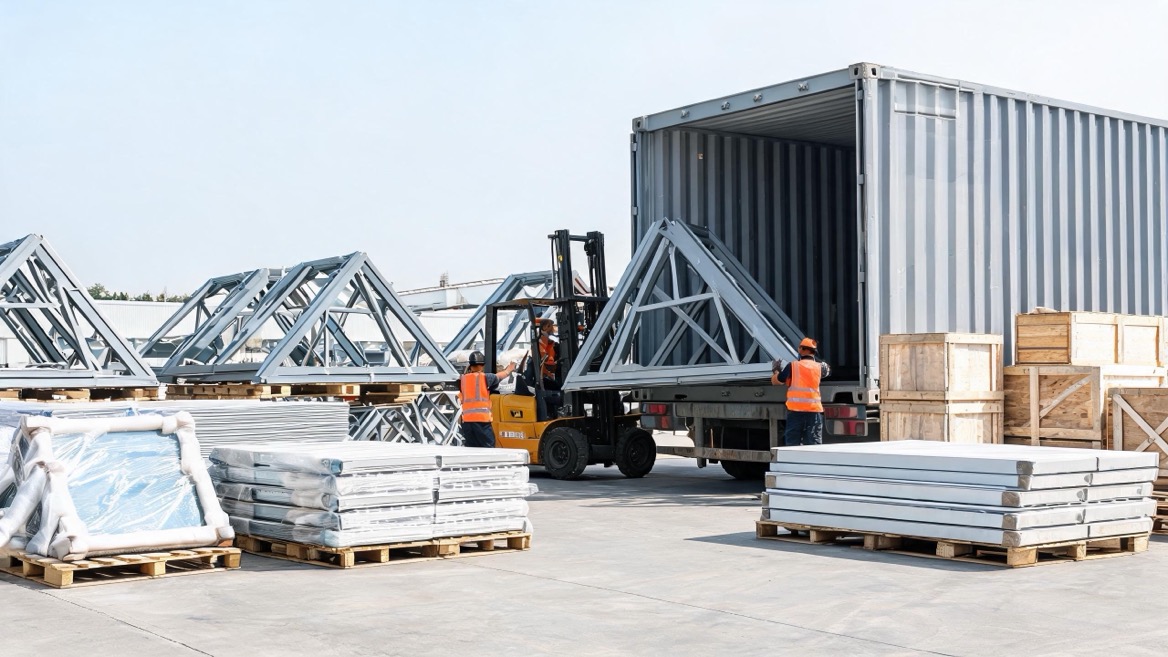
Triangular prefab houses can be shipped as:
- Fully assembled units
- Semi-assembled modules
- Flat-packed frame and panel kits
- Nested or stackable components
- Separate structural, interior, and glazing packages
The lowest product price may create the highest freight cost if the supplier does not optimize container loading. Ask for:
- 20GP, 40GP, 40HQ, and open-top loading options
- Number of units per container
- Package dimensions and total gross weight
- Loading drawings
- Glass-protection method
- Spare-parts carton list
- Installation-tool list
- Destination-port restrictions for oversized cargo
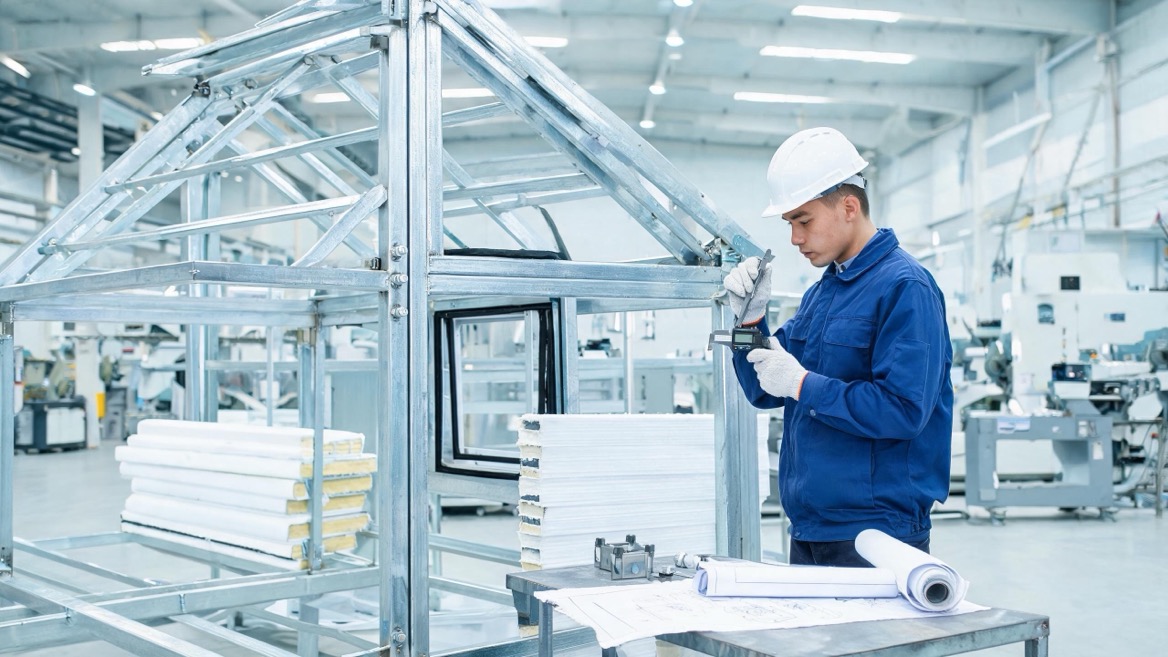
A supplier may quote 2.0 mm steel in the drawing but use 1.5 mm or thinner sections during production. Prevent this by requiring a signed bill of materials, receiving photo evidence with caliper measurements, and arranging pre-shipment inspection.
EPS, rock wool, PU, and PIR panels have different fire, thermal, and cost characteristics. Some suppliers may use lower-density insulation or thinner core material than quoted. Specify the thickness, density, and panel cross-section in the purchase contract.
"Fireproof" is often used loosely in marketing. Ask for the exact test standard, report number, sample description, issuing laboratory, and whether the tested configuration matches your product.
A-frame houses can look impressive in 3D renders but fail around roof penetrations, skylights, large triangular windows, and ridge connections. Request close-up photos of completed installations during or after rain, plus waterproofing detail drawings.
Electrical wiring often causes on-site delays. Confirm voltage, plug type, wire gauge, breaker configuration, grounding, lighting points, HVAC connections, and whether electrical work is pre-installed or only rough-in.
One rarely discussed issue is the roof-to-window interface on triangular prefab houses.
Many A-frame cabins use a full-height front glass wall. The highest leakage risk is usually not the glass itself; it is the narrow joint where sloped roof cladding, flashing, sealant, and the upper triangular window frame meet. If this joint is designed only for showroom use rather than long-term rain exposure, leakage can appear after transport vibration and seasonal temperature changes.
To reduce this risk, ask the factory for:
- A cross-section drawing of the upper triangular glazing connection
- The flashing material and thickness
- Sealant brand, type, and expected temperature range
- Drainage route for water behind the outer cladding
- Photos of the same joint on an installed unit
- A written warranty scope for leakage at roof and glazing connections
This detail is often more important than choosing a fashionable exterior cladding color.
China offers a broad range of triangular prefab house and modular-building suppliers, from specialized A-frame cabin manufacturers to large steel-structure and volumetric-modular companies. The right choice depends on whether your priority is cost control, resort-style appearance, residential engineering, high-volume production, local-code documentation, or OEM flexibility.
For buyers seeking triangular prefab houses with flexible configurations, practical communication, and support for private-label or custom modular projects, Welons Prefab is worth shortlisting as an OEM-focused manufacturing partner. Request a technical proposal, model-specific bill of materials, packaging plan, and sample workflow before moving to production.
Ask for the certificate number, issuing body, legal entity name, site address, scope, issue date, and expiry date. Then check the issuing certification body's verification system or contact it directly. Confirm that the manufacturing site shown on the certificate is the same facility producing your order.
No. CE-related compliance may apply to specific construction products, structural components, windows, electrical equipment, or harmonized standards. It does not automatically mean that the entire building complies with local planning, fire, energy, structural, or installation rules. Buyers should consult a local architect, engineer, or building-control authority.
The minimum package should include approved drawings, bill of materials, steel and panel specifications, electrical diagram, plumbing diagram if applicable, packing list, loading plan, installation manual, fastener list, warranty terms, spare-parts list, and product-specific test reports where required.
Compare the total delivered specification, not the unit price. Build a side-by-side matrix covering floor area, steel grade, steel thickness, insulation type and thickness, wall/roof panel specification, glazing configuration, bathroom equipment, electrical system, shipping method, packaging, installation support, warranty, and spare parts.
Yes, but feasibility depends on its width, height, destination road regulations, port handling limits, and freight cost. Fully assembled units reduce on-site assembly work but can be expensive to transport. Flat-pack or semi-assembled systems usually improve container efficiency, although they require more installation labor at destination.
- [U.S. International Trade Administration: China Design and Construction Market Overview] [trade]
- [China Customs-related export coverage: China-made Prefabricated Buildings Gain Global Traction] [regional.chinadaily.com]
- [China Prefabricated Buildings Market Forecast] [mordorintelligence]
- [Hangxiao Steel Structure Certifications] [hxss.com]
- [DeepBlue SmartHouse Certifications and Standards] [deepbluehome]
- [CIMC Modular Building Company Information] [cimc-modular]


