
Views: 220 Author: Welons Prefab Houses Publish Time: 2026-09-03 Origin: Site


Content Menu
● What Is an Apple Cabin for a Winery?
● What Is a Modular Container House for a Winery?
● Apple Cabin vs Modular Container House: Quick Comparison
● Guest Experience: Which Option Feels More Premium?
>> Why Apple Cabins Work for Boutique Winery Stays
>> Why Modular Container Houses Support Broader Guest Needs
● Design and Brand Positioning
>> Choose Apple Cabin When Your Brand Is About Escape
>> Choose Modular Container House When Your Brand Is About Growth
● Capacity and Layout Flexibility
>> Apple Cabin Layout Strengths and Limits
>> Modular Container House Layout Advantages
● Construction Speed and Opening Timeline
>> Where Apple Cabins Save Time
>> Where Modular Container Houses Save More Time
● Climate, Insulation, and Year-Round Comfort
● A Practical Decision Framework for Winery Owners
>> 1. What Is the Revenue Model?
>> 2. Who Are the Main Guests?
>> 3. How Will the Winery Expand?
>> 4. What Does the Site Allow?
>> 5. What Must Be Approved Locally?
● Expert Recommendation: Use a Hybrid Winery Accommodation Strategy
● Why Factory Capability Matters
● FAQ
>> 1. Are Apple Cabins suitable for winery accommodation?
>> 2. Can modular container houses be used as a winery hotel?
>> 3. Which is better for a small winery: Apple Cabin or modular container house?
>> 4. Can Apple Cabins and modular container houses be customized?
>> 5. Do prefabricated winery accommodation units require permits?
>> 6. Can modular container houses be installed in phases?
>> 7. How can a winery prevent Apple Cabin rooms from overheating?
For winery owners, accommodation is no longer simply a place for guests to sleep. It has become part of the tasting experience, the vineyard story, and the property's revenue model. Choosing between an Apple Cabin and a modular container house can determine how your winery looks online, how guests feel on-site, how quickly rooms can open, and how easily the accommodation offer can expand over time.
Both options use off-site manufacturing and can support fast, scalable hospitality development. However, they serve distinctly different business goals. An Apple Cabin is typically positioned as a compact, design-led guest suite with strong visual impact. A modular container house is usually the more adaptable choice for multi-room accommodation, staff housing, dining areas, reception spaces, storage, and mixed-use winery development.
This guide compares Apple Cabins and modular container houses for winery accommodation from the perspectives of guest experience, operation, design, customization, scalability, transport, maintenance, and long-term commercial value.

An Apple Cabin is a compact prefabricated cabin characterized by a rounded or capsule-like exterior form, panoramic glazing, and a modern, minimalist appearance. It is often used as a standalone hospitality unit for glamping sites, boutique resorts, farm stays, vineyards, and scenic destinations.
For a winery, an Apple Cabin can become more than a room. It can function as a recognizable visual signature that supports premium accommodation pricing and memorable guest photography.
Typical Apple Cabin applications include:
- Private vineyard-view guest suites
- Couples' wine-country retreats
- VIP tasting accommodation
- Glamping cabins near vineyards or orchards
- Pop-up guest rooms for seasonal wine events
- Branded show units for winery tourism projects
- Compact reception, coffee, or retail spaces
The strongest commercial advantage of an Apple Cabin is its immediate visual differentiation. A winery that offers guests a distinctive panoramic cabin can turn accommodation into part of its brand story rather than treating it as a secondary facility.
A guest may remember the sunrise view from a curved glass facade, the private deck overlooking grapevines, or the feeling of staying inside a compact modern retreat. Those moments can support social media exposure, repeat bookings, and stronger direct-booking appeal.
A modular container house is a prefabricated building system designed around modular steel-frame units. Unlike a conventional cargo container conversion, a purpose-built modular container house can be engineered specifically for accommodation, hospitality, offices, staff housing, sanitation facilities, dining rooms, storage, and other functional requirements.
For winery accommodation, the modular container house is often the more practical choice when a project requires several room types, multiple buildings, or operational support spaces.
Common winery uses include:
- Guest rooms and family suites
- Staff dormitories and seasonal worker housing
- Tasting rooms and private event rooms
- Winery offices and booking reception areas
- Kitchens, dining halls, and staff canteens
- Meeting rooms for corporate wine tours
- Storage rooms for linens, housekeeping supplies, or equipment
- Retail pavilions and wine sales rooms
- Temporary accommodation during winery expansion
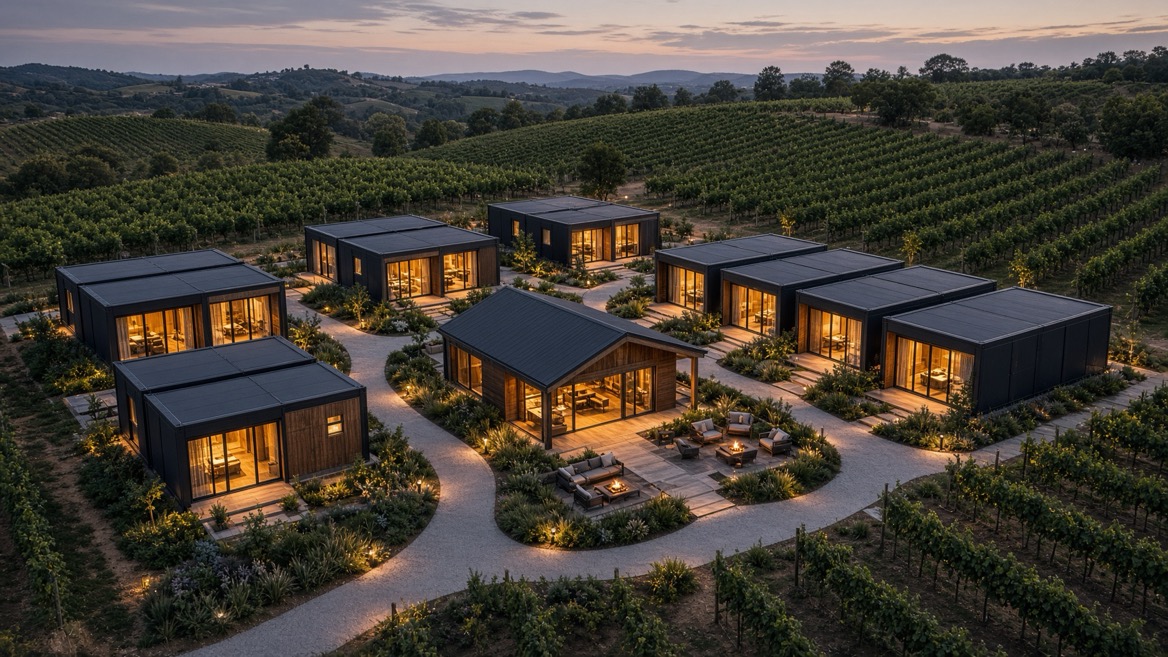
A modular container house can be configured as a single room, a row of guest suites, a two-story accommodation block, or a mixed-use hospitality complex. This makes it highly suitable for winery operators who expect to increase capacity gradually.
The key strength is operational flexibility. Instead of selecting one visually iconic cabin at a time, a winery can create an accommodation system that supports guests, staff, events, food service, and back-of-house operations.
| Comparison Factor | Apple Cabin | Modular Container House |
|---|---|---|
| Primary positioning | Premium, design-led standalone suite | Flexible, scalable accommodation and operational building |
| Best winery use | Romantic vineyard stays, VIP rooms, boutique glamping | Guest room clusters, staff housing, dining, offices, mixed-use facilities |
| Visual impact | High; distinctive capsule or curved profile | Flexible; can be modern, industrial, rustic, or brand-led |
| Guest capacity | Usually best for one couple or a small private group | Can support single rooms, family rooms, dormitories, or large room clusters |
| Layout flexibility | More limited by the signature shell form | High; units can be combined, stacked, extended, or reconfigured |
| Expansion potential | Suitable for adding individual premium cabins | Suitable for phased multi-unit development |
| Back-of-house suitability | Limited | Excellent |
| Transport planning | Requires careful dimensional and route planning | Often simpler for standardized modular logistics |
| Brand storytelling | Strong for boutique and experiential tourism | Strong for scalable wine-resort or destination development |
| Typical buyer priority | Uniqueness and premium guest appeal | Function, capacity, efficiency, and long-term adaptability |
For a winery that wants to sell an emotional overnight experience, the Apple Cabin usually has the advantage.
Wine tourism is closely connected to atmosphere. Guests do not only evaluate the bed, bathroom, or floor area. They evaluate the feeling of arriving at the vineyard, watching the sunset after a tasting, waking up beside grapevines, and sharing the stay online.
A visually distinctive cabin can become a central part of that journey. Winery hospitality specialists emphasize that guest spaces should reflect the site's identity, natural landscape, and brand story rather than functioning as generic rooms. Comfortable seating, views, accessibility, and a deliberate sense of place all help strengthen the visitor experience.
Apple Cabins can create a high-perceived-value experience through a few design elements:
- Panoramic glazing that frames vineyard, mountain, lake, or sunset views
- Compact layouts that feel private and intentional
- Contemporary forms that photograph well for booking platforms
- Separate units that reduce the feeling of staying in a conventional hotel block
- Opportunities for private terraces, outdoor baths, fire pits, or breakfast decks
- A clear visual identity that can be repeated across marketing materials
For example, a winery with six premium Apple Cabin suites could market an overnight package that includes a vineyard tour, private tasting, local dinner, breakfast basket, and late check-out. The room itself becomes part of the package value.
However, visual appeal alone does not guarantee successful hospitality performance. The cabin still needs effective insulation, ventilation, bathroom quality, blackout privacy, sound control, reliable heating and cooling, and safe access in all weather conditions.
Modular container houses can offer a more complete hospitality environment, especially when the winery receives different guest types.
A winery may host:
- Couples booking weekend retreats
- Families requiring larger room layouts
- Tour groups arriving by bus
- Corporate guests attending meetings or team events
- Wedding parties
- Seasonal harvest workers
- Tasting-room staff and visiting distributors
One compact Apple Cabin style may not meet every need. A modular container house development can include standard guest rooms, accessible rooms, family units, shared lounges, kitchen areas, laundry rooms, reception spaces, and staff housing within one coordinated plan.
For a winery planning to operate accommodation year-round, this versatility can be more valuable than a single highly recognizable exterior form.
The right building type should match the winery's brand promise.
If the winery brand is based on luxury, landscape immersion, privacy, and contemporary design, Apple Cabins can create a strong match. If the winery needs a destination model that combines tours, accommodation, events, food service, and staff operations, modular container houses often provide greater design freedom at the project level.
An Apple Cabin is generally a strong choice when your winery positioning includes:
- Boutique wine-country accommodation
- Couples' escapes and anniversary packages
- Scenic views as a key selling point
- Small numbers of higher-value room nights
- Modern or futuristic architecture
- Social-media-friendly guest experiences
- Glamping, eco-retreat, or wellness-oriented tourism
The goal is not necessarily to provide the most rooms. The goal is to make each room feel exceptional.
A modular container house is usually more suitable when your winery needs:
- A larger number of accommodation units
- Multiple room categories
- Staff housing near production or hospitality areas
- Reception, dining, retail, or meeting functions
- Phased expansion over several years
- A consistent room standard across several sites
- A more practical balance between guest-facing and operational spaces
A factory-built modular approach also enables off-site work to proceed while foundations and site preparation are completed. For hospitality developments, that overlap can shorten delivery schedules and help operators open rooms sooner.
This is often the deciding factor.
An Apple Cabin is normally designed as a self-contained unit. Its signature form creates a strong guest impression, but it can impose limitations on internal layout, furniture placement, ceiling geometry, and future reconfiguration.
A modular container house uses a more standardized rectangular geometry. That may appear less dramatic initially, but it makes planning simpler.
Apple Cabins work best when the accommodation program is simple:
- One bedroom or studio sleeping area
- One private bathroom
- Compact wardrobe or storage zone
- Small lounge or tea station
- Scenic window wall
- Optional deck or outdoor seating
The format is ideal for a couple's retreat. It is less ideal when the winery needs a two-bedroom family suite, a housekeeping storage room, a wheelchair-accessible bathroom, a commercial kitchen, or a large indoor dining space.
With a modular container house, a winery can create multiple building types using related structural systems:
1. Guest accommodation modules for couples, families, or groups
2. Connected modules for larger suites or shared lounges
3. Double-story buildings for higher land-use efficiency
4. Service modules for laundry, storage, utilities, and housekeeping
5. Public modules for reception, retail, tasting, dining, or meetings
6. Staff modules for employees working during harvest and tourism seasons
This approach makes it easier to develop the accommodation offer in stages.
For instance, a winery could begin with eight guest rooms and a reception module. In the second stage, it could add a tasting lounge, six more rooms, and a staff dormitory. In the third stage, it could add meeting rooms for corporate groups or a private event pavilion.
That phased model can reduce early capital pressure while preserving a clear expansion path.
Both Apple Cabins and modular container houses can reduce on-site construction work because much of the building is manufactured in a controlled factory environment.
Industry sources report that modular hotel construction can shorten project timelines by up to 50% in suitable applications, largely because factory production can occur alongside site preparation. The actual result depends on design complexity, permitting, foundations, transport distance, crane access, local labor, utility connections, and approval requirements.
For winery owners, faster delivery matters because accommodation revenue is seasonal in many wine regions. Missing a harvest season, festival period, or peak tourism window can affect cash flow.
Apple Cabins can be efficient when the project involves a small number of standardized units on prepared sites. A typical deployment sequence includes:
1. Confirm local planning and building requirements
2. Finalize cabin layout, finishes, and utility specifications
3. Prepare foundations, drainage, electrical, water, and wastewater connections
4. Manufacture the cabins off-site
5. Transport and place the units
6. Complete final connections, furnishing, testing, and landscaping
The project remains relatively simple if the terrain is accessible and the cabins are installed as separate units.
Modular container houses become especially efficient as the number of units and functions increases. A single factory can produce repeated room modules while the winery prepares multiple foundations and service lines.
For larger accommodation projects, repetition supports better consistency in:
- Wall, roof, and floor assemblies
- Bathrooms and plumbing zones
- Electrical layouts
- Doors and windows
- Insulation systems
- Furniture packages
- Quality inspection procedures
This standardization can be important for operators who want every guest room to deliver the same level of comfort.
A winery accommodation project should never choose a unit based on appearance alone. Wine regions can experience hot summers, cold winters, rain, strong sun, humidity, wind, dust, or large day-to-night temperature changes.
Whether you choose an Apple Cabin or a modular container house, specify the building envelope according to the actual site.
Key technical considerations include:
- Wall, roof, and floor insulation performance
- Thermal breaks in steel framing
- Double- or triple-glazed windows where appropriate
- Solar-control glass or shading for large glazed facades
- Heating, cooling, and fresh-air ventilation
- Condensation control
- Waterproofing and drainage details
- Wind, snow, seismic, and corrosion requirements
- Fire safety provisions
- Electrical capacity for heating, cooling, and guest appliances
For an Apple Cabin, the large glazed area can be a major selling feature. It can also create heat gain, heat loss, glare, and privacy concerns if it is not properly specified.
For a modular container house, the challenge is often ensuring that steel-based construction includes a properly engineered insulation and thermal-break strategy. A good manufacturer should provide clear information on wall assembly, insulation thickness, cladding, structural design, and intended climate range.
Before choosing an Apple Cabin or modular container house, assess the project using five operational questions.
Choose Apple Cabin if the goal is to sell fewer rooms at a higher nightly rate through exclusivity, privacy, and visual appeal.
Choose modular container house if the goal is to create more sellable room nights, support groups, or add operational facilities around the accommodation business.
Apple Cabins are well suited to couples, luxury travelers, honeymooners, and design-conscious weekend visitors.
Modular container houses are better suited to mixed guest profiles, including families, groups, business visitors, staff, and long-stay guests.
Apple Cabins are effective for adding a small number of premium units over time.
Modular container houses are more effective for planned expansion into accommodation clusters, dining areas, meeting rooms, storage, or staff facilities.
A steep vineyard, narrow road, remote site, or limited crane access can affect the size and transportation method of every unit.
Complete a transport and installation assessment before finalizing the building dimensions. The most attractive unit on paper may not be the most practical unit to deliver to the site.
Accommodation buildings generally require local review for land use, planning, building safety, electrical systems, sanitation, fire protection, and accessibility. Container-based accommodation does not automatically avoid permitting simply because it is prefabricated. Local building codes, zoning rules, and inspection requirements still apply.
For many wine tourism projects, the most commercially balanced solution is not choosing only one format.
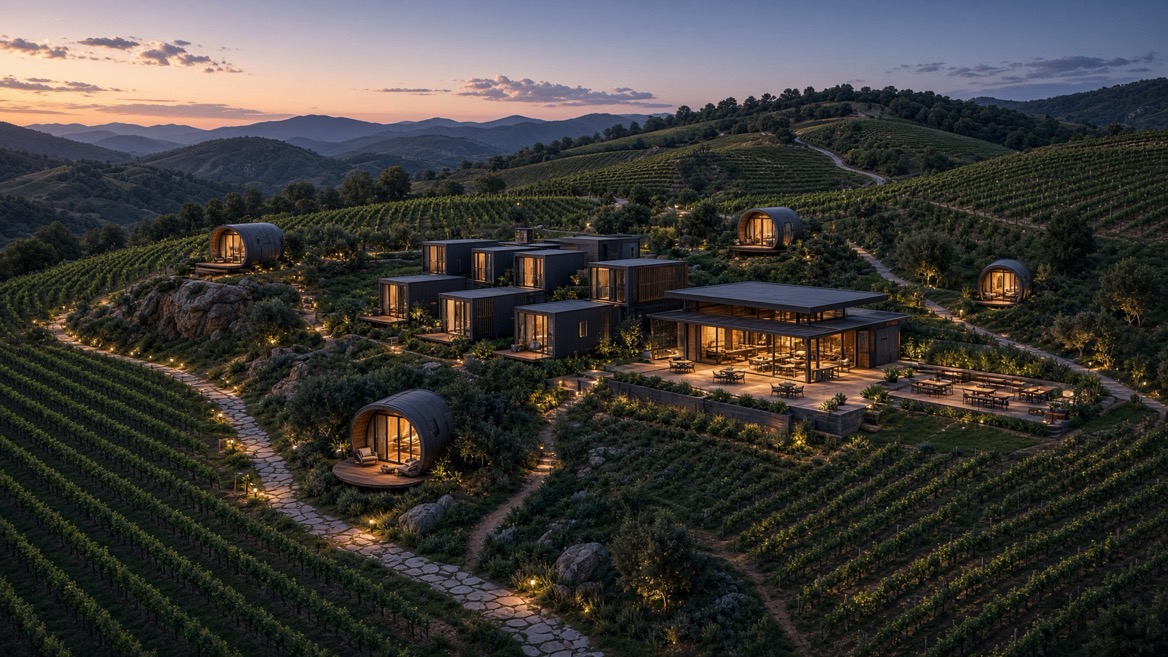
A hybrid development can use Apple Cabins as premium signature suites and modular container houses as the scalable operational foundation.
For example:
- Four Apple Cabins positioned along the best vineyard-view locations
- Twelve modular container guest rooms near reception and parking
- One modular tasting lounge and event room
- One modular kitchen and breakfast service area
- One staff accommodation block for harvest and peak-season employees
- A modular storage and laundry area hidden from guest-facing zones
This creates two price tiers. The Apple Cabins can command a premium because they offer privacy and a memorable stay. The modular accommodation block can provide reliable capacity for standard bookings, tours, events, and group travel.
The result is a stronger operational model than relying entirely on either luxury cabins or standardized guest rooms.
For international winery projects, the supplier's production capacity, customization ability, quality control process, and export experience can have as much influence on the final outcome as the building type itself.
Welons Prefab brings 11 years of experience in modular construction and prefabricated container house production. With a daily production capacity of 300 units, the company can support projects ranging from individual Apple Cabin accommodation units to larger modular container house developments for offices, dormitories, dining facilities, meeting rooms, warehouses, showrooms, and industrial buildings.
For winery accommodation buyers, this means the same supplier can potentially support both front-of-house and back-of-house requirements:
- Apple Cabin guest suites
- Modular guest room blocks
- Reception and booking offices
- Tasting rooms and retail spaces
- Dining halls and kitchens
- Employee dormitories
- Meeting rooms and event facilities
- Storage and service buildings
This one-stop approach can simplify coordination, especially for developers planning phased construction, OEM projects, wholesale purchasing, or customized overseas deployments.
Choose an Apple Cabin for winery accommodation when your priority is creating a high-impact, premium guest experience with strong visual appeal. It is particularly suitable for boutique vineyards, private retreats, scenic wine regions, and accommodation concepts designed around romance, privacy, and memorable views.
Choose a modular container house for winery accommodation when you need adaptable layouts, more rooms, operational support spaces, staff housing, phased growth, or a complete wine-tourism facility.
The best decision is not based on which structure looks more impressive in isolation. It is based on which one supports your target guests, room-rate strategy, land conditions, expansion plan, and operational requirements.
For winery owners seeking both premium appeal and scalable capacity, combining Apple Cabins with modular container houses can create a stronger, more flexible destination accommodation model.
Planning a winery accommodation project? Contact Welons Prefab to discuss customized Apple Cabin suites, modular container guest rooms, staff housing, tasting spaces, and complete prefabricated solutions built around your site, guest profile, and growth plan.
Yes. Apple Cabins are highly suitable for boutique winery stays, especially where vineyard views, privacy, modern design, and premium guest experiences are important. They work particularly well as standalone suites for couples, VIP visitors, and glamping-style accommodation.
Yes. Modular container houses can be configured as guest room clusters, family suites, dormitories, reception buildings, dining areas, staff housing, storage rooms, meeting rooms, and tasting spaces. They are well suited to wineries that need more than a few individual rooms.
For a small winery with a limited number of premium rooms, Apple Cabins may create stronger brand differentiation. For a small winery that also needs staff accommodation, a reception area, storage, or several room types, modular container houses may offer better overall value.
Yes. Both can be customized in layout, insulation, windows, doors, bathroom configuration, interior finishes, electrical systems, air-conditioning, exterior cladding, furniture packages, and branding details. The scope of customization should be confirmed before production.
In most locations, yes. Prefabricated accommodation units usually need to comply with local planning, zoning, building, fire, electrical, sanitation, and accessibility requirements. Approval procedures vary by country, region, and site conditions.
Yes. Phased installation is one of the major advantages of modular construction. A winery can begin with a small accommodation cluster and later add rooms, dining facilities, reception areas, staff housing, or event spaces as demand increases.
Use climate-appropriate insulation, high-performance glazing, external shading, ventilation, air-conditioning, roof insulation, and appropriate cabin orientation. Large glass walls should be planned according to sun direction, local temperatures, and guest privacy needs.
1. [Modular Building Institute — Modular Hotels and Hotel Room Construction]
2. [Stream Modular — Industries Using Prefabricated Modular Construction]
3. [Olson Lewis + Architects — Winery Design Tips for Guest Experience and Operational Efficiency]
4. [Karmod — Modular Container Accommodation and Worker Camp Units]
5. [Wine Spectator — Shipping Crates, Historic Cottages, Tiny Houses Transformed into Winery Hotels]
6. [Tinta Wine — The Wine Tourist Journey: How to Design Memorable Experiences]
7. [Modular Building Institute — The Role of Modular Construction in Hospitality Development]


