
Views: 282 Author: Welons Prefab Houses Publish Time: 2026-08-15 Origin: Site


Content Menu
● Why Desert Tourism Camps Need Climate-Responsive Accommodation
● Space Capsule House vs Tent Housing: At-a-Glance Comparison
● What Is a Space Capsule House for Desert Tourism?
>> Advantages of Space Capsule Houses
● What Is Tent Housing for Desert Tourism Camps?
>> Advantages of Tent Housing Series Products
● Desert Performance: The Factors That Matter Most
>> Temperature Changes After Sunset
● Investment Strategy: Which Product Supports Your Business Model?
● A Practical Hybrid Model for Desert Camps
● Procurement Checklist Before You Order
● FAQs
>> 1. Are Space Capsule Houses suitable for hot desert climates?
>> 2. Can Tent Housing be used year-round in the desert?
>> 3. Which option costs less: Space Capsule House or Tent Housing?
>> 4. Can a desert resort combine capsule rooms and tents?
>> 5. How can a desert camp reduce sand and dust inside guest rooms?
>> 6. What should I send to a manufacturer before requesting a quote?
For desert tourism camps, the decision between a Space Capsule House and Tent Housing is not simply about appearance or initial purchase price. It affects guest comfort, operating costs, seasonal occupancy, maintenance workload, brand positioning, and the long-term expansion potential of the camp.
A well-planned desert accommodation project must withstand intense solar exposure, dry air, windblown sand, major temperature differences between day and night, and often limited infrastructure. Space Capsule Houses generally suit premium, all-season desert resorts that need stronger climate control and a distinctive modern identity. Tent Housing Series products are often the better fit for immersive glamping experiences, phased developments, and operators seeking flexible layouts with a lower entry investment.

Desert tourism is growing alongside demand for memorable outdoor stays, private accommodation, and experience-driven travel. The global glamping market was estimated at USD 3.79 billion in 2025 and is projected to reach USD 7.87 billion by 2033, with demand supported by travelers seeking outdoor settings combined with modern comfort.
However, a desert camp cannot use the same accommodation strategy as a forest, lakeside, or temperate-climate glamping site. Desert conditions require an envelope that can manage heat gain, UV exposure, dust, wind, and sharp overnight temperature changes.
For camp developers, the central question is:
> Do you need a luxury, enclosed accommodation product built for controlled comfort—or a more open, nature-led lodging experience that can be scaled flexibly?
The answer determines whether a Space Capsule House for desert tourism camps or a Tent Housing solution will create the stronger commercial result.
| Decision factor | Space Capsule House | Tent Housing Series |
|---|---|---|
| Guest experience | Modern, private, hotel-like, technology-led | Nature-focused, relaxed, immersive, glamping-oriented |
| Desert heat control | Strong potential with insulated walls, glazing selection, HVAC, and shading | Depends heavily on fabric, insulation package, liner, ventilation, and external shading |
| Sand and dust resistance | More enclosed structure; easier to seal when correctly specified | Requires careful detailing around doors, zippers, seams, platforms, and ventilation openings |
| Night-time comfort | Stable indoor environment with heating and cooling options | Can be comfortable but usually needs an upgraded insulation and HVAC configuration |
| Visual appeal | Futuristic landmark and premium social-media asset | Natural resort aesthetic; blends well with dunes, mountains, and desert landscapes |
| Installation approach | Modular delivery and on-site assembly | Flexible installation; suitable for phased camp development |
| Layout flexibility | Fixed shell, customizable interior layout and equipment | Wide range of sizes, configurations, decks, and communal layouts |
| Typical positioning | Luxury resort, boutique hotel, VIP suites, observatory rooms | Glamping camp, safari-style resort, seasonal tourism, event accommodation |
| Long-term operation | Better suited to year-round premium operations | Strong for scalable, experiential, or mixed-season projects |
| Best use case | High-ADR accommodation with private facilities | Flexible inventory with strong outdoor storytelling |
The strongest desert camp developments often use both. Capsule units can serve as flagship suites, while tent structures create a broader inventory of family rooms, standard glamping units, dining pavilions, reception areas, and event spaces.
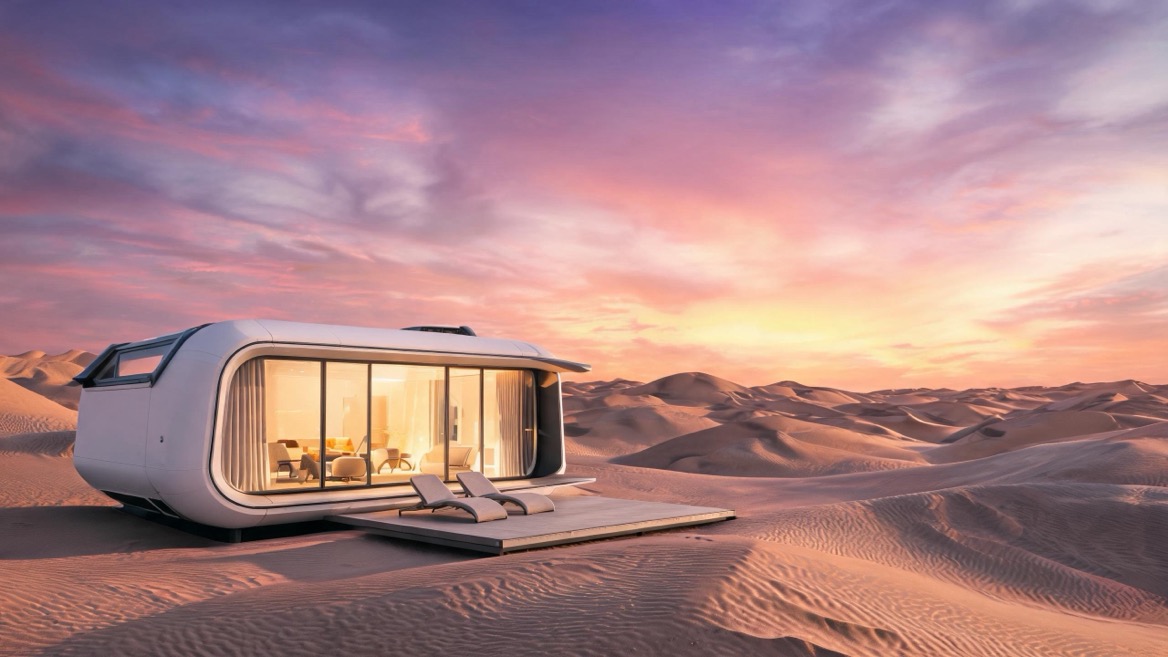
A Space Capsule House is a prefabricated modular accommodation unit with a streamlined external shell, compact interior planning, and a high-tech visual identity. Depending on the selected configuration, it can include a bedroom, bathroom, kitchenette, panoramic window, air-conditioning system, lighting, plumbing connections, and smart-control features.
For desert hospitality operators, its greatest advantage is the ability to create a more controlled guest environment.
- Premium visual identity. The curved, futuristic exterior helps camps differentiate themselves from conventional tent resorts.
- Higher perceived privacy. Solid walls and lockable doors can make guests feel more secure, especially in remote locations.
- More reliable thermal performance. With the right insulation, glazing, HVAC capacity, and shading plan, the unit can support a more stable interior temperature.
- Better suitability for private bathrooms. This is important for luxury couples' stays, VIP guests, and higher-rate desert suites.
- Operational consistency. Housekeeping, room inspection, electrical integration, and interior standardization are generally easier in enclosed modular units.
- Year-round revenue potential. A properly specified capsule unit can support shoulder-season and cooler-night operations more effectively than a basic tent.
A capsule house is not automatically desert-ready simply because it has a closed shell. Project success depends on the engineering package.
Operators should verify:
- Insulation thickness and thermal-break design
- Window glass performance and solar-control treatment
- Roof and façade reflectivity
- Door and window sealing against sand infiltration
- Air-conditioning capacity for local peak temperatures
- Electrical load and backup-power planning
- Foundation design for the local soil condition
- Shading strategy around panoramic glazing
In hot climates, reducing solar heat gain and providing effective shading are essential for improving indoor comfort and lowering cooling demand.
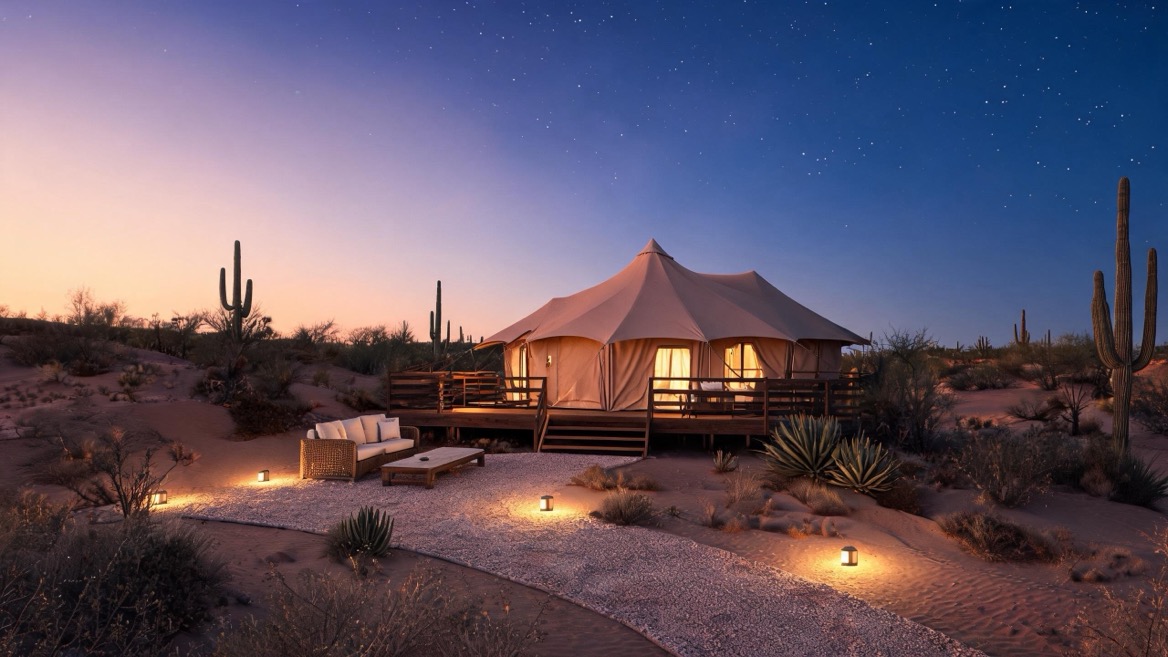
Tent Housing refers to a family of fabric-based or hybrid structures designed for accommodation, dining, reception, events, lounges, and service spaces. Depending on the model, a tent unit may include a rigid frame, PVC or canvas-style exterior, insulated lining, flooring platform, doors, windows, bathroom modules, air-conditioning, and a private outdoor deck.
For a desert tourism camp, tent accommodation creates a closer emotional connection with the landscape. Guests can hear the wind, see the stars, and experience the setting without giving up essential hospitality features.
- A more authentic outdoor atmosphere. Tent lodging supports the "sleep in the desert" experience that many travelers actively seek.
- Flexible site planning. Units can be arranged around dunes, views, fire pits, activity zones, and privacy buffers.
- Lower barrier for phased expansion. Operators can begin with a smaller number of tents, validate demand, and add units later.
- Broad use beyond guestrooms. The same product family can support restaurants, lounges, meeting rooms, dining halls, activity centers, and exhibition areas.
- Efficient resort storytelling. Tent architecture works particularly well for eco-inspired, safari, nomadic, wellness, and adventure-tourism brands.
- Customization opportunities. Size, fabric color, interior finishes, decks, and room functions can be matched to the project concept.
Tent Housing needs a clear specification standard for desert conditions. A visually attractive tent without suitable materials and details may create guest complaints related to heat, dust, noise, or condensation.
Before ordering, request clarity on:
- Outer fabric UV resistance
- Waterproof rating and wind-load design
- Fire-retardant performance
- Insulated inner liner options
- Ventilation and air-conditioning configuration
- Dust-control measures at openings and floor edges
- Platform elevation and drainage design
- Replacement schedule for fabric components
- Spare parts and maintenance support
The correct choice should be based on local conditions, not product photos alone. Desert design must respond to solar radiation, large daily temperature swings, wind, and limited shade.
A desert camp can face intense direct sunlight for long periods. Large exposed surfaces, unshaded glass, and dark external finishes may increase cooling demand.
For both accommodation types, prioritize:
- Light-colored external surfaces to reduce heat absorption
- External shading over windows, entrances, and decks
- Insulated roof and wall systems
- Orientation planning that reduces direct east- and west-facing solar exposure
- Landscaping or shade structures where water and site conditions allow
- Separated service equipment so heat from generators and condensers does not affect guest rooms
A capsule house usually offers more predictable thermal control because it uses a sealed, solid envelope. Tent structures can still perform well, but only when insulation, roof shading, and cooling systems are designed as a complete package.
Sand is a maintenance issue, a comfort issue, and a brand issue. Guests will notice dust on beds, floors, curtains, food areas, and luggage immediately.
Space Capsule Houses typically make it easier to create sealed interiors. Tent Housing needs more rigorous attention to fabric tension, doorway systems, floor-to-wall junctions, screened ventilation, and routine inspection.
For either option, create a camp-wide dust-control plan:
1. Place rooms away from major vehicle routes.
2. Use designated service roads and low-speed policies.
3. Add entry mats, vestibules, or enclosed porch zones.
4. Position outdoor HVAC equipment to avoid drawing in dust.
5. Establish a daily check for seals, fabric tension, and air filters.
6. Stock replacement components before peak season.
Many desert destinations experience much cooler nights than daytime conditions. The building must therefore manage both cooling and heating, rather than focusing on daytime air-conditioning alone.
A high-quality capsule house can combine insulation, sealed doors and windows, and HVAC systems to offer a more hotel-like overnight experience. For tents, use insulated liners, elevated flooring, suitable bedding, controlled ventilation, and equipment sized for the local climate.
The better product depends on your target guest, rate strategy, length of season, and operational capability.
| Business objective | Recommended primary solution | Why |
|---|---|---|
| Launch a luxury desert resort with private bathrooms | Space Capsule House | Supports a stronger premium-room identity and controlled indoor environment |
| Create an experiential glamping camp | Tent Housing Series | Delivers a closer connection to the landscape and flexible resort design |
| Test a new desert destination with phased capital investment | Tent Housing Series | Allows staged construction and flexible expansion |
| Build a high-impact social-media landmark | Space Capsule House | Futuristic form creates strong visual differentiation |
| Offer weddings, retreats, dining, and group events | Tent Housing Series | Larger tent formats can support communal functions |
| Extend the operating season | Hybrid model | Capsule units support premium all-season rooms; tents diversify the experience |
| Develop a mixed accommodation resort | Hybrid model | Creates room-rate tiers and broader guest appeal |
From an operator's perspective, the most commercially resilient answer is often not "capsule versus tent." It is a deliberate combination.
A 30-unit desert camp, for example, could include:
- 8 Space Capsule Houses for premium couples' suites, honeymoon stays, and VIP bookings
- 16 Tent Housing units for standard glamping rooms and family accommodation
- 2 large tent structures for dining, reception, or events
- 2 service modules for staff, storage, linen, or kitchen support
- 2 flexible units for wellness, retail, a meeting room, or a desert-view lounge
This structure gives the operator multiple price points. It also reduces risk. Premium capsule rooms can help raise average revenue per guest, while tent units give the resort capacity to accommodate groups, families, and seasonal demand.
Before selecting a supplier for desert tourism accommodation, use this checklist.
1. Define the guest profile. Are you targeting luxury couples, families, adventure travelers, corporate groups, or event guests?
2. Confirm site data. Share local temperature ranges, wind conditions, solar exposure, rainfall, soil information, access roads, and utility availability.
3. Choose the operating season. A summer-only camp has different HVAC and insulation requirements from a year-round resort.
4. Request material specifications. Do not rely only on drawings or renderings. Confirm frame material, wall composition, insulation, glazing, fabric grade, fire rating, and weather-resistance details.
5. Plan utilities early. Water, wastewater, electrical supply, air-conditioning, drainage, internet, and backup power affect both room design and installation cost.
6. Model the guest journey. Consider arrival, luggage movement, parking, privacy, bathroom access, night lighting, emergency routes, and housekeeping circulation.
7. Specify spare parts and after-sales support. For remote desert sites, spare fabric panels, seals, electrical components, and hardware should be planned before opening.
8. Build a sample unit first. A prototype allows the team to test temperature, dust control, guest movement, lighting, bathroom usability, and photo appeal before committing to the full rollout.
Choose a Space Capsule House when your desert tourism camp needs a premium architectural feature, private bathroom-ready accommodation, greater environmental control, and a higher-rate room category.
Choose Tent Housing when your priority is immersive glamping, flexible expansion, scenic integration, group-use versatility, and a more nature-led guest experience.
For many serious desert tourism developments, the best commercial solution is a hybrid modular accommodation strategy. Capsule houses create a premium flagship product. Tent Housing adds scalable inventory, public spaces, and an emotional connection to the destination.
Welons Prefab brings 11 years of modular building experience to projects requiring customized Space Capsule Houses, Tent Housing Series products, prefabricated container houses, OEM manufacturing, wholesale supply, and integrated project solutions. With a daily output capacity of 300 units, the team can support both pilot installations and larger global resort developments.
Planning a desert tourism camp? Contact Welons Prefab to discuss your site conditions, accommodation mix, customization requirements, production schedule, and one-stop project solution.
Yes, provided the unit is specified for the actual local climate. Insulation, solar-control glazing, shading, exterior finish, sealing, and properly sized HVAC systems are all important. A standard unit should be reviewed and customized before use in an extreme desert environment.
It can, but year-round performance depends on the tent's structural system, insulated liner, fabric quality, floor system, air-conditioning, heating, wind resistance, and maintenance plan. Camps in areas with severe summer heat or cold nights should select an upgraded all-season specification.
Tent Housing often provides a lower-cost route for initial deployment, especially for flexible room layouts and phased development. However, the correct decision should compare total project cost, including platforms, utilities, HVAC, bathrooms, transport, installation, maintenance, and expected room revenue.
Yes. Combining the two can create different accommodation tiers, serve different customer segments, and improve site functionality. Capsule rooms can operate as premium suites, while tents can provide standard rooms, family units, dining halls, lounges, or activity areas.
Use sealed doors and windows, screened or filtered ventilation, properly detailed floor junctions, external entry mats, dust-control zones, regular HVAC filter servicing, and site planning that separates guest rooms from vehicle routes and service areas.
Provide the project location, expected climate, site plan, room quantity, target guest profile, preferred sizes, desired bathroom and electrical configuration, estimated opening date, transport access, and any local fire, structural, or building requirements.
1. [Grand View Research – Glamping Market Size, Share & Trends Report 2026–2033]
2. [New Zealand Ministry for the Environment – Guidance on Passive Solar Design]
3. [Autodesk Forma – Creating Sustainable Buildings Through Passive Design]
4. [ScienceDirect – Glamping Tourism as a Sustainable Response to the Need to Reconnect with Nature]
5. [Technavio – Glamping Market Growth Analysis and Forecast]
6. [Arizton – United States Glamping Market Analysis and Forecast]


