
Views: 261 Author: Welons Prefab Houses Publish Time: 2026-08-24 Origin: Site


Content Menu
● Why Source Round Prefab Houses From China?
● Top 10 Round Prefab House Manufacturers in China
>> 2. CIMC Modular Building Systems
>> 7. Hangxiao Steel Structure
>> 8. Zhejiang Putian Integrated Housing
>> 9. Shanghai Haisheng Special Metal Box
>> 10. WZHHouse
● Manufacturer Comparison for Buyers
● Technical Requirements for Round Prefab Houses
>> Insulation and Envelope Performance
>> Compliance and Documentation
>> Unclear Steel Specifications
>> Downgraded Insulation Panels
>> Underestimated Shipping Cost
>> Undefined Customization Scope
>> 1. Define the Project Scope
>> 4. Approve a Sample or First Article
>> 1. How can I verify whether a supplier's ISO certificate is still valid?
>> 2. Does a round prefab house need a fully circular steel frame?
>> 3. How can I compare two supplier quotations fairly?
>> 4. Should I ship the unit fully assembled, knock-down, or flat-packed?
>> 5. How can I stop a factory from replacing specified materials during bulk production?
China has become an important sourcing base for round prefab houses, dome-inspired structures, quick-assembly units, container-based buildings, and customized modular spaces. For professional buyers, however, choosing a supplier requires more than comparing product images and unit prices.
A reliable round prefab house manufacturer should demonstrate stable production capacity, documented material specifications, engineering support, quality-control procedures, export packaging capability, and clear responsibility for customized designs. This guide reviews 10 China-based manufacturers relevant to round prefab house and modular building sourcing, with a focus on long-term procurement, OEM projects, and practical verification.
China's prefabricated-building supply chain continues to expand, supported by mature steel processing, insulated-panel production, doors and windows, electrical integration, and export logistics. Industry research estimates that China's prefabricated construction market reached approximately CNY 1.62 trillion in 2025, while the country's modular construction market is expected to maintain steady growth through the next decade.
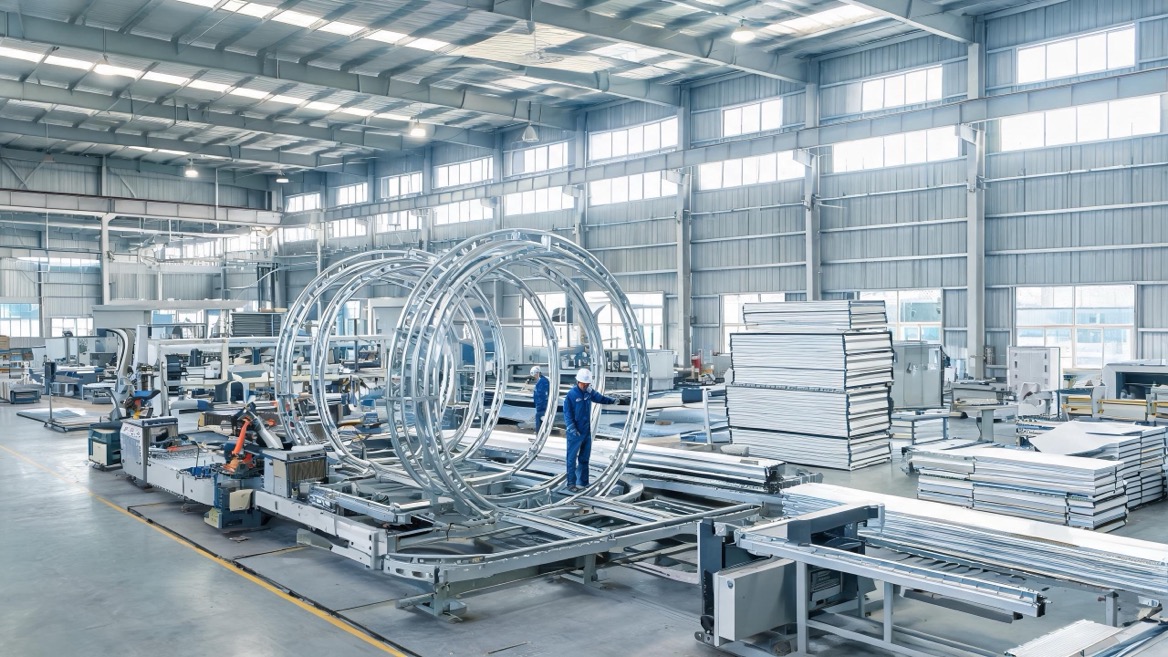
China offers a complete modular building supply chain, especially for projects that require cost control, flexible design, bulk procurement, and international shipping support.
Key manufacturing clusters include:
- Guangdong Province: Foshan, Guangzhou, Shenzhen, and nearby cities offer strong supply chains for steel fabrication, sandwich panels, aluminum windows, container houses, sanitary units, and interior components.
- Zhejiang Province: Ningbo and surrounding areas are well known for light-steel housing, export-oriented prefabricated homes, and customized residential building systems.
- Hebei and Northern China: These regions have extensive resources for steel structures, site camps, container houses, industrial buildings, and project-based modular construction.
- Shanghai and Jiangsu: These areas are often associated with engineering-oriented modular buildings, international project coordination, and higher-specification construction systems.
China's policy direction has also encouraged standardization, quality management, green building materials, and industrialized construction processes. For international buyers, this means more suppliers can offer factory-based production, standardized documentation, and project-specific manufacturing support.
This list is based on sourcing factors that matter to procurement managers, distributors, contractors, and project developers. A supplier should not be selected only because it has attractive photos or a low price.
| Evaluation Area | What Buyers Should Verify | Typical Risk |
|---|---|---|
| Manufacturing Capacity | Factory size, production lines, monthly output, self-owned workshop | A trading company may present itself as a manufacturer |
| Engineering Capability | Structural drawings, connection details, wind and snow load data | Supplier provides only renderings, not engineering documents |
| Material Transparency | Steel grade, thickness, galvanized layer, insulation type, coating system | Materials are downgraded after the quotation stage |
| Quality Control | Incoming inspection, in-process checks, final inspection records | No traceable QC documents or batch records |
| Compliance Documents | ISO, CE, EN 1090, fire tests, material reports | Certificates may be expired, irrelevant, or not linked to the factory |
| Export Readiness | Packing plan, container loading, installation manual, shipping documents | High freight cost, damaged units, missing installation parts |
| OEM/ODM Support | Drawings, branding, layout changes, material options, technical response | "Customization" is limited to color or logo printing |
| Communication Efficiency | English documents, version control, technical clarification process | Verbal promises create disputes during production |
For modular construction projects, a certificate alone does not guarantee that a product complies with local building requirements. Buyers must confirm whether the supplier's documents apply to the actual product, intended use, and destination market. CE, ISO 9001, EN 1090, ICC-ES, and BOPAS all have different scopes and should be reviewed carefully.
The companies below represent different strengths across quick-assembly prefab units, light-steel homes, container houses, engineering modular buildings, and custom steel structures. Buyers should still conduct their own factory audits, document reviews, and sample inspections before placing an order.
| Manufacturer | Background | Main Strength | Suitable Projects | Customization Focus |
|---|---|---|---|---|
| Welons Prefab | Around 11 years of industry experience | Quick-assembly prefab units, container houses, modular buildings | Offices, dormitories, canteens, showrooms, warehouses, industrial facilities | Flexible OEM, customized layouts, project support |
| CIMC Modular Building Systems | Engineering modular building specialist | Large-scale modular projects | Hotels, apartments, public buildings, commercial projects | Engineering development and international project support |
| GS Housing / GSMOD | Active since 2001 | Flat-pack container houses and site camps | Camps, mining sites, offices, emergency units | Batch production and project-based configurations |
| DEEPBLUE SMARTHOUSE | Founded in 2009 | Light-steel homes and residential systems | Villas, holiday homes, residential projects | Design-led light-steel and panelized solutions |
| Ark Prefab | Modular construction participant | Prefabricated and modular building systems | Commercial and project-based applications | Project-oriented modular design |
| Atlantic Modular System | Engineering-focused modular supplier | Steel-frame and modular construction | Commercial, public, and infrastructure projects | Structural and modular integration |
| Hangxiao Steel Structure | Steel-structure specialist | Structural steel and prefabricated buildings | Industrial, commercial, and large-span projects | Engineering-grade steel structure support |
| Zhejiang Putian Integrated Housing | Integrated housing manufacturer | Container houses and site accommodation | Camps, dormitories, offices, temporary buildings | Standard modules and export packaging |
| Shanghai Haisheng Special Metal Box | Metal module supplier | Box-type modular units | Site offices, utility rooms, modular facilities | Transportable steel modules |
| WZHHouse | Northern China modular supplier | Expandable homes and portable houses | Distributors, small projects, mobile living units | Multi-product OEM and export supply |
Welons Prefab is a China-based manufacturer with approximately 11 years of experience in quick-assembly prefab units, modular buildings, and prefabricated container houses. Its solutions are commonly used for offices, dormitories, dining facilities, meeting rooms, warehouses, showrooms, industrial buildings, and temporary project facilities.
For buyers sourcing a Round Prefab House, dome-inspired unit, curved modular structure, or custom fast-assembly building, Welons Prefab is particularly relevant when the project requires practical customization without the high entry threshold often associated with large engineering contractors.
The company's stated daily output of up to 300 units provides a useful capacity reference for distributors, contractors, and project buyers who need scalable supply. Its position is well suited to customers seeking a balance between cost efficiency, flexible specifications, responsive communication, and deep OEM support.
Key sourcing advantages include:
- Flexible configurations for dimensions, layouts, insulation, doors, windows, electrical systems, bathrooms, and exterior finishes.
- Support for OEM branding, wholesale supply, and custom project requirements.
- Practical solutions for small and mid-sized brands, regional distributors, project contractors, and overseas procurement teams.
- Ability to combine standard modular production with project-specific customization.
- One-stop support covering product selection, drawing clarification, packing advice, installation guidance, and export coordination.
For a round or curved prefab building, buyers should request a complete technical package before finalizing the order. This should include the floor plan, elevation drawings, structural concept, bill of materials, roof waterproofing details, connection drawings, packing method, and installation sequence.
CIMC Modular Building Systems is more focused on engineering-grade modular construction. It is suitable for larger projects involving hotels, apartments, commercial buildings, public facilities, and projects that require more detailed engineering coordination.
The company emphasizes international project experience, quality supervision, technical development, and adaptation to requirements in developed markets. Public information indicates that its technical team includes more than 200 senior experts, engineers, and designers.
For buyers of round prefab houses, CIMC may be more suitable when the circular form is part of a larger engineered project rather than a simple standalone cabin. For example, a buyer developing a modular hotel, visitor center, commercial complex, or multi-unit residential project may benefit from this type of supplier.
CIMC has referenced BOPAS accreditation and modular building approvals related to the United Kingdom and Hong Kong markets. Buyers should verify whether any listed accreditation applies to their specific product type, project design, and destination country.
GS Housing, also known as GSMOD, has operated in the modular building sector since 2001. Its product range includes flat-pack container houses, prefabricated buildings, steel structures, light-steel housing, and project camp solutions.
This supplier is a relevant option for construction camps, mining operations, emergency accommodation, workforce dormitories, temporary offices, and modular commercial spaces. Its product approach is generally suited to repeatable modules, fast installation, and project-based procurement.
For round prefab house projects, buyers should clarify whether the supplier can provide:
- Curved structural members.
- Circular roof systems.
- Custom exterior cladding.
- Non-standard connection details.
- Waterproofing solutions for curved or segmented roof panels.
- Transport plans for irregular-shaped components.
GS Housing is generally more relevant for customers whose requirements are centered on rapid deployment and modular functionality rather than highly customized architectural forms.
DEEPBLUE SMARTHOUSE, founded in 2009 and based in Ningbo, specializes in light-gauge steel homes, residential prefabricated buildings, and panelized construction systems. Public information states that the company has delivered more than 10,000 projects across over 50 countries.
The company may be a strong candidate for buyers sourcing residential-style round prefab houses, holiday cabins, light-steel villas, dome-inspired homes, or customized accommodation units. Its product direction is closer to permanent or semi-permanent residential construction than standard temporary container housing.
DEEPBLUE publicly references certifications and quality documents such as ISO 9001, ISO 14001, ISO 45001, EN 1090, CE, and ICC-ES. However, buyers should confirm the exact scope, validity, issuing body, and applicability of each document before using it for local project approval.
Important technical points to verify include:
- Light-steel wall thickness and galvanized coating.
- Wind, snow, and seismic design loads.
- Wall assembly and vapor-control layers.
- Roof waterproofing details.
- Thermal performance and insulation specification.
- Foundation requirements.
- Local code compliance responsibilities.
Ark Prefab is listed in several market analyses as a participant in China's modular construction sector. Its positioning is relevant for prefabricated buildings, modular systems, and project-oriented applications.
This type of supplier can be suitable for buyers who see a round prefab house as part of a larger commercial, hospitality, camp, office, or modular development project. Rather than treating the round unit as a retail product, the supplier may approach it as a design-and-manufacturing project.
Buyers should separate the procurement process into three controlled phases:
1. Concept design and pricing.
2. Engineering drawings and technical approval.
3. Manufacturing, inspection, packing, and shipment.
Each phase should have a documented scope, timeline, and approval procedure.
Atlantic Modular System is identified in market research as a modular construction participant in China. It is more relevant to engineering-oriented buyers looking for modular buildings with structural coordination, technical detailing, and site-installation planning.
For circular showrooms, curved reception areas, modular offices, commercial spaces, or public facilities, this type of manufacturer may be suitable if it can provide verified structural drawings and connection details.
The most important questions are not simply whether the supplier can produce a round shape, but whether it can control:
- Structural load transfer across curved or polygonal segments.
- Roof drainage and waterproofing.
- Factory pre-assembly and dimensional tolerance.
- Lifting and transportation plans.
- On-site adjustment when foundations are not perfectly level.
- Installation responsibilities and technical support.
Hangxiao Steel Structure is recognized in the steel-structure and prefabricated-building sector and appears in modular construction market research.
It can be considered for buyers requiring more demanding steel engineering, including large-span circular buildings, industrial facilities, exhibition halls, commercial structures, and projects with significant structural requirements.
This type of supplier is typically more suitable for medium- to large-scale projects with clear specifications, professional drawings, and formal procurement procedures. Buyers should prepare a complete technical brief before requesting a quote.
Key verification points include:
- Steel grade and mill certificates.
- Welding process documentation.
- Weld inspection and quality records.
- Corrosion-protection system.
- Coating thickness.
- Structural calculations.
- Site assembly scope.
- Project references with similar spans or loads.
Zhejiang Putian Integrated Housing is included in market reports covering Chinese prefabricated and modular building suppliers. Its product category is generally associated with integrated housing, container-based units, project accommodation, and modular facilities.
This supplier type is relevant for temporary buildings, site camps, dormitories, offices, storage spaces, and export-oriented container house projects. Buyers seeking a round prefab house should first decide whether they need a genuinely circular structure or a circular visual effect.
There are two common approaches:
- Use multiple standard rectangular modules arranged in a circular or curved layout.
- Use custom curved steel components and non-standard wall or roof panels.
The first option usually offers better container loading efficiency and easier maintenance. The second offers a stronger architectural identity but requires more precise engineering, waterproofing, and installation control.
Shanghai Haisheng Special Metal Box is listed in modular building market coverage and is associated with metal box modules, transportable units, and project-oriented prefab spaces.
This type of supplier may suit buyers seeking movable site units, equipment rooms, modular offices, logistics facilities, or standardized steel modules. For round prefab house procurement, it offers a useful alternative concept: a project can create a circular layout or a curved visual identity without necessarily using a fully circular structural shell.
For example, standard metal modules can be combined around a central courtyard or connected with a curved façade system. This approach can reduce:
- Non-standard steel fabrication costs.
- Freight costs for oversized components.
- Risk of damage during transportation.
- Installation complexity.
- Replacement-part difficulty.
WZHHouse is a China-based supplier from Hebei associated with expandable homes, portable houses, modular buildings, and export-oriented housing products.
It may be suitable for distributors, small project developers, and buyers who want to test several fast-assembly housing products through a trial order. Its broader product range can be useful for buyers planning to combine expandable units, portable houses, and modular cabins within one product portfolio.
For round prefab house sourcing, buyers should not assume that experience with expandable or container homes automatically means that the supplier can produce a reliable circular structure. Request actual project photos, technical drawings, material specifications, installation videos, and waterproofing details for any non-standard design.
Capacity, MOQ, lead time, and certification availability may change according to product type, order volume, customization level, and factory schedule. The table below should be used as a sourcing framework rather than a fixed commercial commitment.
| Evaluation Area | What Buyers Should Verify | Typical Risk |
|---|---|---|
| Manufacturing Capacity | Factory size, production lines, monthly output, self-owned workshop | A trading company may present itself as a manufacturer |
| Engineering Capability | Structural drawings, connection details, wind and snow load data | Supplier provides only renderings, not engineering documents |
| Material Transparency | Steel grade, thickness, galvanized layer, insulation type, coating system | Materials are downgraded after the quotation stage |
| Quality Control | Incoming inspection, in-process checks, final inspection records | No traceable QC documents or batch records |
| Compliance Documents | ISO, CE, EN 1090, fire tests, material reports | Certificates may be expired, irrelevant, or not linked to the factory |
| Export Readiness | Packing plan, container loading, installation manual, shipping documents | High freight cost, damaged units, missing installation parts |
| OEM/ODM Support | Drawings, branding, layout changes, material options, technical response | "Customization" is limited to color or logo printing |
| Communication Efficiency | English documents, version control, technical clarification process | Verbal promises create disputes during production |
A round prefab house may look simple from the outside, but performance depends heavily on the structural frame, roof connections, insulation system, waterproofing details, and transportation design.
Buyers should clearly define:
- Main structural system: light-gauge steel, galvanized steel frame, square tube frame, H-beam frame, aluminum alloy, or hybrid system.
- Steel grade and wall thickness.
- Galvanized coating weight or anti-corrosion coating system.
- Bolt grade and connection method.
- Welding process and inspection requirements.
- Roof framing and circular segment connections.
- Structural design loads for wind, snow, earthquake, and occupancy.
- Maximum allowable foundation tolerance.
For coastal, humid, or high-salinity locations, anti-corrosion protection should be written into the contract, including coating type, thickness, maintenance requirements, and cut-edge repair treatment.
A quotation saying "50 mm insulated panel" is not sufficiently detailed. Buyers should specify:
- Insulation core type: EPS, rock wool, glass wool, PU, or PIR.
- Core thickness and density.
- Face-sheet thickness.
- Thermal conductivity.
- Fire classification.
- Roof and wall joint treatment.
- Vapor barrier and condensation-control layers.
- Door and window sealing.
- Drainage slope and flashing details.
Round and dome-shaped buildings often have more joints than rectangular buildings. More joints mean a greater risk of water penetration if sealing, overlap direction, fasteners, and flashing are not properly designed.
Depending on the destination market, buyers may need to request:
- ISO 9001 quality-management documentation.
- ISO 14001 environmental-management documentation.
- ISO 45001 occupational health and safety documentation.
- EN 1090 documents for applicable structural steel components.
- Fire test reports for insulation and wall systems.
- Material test reports.
- Electrical compliance documents.
- Window, glass, and door performance reports.
- ISPM 15 or relevant fumigation documents for wooden packaging.
- Installation manuals, packing lists, and maintenance guidelines.
China's national standards platform announced a 2025 standard plan related to technical requirements for steel-structure box modular units and connection accessories. The framework covers modular units, connection components, MEP systems, inspection rules, packing, and transportation. Even for non-box round prefab houses, buyers can use this framework as a reference when reviewing a supplier's manufacturing and delivery documentation.
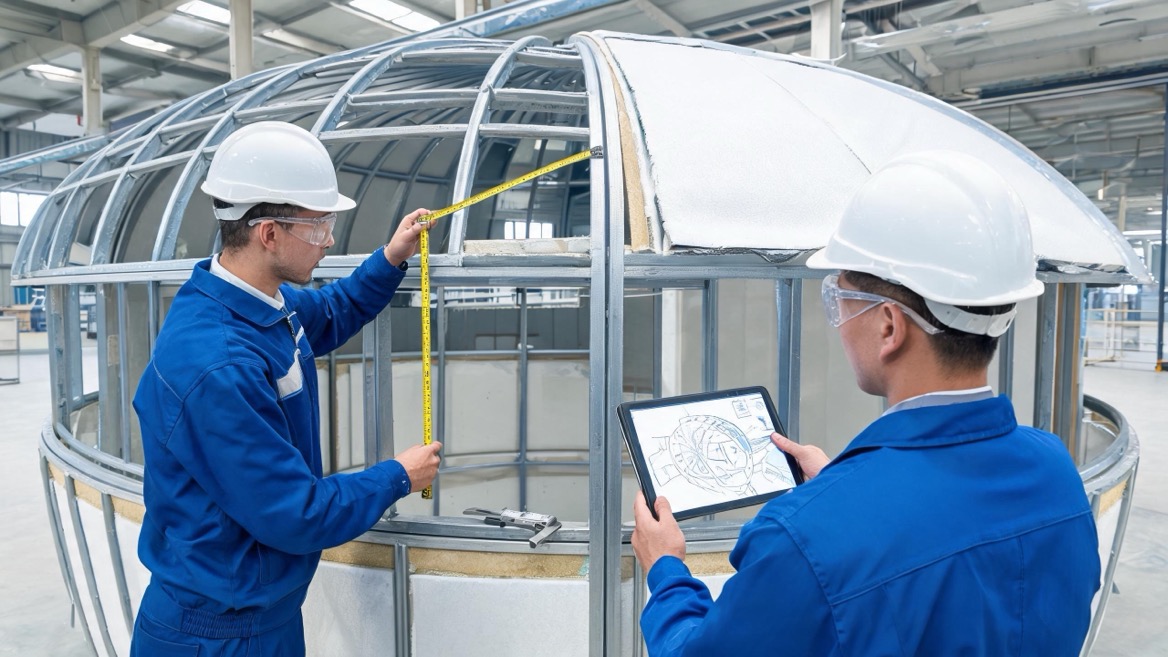
Some suppliers quote a "steel frame included" price without identifying the steel grade, thickness, galvanized layer, or frame weight. This makes it easy to reduce material quality after the order is confirmed.
How to avoid it:
Request a line-by-line bill of materials and attach it to the purchase contract. Include steel grade, thickness, anti-corrosion treatment, weight range, and acceptable tolerance.
Two wall panels with the same total thickness can have very different performance. Suppliers may reduce insulation density, face-sheet thickness, fire rating, or core material to lower costs.
How to avoid it:
Specify the panel composition in detail: outer sheet thickness, inner sheet thickness, insulation material, insulation density, thickness, thermal value, and fire performance.
A supplier may show an ISO or CE certificate that does not cover the actual factory, product category, or destination-market requirement.
How to avoid it:
Verify the legal entity name, factory address, certificate number, issuing body, validity period, and scope. Ask the supplier to explain exactly how each document relates to your project.
Round or irregular prefab structures can occupy more container space than standard rectangular units. Oversized components may require flat-rack containers, open-top containers, special trucking, or additional lifting equipment.
How to avoid it:
Request a detailed loading plan before confirming the order. It should show container type, quantity per container, packing dimensions, unit weight, gross weight, loading sequence, and destination-port handling requirements.
"Fully customized" may only mean color selection and logo printing. It may not include structural redesign, MEP coordination, local code adaptation, fire design, or curved roof engineering.
How to avoid it:
Separate customization into clear categories: appearance, dimensions, structure, materials, MEP, interior layout, brand identity, packaging, and local compliance support. Define cost, lead time, drawings, and responsibilities for each category.
One of the most overlooked risks in round prefab house procurement is not the main frame. It is the combination of custom curved flashing, roof-edge finishing, transport vibration, and on-site reassembly tolerance.
A round or dome structure may look perfect during factory assembly. However, after ocean transport, lifting, unloading, and installation on a foundation with minor tolerance deviations, curved roof panels and custom edge trims can shift slightly. Even a small misalignment may cause water leakage, air leakage, difficult door alignment, or inconsistent wall joints.
Before placing a bulk order, ask the supplier to complete the following:
1. Conduct a full factory pre-assembly.
2. Provide close-up photos of roof joints, flashing, door/window interfaces, pipe penetrations, and drainage details.
3. Demonstrate reassembly after disassembly, not just one-time factory assembly.
4. Label every component and provide a numbered packing list.
5. Supply spare curved trims, seals, fasteners, and critical fittings.
6. Provide foundation-tolerance requirements and on-site adjustment instructions.
A circular structure that can be assembled is not automatically a structure that can remain watertight over time. Waterproofing details, installation sequencing, and defect liability terms should be clearly included in the purchase agreement.
Before asking for quotations, prepare a one-page project brief covering:
- Application: resort, camp, office, dormitory, retail, showroom, warehouse, or industrial use.
- Installation location and climate.
- Wind, snow, humidity, coastal exposure, and seismic conditions.
- Required size, occupancy, layout, and number of units.
- Need for bathrooms, kitchens, HVAC, plumbing, electrical systems, and fire protection.
- Shipping method: fully assembled, knock-down, or flat-packed.
- Target quantity, budget range, and required delivery date.
- Destination country and expected local approval requirements.
Avoid sending only: "Please quote your round prefab house."
Instead, ask each supplier to provide:
- Floor plan and elevations.
- Structural system explanation.
- Detailed bill of materials.
- Insulation and fire-performance options.
- Door, window, bathroom, electrical, and interior options.
- Unit price, MOQ, sample cost, and volume pricing.
- Production lead time.
- Packing and container loading plan.
- Installation documents.
- Warranty and spare-parts policy.
- Available quality and compliance documents.
A remote or on-site factory audit should include:
- Raw-material warehouse and identification labels.
- Steel cutting, welding, grinding, coating, and assembly processes.
- Sandwich panel and component sourcing.
- Quality-control area and inspection records.
- Finished goods and export packing area.
- Current production orders.
- Business license entity and factory address.
- Consistency between certificates and actual manufacturing operations.
For a standard product, order one sample unit or a small trial order. For a highly customized round prefab house, approve critical 1:1 sections first, such as a curved wall segment, roof joint, window interface, or complete prototype unit.
Inspect:
- Dimensions against approved drawings.
- Steel thickness and material specifications.
- Weld quality and surface finishing.
- Door and window operation.
- Waterproofing and sealing.
- Electrical wiring and grounding.
- Panel fit and finish.
- Packing protection.
- Assembly time and tools required.
- Spare-parts availability.
For bulk orders, use a controlled inspection process:
- Pre-production confirmation.
- First-article approval.
- Mid-production inspection.
- Pre-shipment inspection.
- Container-loading inspection or video record.
- Third-party inspection for critical projects.
The inspection report should include quantities, dimensions, materials, surface quality, packaging, labels, photo evidence, defects, corrective actions, and final approval status.
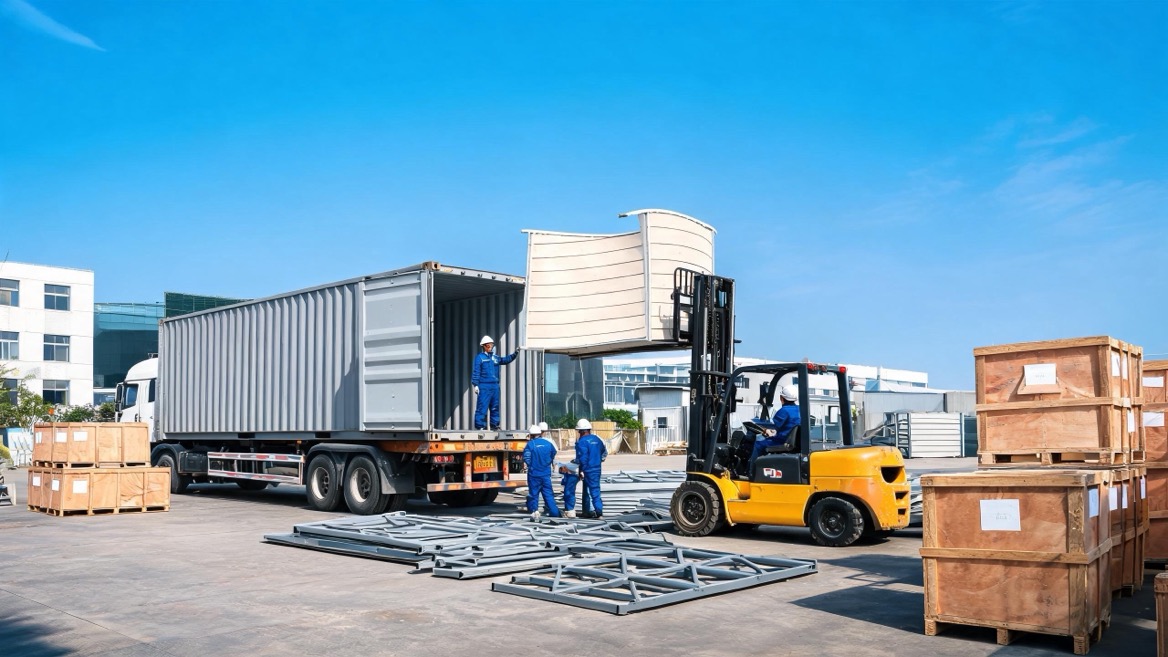
A reliable Round Prefab House supplier should be evaluated through engineering documents, material transparency, factory controls, customization depth, export readiness, and long-term communication—not only by appearance or price.
Welons Prefab is a practical option for buyers seeking quick-assembly prefab units, container houses, modular offices, dormitories, showrooms, warehouses, industrial spaces, and customized OEM solutions. Its manufacturing capacity, flexible configuration approach, and responsiveness make it particularly relevant for small and mid-sized brands, distributors, contractors, and project buyers seeking a balanced sourcing partner.
For an accurate proposal, prepare your drawings, installation location, required configuration, estimated quantity, and destination port before contacting suppliers. This allows manufacturers to provide more reliable technical recommendations, shipping plans, lead times, and pricing.
Check the certificate number, company name, factory address, scope, issue date, and expiry date. Then verify the certificate directly through the certification body's official website or official contact channel. Confirm that the scope includes manufacturing rather than only trading or sales activities.
Not always. A circular visual effect can be created with polygonal framing, multiple modules arranged around a courtyard, or curved façade panels. A true circular steel frame offers a stronger architectural identity but usually requires more custom fabrication, more careful waterproofing, and higher transport and installation costs.
Use the same approved drawings and bill of materials. Compare steel specifications, insulation core, panel thickness, doors, windows, electrical systems, bathrooms, shipping method, installation scope, warranty, and Incoterms. Comparing only the price per square meter or price per unit is usually misleading.
Fully assembled units reduce site installation time but use more container volume. Knock-down or flat-packed systems can reduce freight cost but require better installation skills at the destination. For round or irregular units, review maximum packing dimensions, unit weight, container type, and local lifting requirements before choosing the transport method.
Attach the approved bill of materials to the contract. Specify key brands, steel grades, thicknesses, insulation density, panel composition, hardware, and electrical components. Conduct mid-production and pre-shipment inspections, require batch labels and material records, and consider third-party testing for critical materials.
- China Customs statistics on prefabricated buildings and related export categories. [english.customs.gov]
- China government guidance on standardized prefabricated construction and quality management. [english.www.gov]
- China National Standardization Administration information on steel-structure modular units and connection accessories. [std.samr.gov]
- China Prefab House, Modular Building, Mobile House & Space Fair industry information. [pmmhf]
- Modular Building Institute, an international trade association for commercial modular construction. [modular]


