
Views: 236 Author: Welons Prefab Houses Publish Time: 2026-08-25 Origin: Site


Content Menu
● Coastal Resort Building Challenges
>> What coastal resort operators should assess
● Space Capsule House Overview
>> Why capsule houses suit resort accommodation
>> Capsule house limitations to consider
>> Why round prefab houses suit coastal sites
>> Round prefab house limitations to consider
● Side-by-Side Resort Comparison
● Which Option Delivers Better ROI?
>> Example resort configuration
● Coastal Specification Checklist
>> 1. Confirm site-specific structural loads
>> 2. Upgrade corrosion protection
>> 3. Design the foundation for water and wind
>> 4. Protect utilities and guest access
● How to Choose the Right Supplier
● FAQ
>> Is a Space Capsule House suitable for a beachfront resort?
>> Are round prefab houses better in high winds?
>> Which option is better for luxury resort guests?
>> Can Space Capsule Houses be customized for resort branding?
>> What maintenance is required for prefab houses near the sea?
>> Can a coastal resort combine capsule houses and round prefab houses?
>> What information should I provide before requesting a quote?
Choosing between a Space Capsule House and a Round Prefab House for a coastal resort is not simply a design decision. It affects guest appeal, construction logistics, site resilience, maintenance planning, room revenue strategy, and long-term brand positioning.
For resort developers, both options can create memorable stay experiences faster than conventional construction. However, they serve different operating models. A Space Capsule House is often the stronger fit for premium, compact, highly repeatable guest units, while a Round Prefab House can be better suited to immersive glamping concepts, larger communal spaces, and wind-conscious site layouts.
At Welons Prefab, we have spent years supporting modular building projects that require flexible layouts, consistent manufacturing quality, customized interiors, OEM support, and scalable delivery. For coastal hospitality projects, the right choice should begin with the site's wind, salt exposure, flood elevation, local regulations, target guest profile, and expected operating season—not appearance alone.

A coastal resort places buildings in a demanding environment. Salt-laden air, high humidity, wind-driven rain, strong sunlight, sand abrasion, and occasional flooding can shorten the life of poorly specified materials and connections.
Carbon steel corrosion in coastal environments is influenced by moisture exposure, airborne chloride deposition, and local atmospheric conditions. This is why a resort developer should review not only the exterior wall material, but also fasteners, door hardware, roof joints, chassis coatings, utility penetrations, drainage paths, and foundation connections.
For sites within flood-prone or wave-exposed areas, the building platform and critical systems also need careful planning. Elevating buildings and locating electrical equipment above the expected flood level can help protect resort operations during severe weather events.
Before selecting a Space Capsule House or Round Prefab House, evaluate:
- Distance from the shoreline and direct salt-spray exposure
- Local wind-load requirements and storm history
- Flood elevation, drainage, erosion, and foundation conditions
- Transportation access for oversized modules or panelized components
- Guest segment, such as couples, families, eco-travelers, or luxury travelers
- Target room rate and required return on investment
- Maintenance capacity for coatings, seals, glazing, and exterior cleaning
- Permitting requirements for tourism accommodation and temporary structures
A visually attractive prefab resort unit can still become an expensive operational problem if its coastal specification is incomplete.
A Space Capsule House is a compact modular accommodation unit with a streamlined exterior, contemporary glazing, integrated interior systems, and a futuristic visual identity. It is commonly used for boutique resorts, scenic camps, mountain retreats, beachside accommodation, short-stay rental sites, and destination-based hospitality projects.
Its greatest commercial strength is differentiation. Guests often see the capsule unit as part of the experience rather than merely a room.
The Space Capsule House format works especially well when a resort wants to create a recognizable accommodation product across multiple units or locations.
Key advantages include:
- Strong visual appeal for photography, short-form video, and social sharing
- Compact layouts that suit couples, solo travelers, and premium short stays
- Factory-integrated interiors that reduce on-site finishing work
- Large windows that frame sea, forest, mountain, or lake views
- Repeatable unit designs that simplify purchasing and operational planning
- Flexible customization for furniture, lighting, bathrooms, HVAC, exterior finishes, and smart controls
- Faster deployment potential compared with fully site-built guest rooms
From a guest-experience perspective, the capsule format is highly effective when placed around a strong view corridor. A well-positioned panoramic window can turn a small room into a premium accommodation product.
A Space Capsule House is not automatically the best answer for every coastal project.
Potential limitations include:
- More limited usable floor area than larger round structures
- A higher need for precise transport and crane-access planning for fully assembled modules
- Glazing requires careful specification for wind pressure, water penetration, solar gain, and impact risk
- Curved exterior forms may require manufacturer-specific replacement panels or components
- A futuristic appearance may not align with every resort brand, heritage setting, or natural landscape
The product should also be engineered for the exact site. A standard inland specification should not be assumed suitable for beachfront exposure.
A Round Prefab House is a circular or near-circular prefabricated structure. Depending on the supplier and design, it may include a dome form, radial framing, circular wall system, yurt-inspired structure, or modern rounded cabin profile.
For coastal resorts, round buildings are commonly considered for glamping units, wellness rooms, cafés, yoga spaces, lounges, activity hubs, family cabins, and distinctive guest accommodation.
The circular form is often valued for its visual softness and ability to sit naturally within a landscape. Unlike sharply rectilinear guest blocks, a round unit can support an eco-retreat, low-density resort, wellness destination, or nature-focused accommodation brand.
A round structure may also provide aerodynamic advantages because wind can flow around a curved building profile rather than concentrate around sharp corners. However, actual wind performance always depends on the engineered structure, roof connection, anchors, foundations, openings, and local design loads—not shape alone.
Key advantages include:
- Organic visual integration with coastal vegetation and natural terrain
- Flexible open-plan interiors for relaxation, wellness, or group use
- Reduced corner areas and a distinctive sense of spaciousness
- Potentially efficient enclosure geometry for a given floor area
- Strong fit for eco-lodges, wellness resorts, and experiential camping projects
- Panoramic design opportunities through skylights, wraparound windows, or central ceiling features
A circular layout requires more careful interior planning than a rectangular module.
Common concerns include:
- Standard furniture may not sit efficiently against curved walls
- Custom cabinetry and curved finishes can increase fit-out complexity
- Larger circular roofs may require specialized engineering and waterproofing details
- Some models may be delivered in components, increasing on-site assembly requirements
- A round shape alone does not eliminate the need for hurricane ties, engineered anchors, corrosion-resistant hardware, and certified glazing
For resorts that want identical hotel-style rooms with predictable furniture layouts, the Space Capsule House may be easier to standardize. For destination properties selling a natural retreat atmosphere, the Round Prefab House may create a stronger emotional connection.
| Factor | Space Capsule House | Round Prefab House |
|---|---|---|
| Primary guest appeal | Futuristic, premium, photo-friendly stay | Natural, immersive, wellness-oriented stay |
| Best for | Boutique stays, couples, scenic resorts, repeatable room inventory | Glamping, eco-resorts, family units, lounges, wellness spaces |
| Interior planning | Usually pre-planned and compact | More open, but may need custom furniture planning |
| View strategy | Large front-facing panoramic glazing | Panoramic windows, skylights, or multi-directional openings |
| Manufacturing approach | Often highly integrated modular production | Can be modular, panelized, or assembled on-site |
| Branding style | Modern, technological, distinctive | Organic, calm, nature-focused |
| Transport planning | Requires route, width, height, and crane review | May be easier to ship in components, depending on design |
| Wind response | Streamlined exterior can reduce certain wind pressures, but engineering governs | Curved form can reduce pressure concentration, but engineering governs |
| Coastal maintenance | Focus on seals, glazing, metal finish, and chassis protection | Focus on roof membrane, joints, anchors, and curved exterior components |
| Room expansion | Add more individual modules in phases | Add separate units or create larger circular communal buildings |
The most commercially effective approach may be a mixed accommodation strategy. For example, a resort can use capsule houses as high-rate ocean-view guest units and round prefab houses as a café, yoga pavilion, reception lounge, or family-focused glamping zone.
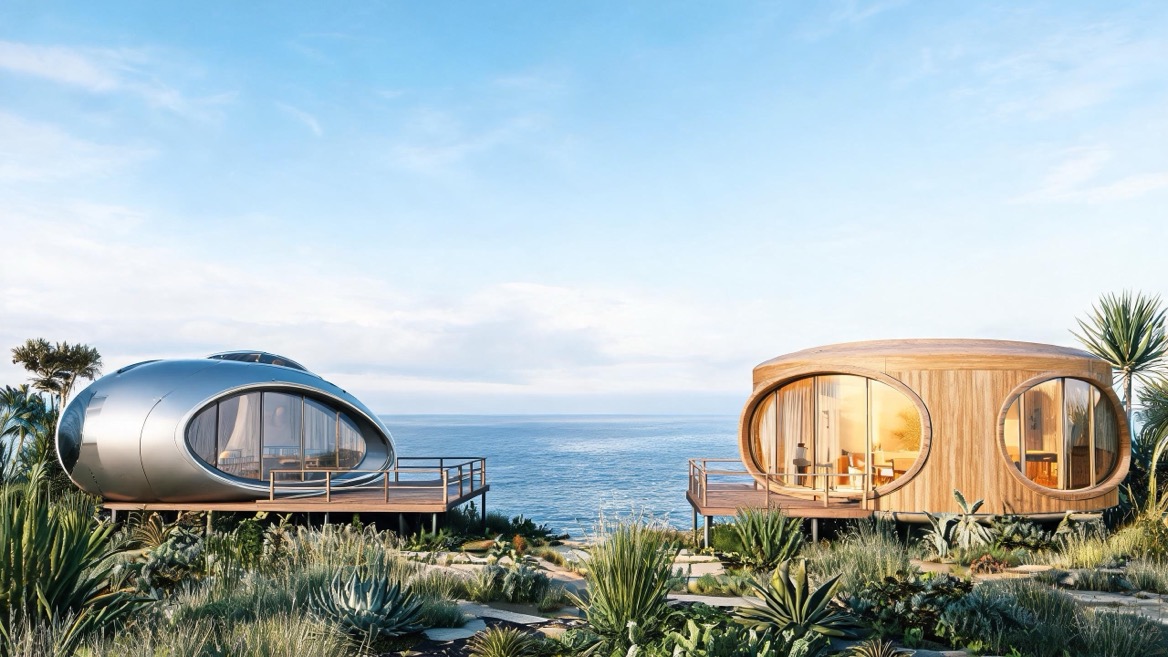
There is no universal winner because resort return depends on occupancy, average daily rate, seasonal demand, land conditions, local labor cost, installation time, and maintenance.
However, a practical rule is useful:
- Choose a Space Capsule House when your project depends on premium room positioning, visual differentiation, rapid unit replication, and higher revenue per compact accommodation unit.
- Choose a Round Prefab House when your brand depends on nature immersion, flexible shared spaces, wellness programming, or a softer architectural profile.
- Use both when you want different accommodation tiers and a coherent destination experience.
Imagine a 24-unit coastal boutique resort:
1. Install 12 Space Capsule Houses on elevated foundations facing the best ocean or sunset views.
2. Position 8 Round Prefab Houses in a landscaped garden zone for families and longer stays.
3. Use 2 larger round units as a reception lounge and wellness studio.
4. Reserve 2 capsule units for premium suites with upgraded terraces, private tubs, and uninterrupted views.
This configuration creates different price tiers while keeping the property visually unified. It can also reduce the risk of relying on one room type for all guests.
The building type is only half of the decision. The following technical requirements should be confirmed with the manufacturer, local architect, structural engineer, and permitting authority.
Ask for engineering that addresses:
- Design wind speed and exposure category
- Windborne debris requirements where applicable
- Roof uplift and wall-to-foundation connection design
- Seismic requirements, if relevant
- Snow load requirements for year-round coastal mountain regions
- Glazing performance for wind pressure and water penetration
Do not rely on a general statement that a unit is "wind resistant." Request the project-specific design basis and supporting documents.
Coastal exposure requires a detailed material schedule. Consider:
- Galvanized or properly coated structural steel
- Marine-suitable coating systems
- Corrosion-resistant fasteners and hardware
- Sealed dissimilar-metal interfaces to reduce galvanic corrosion risk
- Drainage details that prevent standing water and debris accumulation
- Regular inspection access for structural connections and chassis areas
Design guidance for coastal structures emphasizes drainage, sealed joints, protection from coating damage, and avoiding direct contact between dissimilar metals where possible.
Foundation selection depends on soil, flood zone, erosion conditions, wind load, and local building rules. Possible approaches may include:
- Concrete piers
- Steel screw piles
- Reinforced concrete pads
- Elevated platforms
- Deep piles or columns in high-hazard locations
In flood-prone settings, an elevated foundation can help protect the building and keep important utility components above expected water levels. Do not choose a foundation system based on installation speed alone.
A resort unit remains unusable if its electrical, water, wastewater, access route, or emergency egress fails.
Plan for:
- Raised electrical and mechanical equipment
- Protected water and drainage connections
- Safe elevated walkways where needed
- Non-slip decking and corrosion-resistant railings
- Backup power and communications for remote properties
- Clear emergency evacuation routes
For an overseas resort developer, supplier selection should be based on more than a catalog image or a low unit price.
A reliable prefab manufacturer should be able to provide:
- Detailed product drawings and dimensions
- Material specifications
- Customization options
- Manufacturing capacity and lead-time planning
- Quality-control process information
- Packaging and shipping recommendations
- Installation guidance
- OEM and branding support
- Clear scope boundaries for foundations, utilities, transport, and local approvals
Welons Prefab supports modular building projects with flexible customization, OEM capability, wholesale supply, and scalable production capacity of up to 300 units per day. For coastal resorts, the most important early step is to share the site location, intended use, target room quantity, local weather conditions, and preferred interior configuration.
This allows the product concept to be developed around commercial goals and environmental conditions rather than forcing the project to fit a standard model.
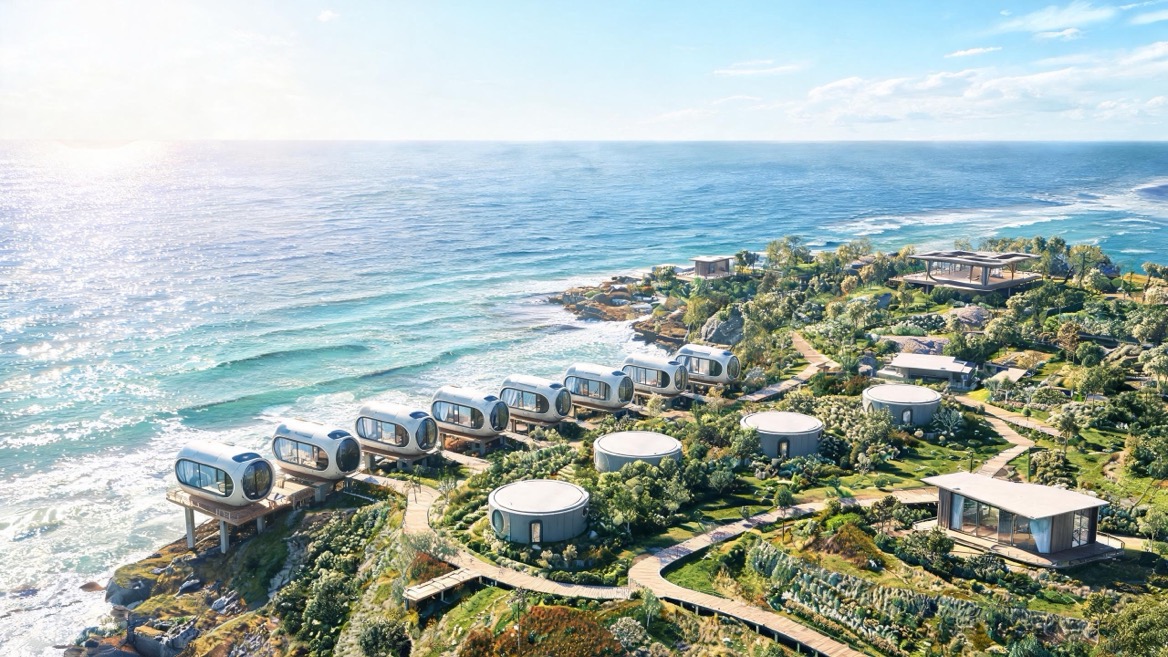
For a coastal resort focused on premium, compact, highly visual accommodation, a Space Capsule House is usually the better flagship guest-room solution. It can create a recognizable resort identity, support view-oriented room design, and simplify the rollout of repeatable accommodation units.
For an eco-lodge, wellness retreat, family-oriented glamping site, or communal resort zone, a Round Prefab House can deliver a warmer and more landscape-sensitive guest experience.
The strongest coastal resort developments do not select a unit only because it looks impressive. They combine attractive architecture with correct wind engineering, corrosion protection, drainage, elevated foundation planning, serviceability, and a clear commercial model.
Ready to develop your coastal resort accommodation concept? Contact Welons Prefab with your site plan, room quantity, preferred house type, target market, and customization requirements. Our team can help you evaluate Space Capsule House and Round Prefab House solutions for your project.
Yes, provided that the unit is specified for the actual site conditions. The structure, glazing, anchors, exterior materials, corrosion protection, drainage, and foundation must be designed around local wind, salt exposure, and flood requirements.
A round form can allow wind to move around the building more smoothly than a structure with sharp corners. However, real performance depends on engineered framing, roof connections, anchors, openings, foundations, and local wind-load requirements.
A Space Capsule House is often better for luxury couples and short-stay travelers because it creates a modern, exclusive, view-focused experience. A Round Prefab House may be better for wellness guests, families, groups, and nature-oriented travelers.
Yes. Common customization options include exterior colors, interior finishes, furniture packages, lighting, bathroom layouts, smart controls, logos, signage, terraces, and window configurations. The available options depend on the selected model and project requirements.
Coastal maintenance should include inspection of coatings, sealants, roof joints, drainage paths, fasteners, glazing seals, exterior hardware, and foundation connections. Salt deposits should be cleaned regularly, especially on exposed metal components.
Yes. Combining the two can create a useful room and amenity mix. Capsule units can serve as premium guest rooms, while round units can be used for family accommodation, cafés, reception areas, yoga rooms, lounges, or event spaces.
Provide the project location, site plan, required unit quantity, preferred floor area, target use, climate conditions, local building requirements, desired finishes, delivery destination, and expected opening date.
1. [Whole Building Design Guide — Waterfront and Coastal Structures Corrosion Issues Knowledge Area]
2. [FEMA — Coastal Facilities Fact Sheet]
3. [NOAA Office for Coastal Management — Sea Level Rise Viewer]
4. [National Library of Medicine — Marine Atmospheric Corrosion of Carbon Steel: A Review]
5. [AIA California — Design for Coastal Flooding: Building-Level Actions]
6. [FEMA — Home Builder's Guide to Coastal Construction]
7. [Mandala Homes — The Ancient Wisdom of Building Round Homes]
8. [Gessato — Round Houses: Benefits, Plans and Design Ideas]


