
Views: 274 Author: Welons Prefab Houses Publish Time: 2026-10-09 Origin: Site


Content Menu
>> 2. K-HOME
>> 5. PTH House
>> 6. WZH Group
>> 7. CGCH
>> 10. Hebei Shengtai Integrating Housing
● Buyer's Guide to Specification and Risk
>> Start With the Building's Actual Use
>> Verify Certificates by Scope
>> Inspect Before Finishing Hides the Evidence
>> The Overlooked Packing Problem
>> How can I check whether a factory's ISO certificate has expired?
>> Does CE marking mean a container office can be installed anywhere in Europe?
>> How should I test an OEM supplier before committing to a large order?
>> How can I detect lower-grade materials in a production batch?
>> Are flat-pack units always cheaper than fully assembled offices?
A prefabricated office container may look like a simple purchase: choose a layout, agree on a price, and arrange shipment. For a procurement manager, the decision is more demanding. The office must suit its intended use, withstand transport and local conditions, and arrive with enough documentation to support installation and approval.
China has a broad manufacturing base for modular buildings. Its suppliers can combine steel fabrication, insulated panels, doors, windows, electrical components, and interior finishes within established regional supply chains. According to a 2026 Reuters analysis citing customs data, China's prefabricated-building exports reached approximately $4.3 billion in 2025. That figure covers a wider range of buildings than office containers alone, but it shows the scale of the export sector.
Demand is also changing. The Modular Building Institute estimated that permanent modular construction reached $20.5 billion in the United States in 2025, with office applications among the sector's opportunities. For overseas buyers, this means a growing choice of suppliers—but also a greater need to distinguish a capable manufacturing partner from a company offering only an attractive catalog.
This article introduces ten China-based manufacturers worth investigating. It is a procurement shortlist, not an independently audited ranking. Published production figures, certificates, and market claims should be checked against the specific factory and product in your quotation.
A strong supplier does more than manufacture a steel-framed unit. It can translate site requirements into controlled drawings, repeat the approved specification across a production batch, and explain exactly what arrives at the destination.
Use four questions to build your shortlist:
1. Does the factory make the system you need? A flat-pack office, a fully assembled modular office, and an office built from a modified shipping container have different structures, shipping methods, and installation requirements.
2. Can its engineers support the design? Request layout drawings, connection details, material specifications, and structural calculations when the project requires them.
3. Can it control production quality? Ask how the factory checks incoming steel and panels, welding, protective coatings, trial assembly, waterproofing details, and final packing.
4. Can it deliver a usable building package? Confirm the relevant test reports, destination-specific requirements, production schedule, installation instructions, and after-sales responsibilities.
The order below highlights different purchasing needs. Welons Prefab appears first as the company commissioning this guide; apply the same verification standards to its claims as to those of every other manufacturer.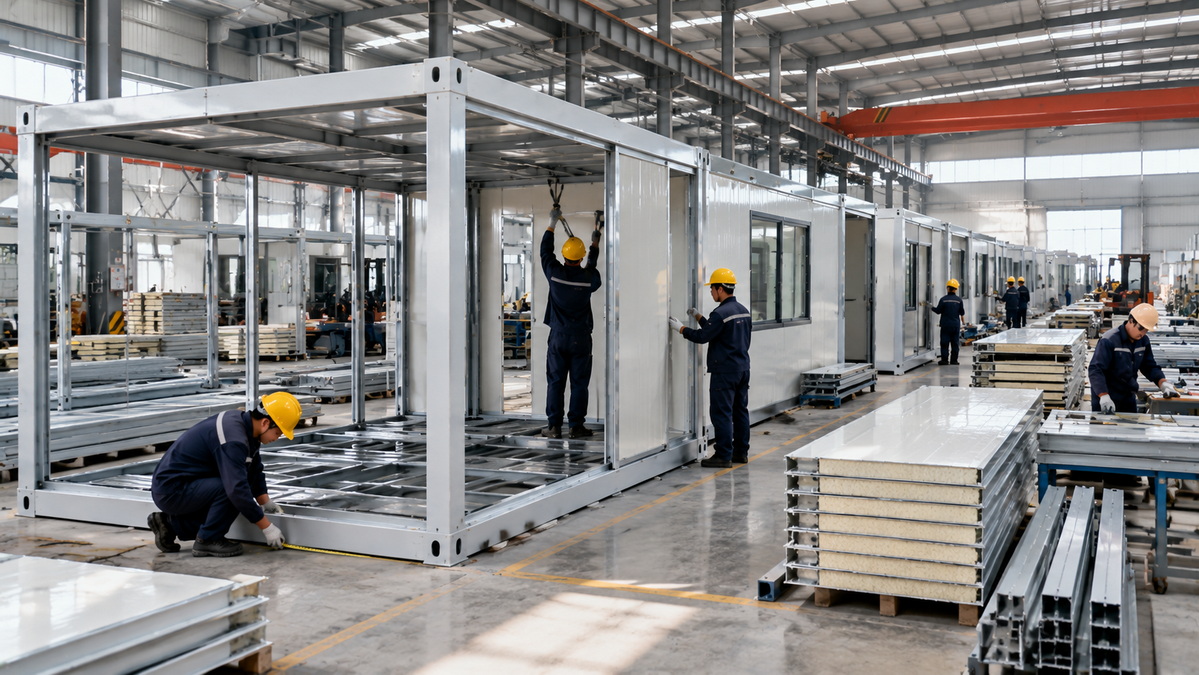
The figures below use different measures. A daily output of flat-pack kits is not directly comparable with a monthly output of fully fitted modules or a capacity measured in square meters.
| Manufacturer | Published production capacity or scale | Published MOQ | Documentation to check | Potential fit |
|---|---|---|---|---|
| Welons Prefab | 300 units per day, company-stated | Not publicly stated | Request current certificates and product test reports | Customized offices and mixed-use site facilities |
| K-HOME | More than 15,000 flat-pack units per year, company-stated | One unit | ISO 9001 and applicable product documents | Flat-pack offices and workforce facilities |
| DXH Container | Approximately 500 container-house units per day, company-stated | Not publicly stated | Product-specific tests and factory records | Customized offices and repeat orders |
| Lida Group | 5,000 m² per day across steel-structure and prefab products, company-stated | Not publicly stated | ISO certificates and applicable EN 1090 documents | Offices within larger camp projects |
| PTH House | Two owned bases and more than 3,000 reported projects | Not publicly stated | Current management-system and project documents | Engineered multi-building developments |
| WZH Group | 15,000 prefab-house units per year, company-stated | Not publicly stated | ISO, CE, and other claims by product scope | Export-oriented custom container systems |
| CGCH | More than 60,000 flat-pack units annually at its Anhui operation, company-stated | Not publicly stated | Plant-specific certificates and test reports | Larger-volume modular programs |
| CIMC Modular Building | More than 2,500 modules per month in-house, company-stated | Not publicly stated | Relevant project and product records | Complex permanent modular buildings |
| GS Modular | Group-scale production information is published, but product categories vary | Not publicly stated | Certificates for the contracting entity and proposed plant | Permanent steel-frame modular offices |
| Hebei Shengtai Integrating Housing | Not established in the reviewed reporting | Not established | Full factory and product qualification needed | A candidate requiring further investigation |
Note: "Not publicly stated" does not mean a manufacturer has no MOQ, certification, or capacity. It means the information should be requested and verified before comparison.
Potential fit: Buyers seeking flexible office layouts or a single supplier for offices, dormitories, canteens, meeting rooms, and other modular site buildings.
Welons Prefab describes itself as a manufacturer and one-stop provider of modular buildings and prefab container houses. Its published range includes container houses, fast-assembly units, mobile toilets, insulated panels, and customized steel structures. The company states a production capacity of 300 units per day.
Welons reports 11 years of professional experience in the information supplied for this article. That statement should not be mistaken for a verified year of legal incorporation. Its company information describes support from design and production through transportation, installation, and after-sales service, but does not publish a detailed breakdown of sales by destination market.
For an OEM buyer or a smaller brand, Welons is a relevant candidate when responsive coordination and changes to layouts, finishes, or supporting facilities matter. The practical test is to send a detailed brief and ask the team to return a marked-up drawing, bill of materials, proposed schedule, and list of exclusions. Buyers should also clarify what the 300-unit capacity includes and request current, office-specific documentation.
Potential fit: Flat-pack offices ordered alongside accommodation, classrooms, canteens, or other workforce facilities.
K-HOME traces its operations to 2007 on a company office-container page. It describes production bases in Henan and Shandong and offers detachable, flat-pack, folding, and expandable container systems, as well as steel structures. Its published projects include modular offices in Cameroon and container office buildings in Saudi Arabia.
The company states an annual capacity of more than 15,000 flat-pack units and a one-unit minimum order. It also warns that shipping a single unit may not be economical. K-HOME describes work in more than 70 countries and offers customization of layouts, materials, and supporting facilities.
A buyer should ask whether the quoted unit is a standard model with limited changes or a fully revised design. Confirm the exact production plant, approved drawing revision, and documents supplied with the order.
Potential fit: Buyers comparing several office formats or planning repeat orders.
Suzhou Daxiang Container House Co., Ltd., marketed as DXH Container, says it has designed and manufactured modular container buildings since 2008. Its products include flat-pack, detachable, folding, and expandable units. It also publishes guidance on single container offices and combined office complexes.
DXH reports a manufacturing site exceeding 60,000 m² and output of approximately 500 container-house units per day. It identifies customers across North America, Europe, Southeast Asia, the Middle East, and other regions.
The range of formats makes DXH useful for an early comparison of delivery methods. Before relying on its headline output figure, ask which unit types it covers, how much fit-out is included, and what daily capacity remains available during your proposed production period.
Potential fit: Site offices forming part of a larger accommodation camp or steel-building package.
Lida Group states that it was established in 1993. Its portfolio includes container houses, prefab houses, and steel structures. Office-related products include flat-pack and expandable units used in industrial and workforce settings.
The company publishes a capacity of 5,000 m² per day across steel-structure and prefab-house products. This is a measure of floor area across product categories—not a daily count of completed office containers. Lida lists projects in the Middle East, Africa, Europe, Australia, and Southeast Asia and describes customized container formats and integrated project services.
Its published ISO and EN 1090-related claims deserve a product-specific review. Match every certificate to the legal entity, factory, fabricated component, and validity period relevant to your purchase.
Potential fit: Engineered offices within a multi-building workforce camp or commercial development.
PTH says it was founded in 1998 and operates two owned manufacturing bases. It reports more than 3,000 delivered projects across over 150 countries and regions. Its project scope includes workforce camps, steel structures, public buildings, and commercial facilities.
PTH's approach is suited to projects that need coordinated engineering rather than a small catalog-only cabin order. Its published applications combine offices with dormitories, kitchens, clinics, and other facilities. It also describes an in-house engineering team and management-system certifications.
Buyers should define the boundary between factory design, local engineering approval, manufacturing, transport, and site installation. That division of responsibility is particularly important for multi-storey or long-term occupied buildings.
Potential fit: Buyers deciding between flat-pack, folding, expandable, and modified-container options.
Hebei Weizhengheng Modular House Technology Co., Ltd., known as WZH Group, states that it was founded in 2001. Its website reports annual output of 15,000 prefab-house units and describes customers in Australia, North America, Europe, Southeast Asia, Africa, and the Middle East.
WZH presents a service scope running from design to manufacture, transport, and installation. It also publishes ISO, CE, SAA, and other certification claims. A broad range of formats can be helpful, but it increases the importance of identifying which system is actually quoted.
Ask for a sample packing list, assembly instructions, and the test reports for the selected model. A report for one expandable house should not automatically be treated as evidence for a different flat-pack office.
Potential fit: Larger-volume orders involving standard modular units and selected customized configurations.
CGCH describes a business covering modular-building research and development, manufacturing, and project delivery. Its range includes detachable, foldable, and expandable container houses. A published factory page states that its Anhui operation produces more than 60,000 flat-pack units annually.
That figure applies to a stated operation and product type; it is not a verified annual count of fully fitted offices. CGCH also describes commercial and residential applications and a broad customer reach.
When requesting a quotation, identify the contracting company and the plant that will make the order. Ask which components are produced in-house, which are sourced, and where final inspection occurs. The reviewed company information does not establish a sufficiently clear incorporation year to state one here.
Potential fit: Technically demanding, permanent modular office developments.
CIMC Modular Building states that its modular-building operation began in 2004. It reports in-house capacity exceeding 2,500 modules per month and a portfolio of more than 200 global projects. Listed applications include office and commercial buildings, hotels, accommodation, schools, and healthcare facilities.
Its service model spans design, manufacturing, logistics, and construction. That scope may be valuable when a permanent office project needs extensive technical coordination. It may be more than is needed for a small relocatable site office.
Clarify whether the proposed purchase is a finished building project, a supply-only module package, or an OEM arrangement. Each has different design, approval, and installation responsibilities.
Potential fit: Permanent steel-frame modular offices requiring substantial design coordination.
GS Modular identifies itself as part of GS Housing Group and describes work in permanent modular construction. Its applications include offices, schools, commercial facilities, and worker accommodation. The parent group publishes a history beginning in 2001; that should not be presented as a separately verified founding year for the GS Modular brand.
The company discusses engineering, manufacturing, compliance planning, and installation. It also publishes certification and group-scale production information, although capacities across different facilities and product types are not directly comparable.
Ask for capacity specific to the proposed office modules. Confirm the contracting entity, actual manufacturing base, certificate scope, and who will provide design information to the project's local engineer.
Potential fit: A manufacturer to investigate if the buyer has time for full primary-source qualification.
Reuters identified Hebei Shengtai Integrating Housing as a prefab-home manufacturer in Hengshui that had shifted attention toward overseas markets. The reporting provides evidence of a manufacturer participating in the sector, but it does not establish its office-container production capacity, minimum order, certification status, founding year, or formal OEM/ODM scope.
For that reason, Hebei Shengtai should be treated as an investigation candidate, not a prequalified office-container supplier. Ask whether it currently produces offices, which destination markets it serves, and whether an independent inspector can visit the proposed factory. If its capabilities cannot be documented for your exact product, remove it from the final tender list.
"20-foot prefab office" is not a complete specification. A temporary construction-site office, a staffed sales office, and a long-term industrial facility may have different requirements for occupancy, comfort, fire safety, foundations, and local approval.
A useful request for quotation should state:
- Structure: Frame geometry, steel grade and thickness, floor loads, welds, connections, lifting points, and the site's required wind, snow, or seismic design inputs.
- Building envelope: Wall and roof construction, insulation type and thickness, weather seals, drainage, and corrosion-protection system.
- Interior and services: Doors, windows, flooring, lighting, electrical supply, ventilation, HVAC allowances, plumbing, and responsibility for connections.
- Delivery: Assembled or flat-pack format, packed dimensions and weights, lifting method, installation sequence, and spare parts.
- Documentation: Approved drawings, bill of materials, relevant test reports, inspection records, packing list, and installation instructions.
Do not accept "fireproof" or "wind-resistant" as a substitute for a defined performance requirement. A test report for an individual panel, for instance, does not by itself establish the performance of the complete wall assembly.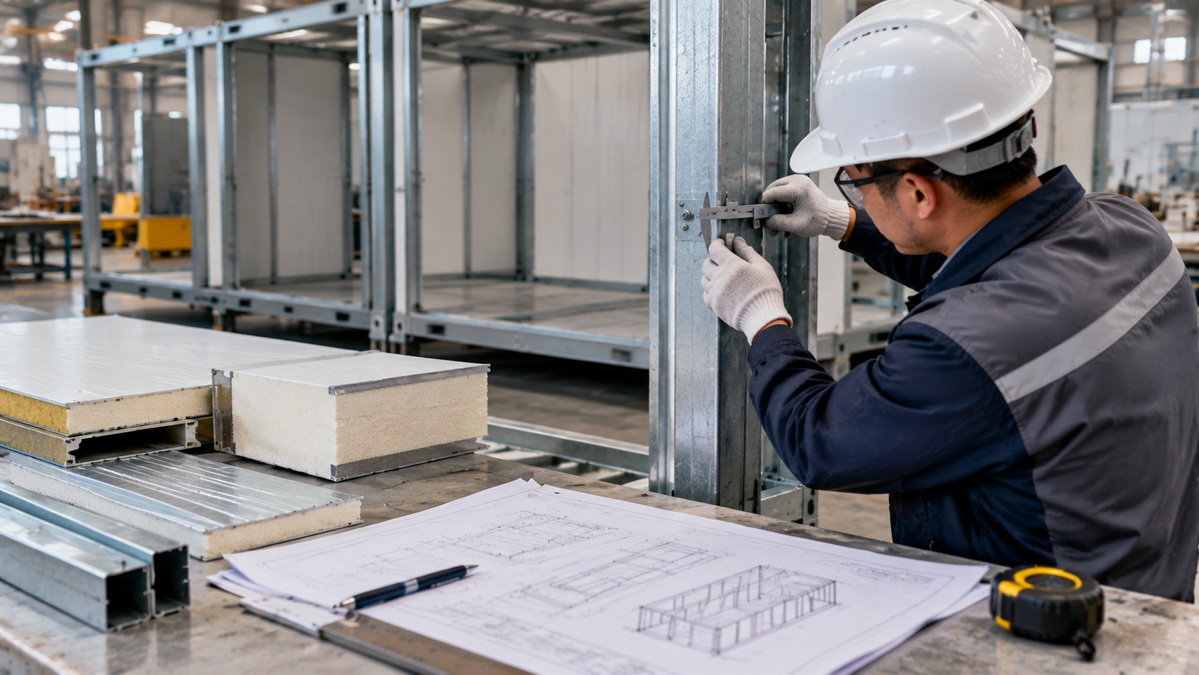
A management-system certificate can help establish how a factory manages its processes. It does not prove that every office model meets the destination's building rules.
For ISO certificates, match the certified company name, site address, scope, issuing body, and validity dates to the entity making your order. Check current status through the appropriate accreditation or certification channels rather than relying on a scanned image in a catalog.
For an EU-bound project, ask which product or component a CE document covers and what declaration or technical assessment supports it. RoHS relates to electrical and electronic equipment; it is not a blanket environmental approval for a complete steel office building. Have qualified local professionals determine which rules apply to the delivered components and the finished installation.
A completed office can conceal important substitutions. Once flooring, wall linings, and trim are installed, it becomes harder to confirm steel thickness, insulation composition, and certain connection details.
Set inspection points in the purchase agreement:
1. Before production: Approve drawings, the bill of materials, and a representative sample or pilot unit.
2. During fabrication: Inspect accessible frames, welding, panel markings, coatings, and critical dimensions.
3. Before packing: Check functional items, finishes, seals, and the count of every component.
4. Before shipment: Reconcile packed units and hardware against the approved documents.
An independent inspector can be particularly valuable when the order is large, the factory is new to the buyer, or installation will occur far from the manufacturing site.
A common but under-discussed risk appears after a satisfactory sample. The production batch may use the approved main frame and panels, yet arrive with substituted trim, seals, fasteners, connectors, or service fittings. Each missing item looks minor on a price sheet. On site, one incompatible profile can delay the assembly of multiple offices.
Require a unit-by-unit packing reconciliation tied to the approved drawing revision and bill of materials. Photograph labels on panel bundles and hardware cartons. Count corners, joint covers, roof-drainage parts, thresholds, electrical fittings, and agreed spares.
Put the remedy in writing: who supplies missing parts, who pays for expedited freight, and how installation delays will be handled. Do not leave these questions to an informal promise made after the containers reach the port.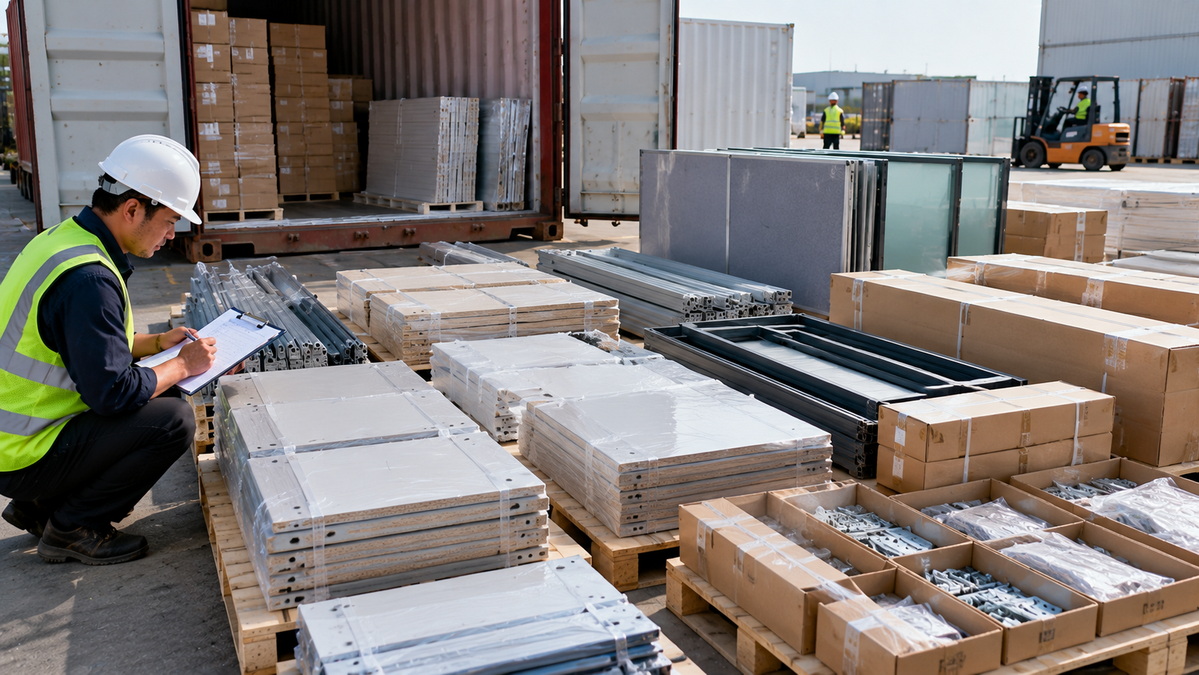
Two suppliers can quote the same nominal office size while offering different insulation, fit-out, packing methods, and installation support. Compare bids against one controlled specification, then estimate cost through installation and commissioning.
Include freight, insurance where relevant, destination charges, duties, inland transport, crane hire, foundations, assembly labor, local approvals, and contingency. State the agreed Incoterms® 2020 rule and named place, but separately define who handles unloading, import clearance, installation, inspections, and handover. A trade term cannot replace a complete technical contract.
The right prefabricated office container manufacturer is the one that can deliver your approved specification repeatedly, document its materials and processes, and support the building through transport and installation. Company history and published capacity can help form a shortlist; drawings, samples, inspections, and clear contract terms determine whether that shortlist is dependable.
If your project combines customized offices with dormitories, canteens, meeting rooms, or other modular facilities, invite Welons Prefab to quote alongside other qualified suppliers. Send the intended use, destination, target quantity, layout, delivery schedule, and documentation requirements. Then compare every proposal against the same written specification—line by line.
Request the complete certificate and record its number, certified legal name, site addresses, scope, issuing body, and validity dates. Check its current status through IAF CertSearch where available, or contact the issuing certification body. A valid certificate for a sales office or another factory is not evidence that the plant making your offices has the same certified scope.
No. First establish which component or product carries the marking and the applicable regulatory basis. Construction-product documentation, electrical compliance, and permission to install and occupy a building are separate matters. The complete configuration should be reviewed against the destination's requirements before production starts.
Give shortlisted suppliers the same brief. Ask each for a revised layout, bill of materials, technical exceptions, schedule, and sample plan. A capable team should identify conflicting requirements rather than silently quoting around them. Approve a representative pilot unit, then inspect a production batch against the frozen specification.
Define measurable requirements in the contract. Request material certificates, panel identification, coating records, and traceable batch details. Inspect while frame members and panel cores remain accessible. A photograph of a finished office is not reliable evidence of concealed steel thickness or insulation composition.
No. Flat-pack systems may reduce shipping volume, but they add on-site labor, handling, assembly equipment, and weather-sealing work. Fully assembled modules may reduce site work but can be harder and more expensive to transport and lift. Compare both options using packing dimensions, destination freight, installation labor, equipment, and schedule—not factory price alone.
- [K-HOME — Company and Product Information]
- [Lida Group — Container House Manufacturing]
- [CGCH — About Us]
- [CIMC Modular Building — Company Information]
- [Reuters — China's Prefab-Home Manufacturers Pivot to Exports]
- [Modular Building Institute — Industry Analysis and Reports]
- [ISO — Certification and Verification Guidance]
- [European Commission — Construction-Product CE Marking and Declarations]


