
Views: 288 Author: Welons Prefab Houses Publish Time: 2026-09-14 Origin: Site


Content Menu
● How We Evaluated Manufacturers
>> What "Certification" Really Means
● Top 10 Pre Fab Container Homes Manufacturers in China
>>> Why Buyers May Shortlist Welons Prefab
>>> Recommended Due Diligence Questions
>>> Best Fit
>>> OEM and ODM Considerations
>> 3. Wellcamp
>>> Best Fit
>>> Best Fit
>> 5. K-Home
>>> Best Fit
>> 6. CBOX
>>> Best Fit
>>> Buyer Caution
>> 7. WELLCAMP Steel Structure & Modular Housing
>>> Best Fit
>> 8. Shanghe / Yichen Prefab House
>>> Best Fit
>> 9. Regional Expandable and Folding-Home Specialists
>>> Best Fit
>>> What to Verify
>> 10. Project-Focused Modular Building Suppliers
>>> Best Fit
● Product Specifications That Matter
>> Steel Frame and Corrosion Protection
>> Flooring
● The Less-Discussed Sourcing Trap: "Sample Specification Drift"
● Buyer's Guide: How to Verify a Factory
>> Step 1: Confirm the Legal Manufacturer
>> Step 2: Review Technical Documents
>> Step 3: Audit the Quality-Control Process
● MOQ, Capacity, and Certification Comparison
● Logistics and Shipping Considerations
>> Customs and Destination Compliance
● FAQ
>> 1. How can I verify whether a supplier's ISO certificate is still valid?
>> 2. Does CE certification mean a pre fab container home can be legally installed anywhere in Europe?
>> 3. How should I compare quotations from different China container-house suppliers?
>> 4. What should be included in a pre-shipment inspection?
>> 5. What is the most important question to ask before paying a deposit?
China remains one of the most important sourcing locations for pre fab container homes, flat-pack container houses, folding homes, expandable units, and modular site-building systems. For procurement teams, however, selecting a supplier should not be based only on a low unit price or attractive catalog images. The right long-term partner must demonstrate repeatable quality, export documentation capability, engineering support, production stability, and transparent communication.
China's prefabricated-construction market was projected to reach CNY 1.62 trillion in 2025, with continued growth forecast through 2029. Export activity is also increasing: China's prefabricated-building exports reportedly rose from about USD 1.47 billion in 2015 to approximately USD 4.34 billion in 2025.
This article evaluates manufacturers from a professional buyer's perspective. It focuses on companies serving construction contractors, distributors, project developers, accommodation-camp operators, public-sector buyers, and brands seeking OEM or ODM pre fab container homes.
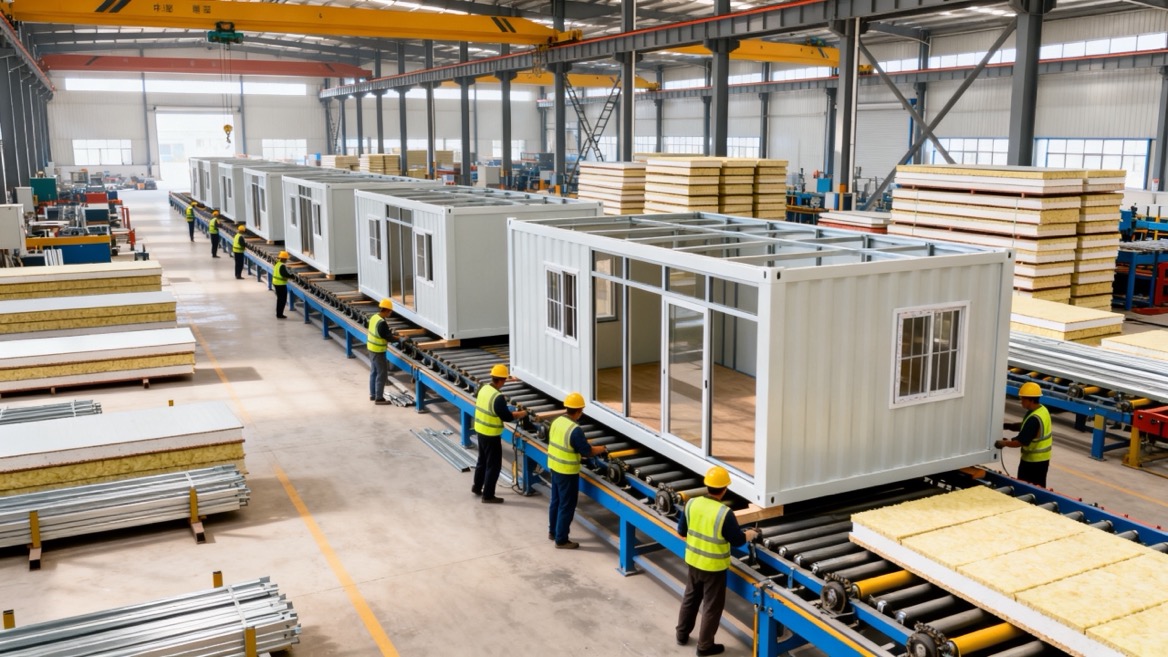
China has a broad industrial ecosystem for prefab container housing, including steel processing, sandwich-panel production, doors and windows, electrical systems, flooring, insulation, fasteners, and export packaging. This supply-chain depth allows many manufacturers to combine standardized production with project-specific customization.
Several manufacturing clusters are particularly relevant:
- Guangdong: Strong for export-oriented modular buildings, container houses, folding units, steel structures, and architectural finishing components. Foshan, Guangzhou, Zhaoqing, and surrounding cities benefit from mature metalworking and building-material supply chains.
- Shandong: Known for steel structures, integrated camp buildings, industrial prefab facilities, and large engineering-oriented suppliers.
- Henan: A practical sourcing region for container accommodation, sandwich panels, steel frames, and high-volume site-camp solutions.
- Hebei and Tianjin regions: Important for structural-steel fabrication and project-oriented modular construction.
- Jiangsu and Zhejiang: Often selected for higher-specification modular systems, architectural components, and customized residential applications.
For international buyers, China's advantage is not simply lower labor cost. The stronger advantage is the ability to source an integrated package: engineering drawings, structural frames, wall systems, insulation, electrical layouts, furniture options, packaging, shipping coordination, installation instructions, spare parts, and after-sales support.
A supplier list is useful only if the evaluation criteria are visible. The companies below were selected based on publicly available company information, stated product capabilities, manufacturing focus, project orientation, export readiness, and relevance to professional buyers.
| Evaluation Area | What Professional Buyers Should Check | Why It Matters |
|---|---|---|
| Manufacturing capability | Production lines, factory area, workforce, annual or daily output, subcontracting ratio | Indicates whether the supplier can support stable delivery beyond a sample order |
| Engineering capability | CAD drawings, structural calculations, wind/snow-load options, electrical plans, installation manuals | Determines whether the product can suit local project conditions |
| Quality-control process | Incoming material inspection, steel-thickness checks, weld inspections, coating checks, pre-shipment inspection | Reduces the risk of inconsistent batches |
| Material transparency | Steel grade, galvanizing/coating details, sandwich-panel core, insulation density, flooring and roofing specification | Helps buyers avoid hidden specification downgrades |
| Compliance documentation | ISO management certificates, CE-related documentation where applicable, fire-test reports, material declarations | Supports project approvals and import documentation |
| OEM/ODM flexibility | Branding, dimensions, layouts, color systems, interior packages, packaging, private-label support | Important for distributors and regional building brands |
| Delivery reliability | Production lead time, container-loading plan, packing method, spare-parts policy | Critical for site schedules and total landed cost |
| Communication quality | Drawing confirmation, revision handling, response speed, bilingual project coordination | A practical indicator of whether a project will stay on track |
A certification should never be treated as a universal pass for every destination market. ISO 9001 generally relates to quality-management systems. CE marking applies to relevant products placed on the European Economic Area market under applicable rules, but it does not automatically prove that a complete modular building meets every local planning, fire, structural, electrical, or residential-code requirement.
For a container home project, request the actual supporting documents that match the product and destination:
- Steel material certificates and grade information.
- Structural design calculations for specified wind, snow, seismic, and live-load conditions.
- Welding procedure information when relevant.
- Sandwich-panel fire classification and insulation specifications.
- Electrical component certifications appropriate to the target market.
- Coating or galvanization details for corrosive, coastal, or tropical environments.
- Certificate numbers, issuing body, scope, expiry date, and legal entity name.
The following manufacturers serve different buyer profiles. A company suitable for a 1,000-unit labor-accommodation project may not be the right choice for a boutique glamping brand, a dealer requiring private-label packaging, or a permanent residential development needing localized engineering approval.
| Manufacturer | Founded | Main Focus | Production / Scale Signals | Typical Buyer Fit | Publicly Stated Certifications or Compliance Signals |
|---|---|---|---|---|---|
| Welons Prefab | 11+ years of claimed professional experience | Modular buildings, prefab container houses, fast-assembly units, panels, steel structures | 300 units/day stated capacity | Distributors, SMEs, contractors, custom/OEM projects | International safety and durability standards claimed; document verification recommended |
| GS Housing | 2001 | Flat-pack containers, modular camps, steel structures, MIC | 8 automated lines; 70,000+ units/year claimed | Large camps, institutional and project buyers | CE, ISO, SGS stated |
| Wellcamp | 19+ years stated experience | Folding container houses, camps, steel structures, portable facilities | 20,000 m² factory area and three production lines stated | Export camp and standardized container buyers | ISO, CE, UL, ASTM, BV, SGS stated |
| Lida Group | 1993 | Container houses, prefab camps, steel structures, warehouses | Multiple subsidiaries and production lines stated | Large camp, industrial, government and engineering projects | ISO 9001, ISO 14001, OHSAS 18001, CE, SGS stated |
| K-Home | 2007 | Container accommodation, sandwich panels, steel structures, OEM prefab houses | 100,000 m² facility and 260 employees stated | Schools, camps, offices, dormitories and project accommodation | CE EN 1090 and ISO 9001:2015 stated |
| CBOX | Not independently confirmed in this review | Flat-pack, detachable, folding and hospital-use container units | 350,000 m²; 200,000 containers/year claimed | High-volume standard container projects | Buyer should request current product-specific documents |
| WELLCAMP Steel Structure & Modular Housing | 19+ years stated experience | Export prefab houses, folding container homes, steel structures | Multi-factory group model stated | Buyers seeking export-oriented standard systems | CE, ISO, SGS and additional claims stated |
| Shanghe / Yichen Prefab House | Not independently confirmed in this review | Apple cabins, expandable houses, flat-pack units, customized prefab buildings | Standardized export-management claims | Smaller custom projects, resort and cabin buyers | ISO system, CE standards and ISPM-15 export-packaging claims |
| Guangdong CBOX | Not independently confirmed in this review | Modular office containers, hospital units, flat-pack homes | 500+ sets/day and 200,000 containers/year claimed | Large standardized modular orders | Documentation should be verified per project |
| Regional OEM Container-House Factories | Varies | Expandable, foldable, detachable and private-label units | Often medium-scale and highly flexible | Importers, distributors, test-market buyers | Varies; audit before order |
Welons Prefab is positioned as a one-stop manufacturer and solution provider for modular buildings and pre fab container homes. Its portfolio includes standard container houses, fast-assembly prefab homes, mobile toilets, color-steel sandwich panels, rock-wool boards, customized steel structures, and related modular-building solutions.
The company states a daily production capacity of 300 units and offers support across design, production, storage, transport, installation, and after-sales service. Its stated application range includes offices, worker dormitories, canteens, meeting rooms, warehouses, exhibition halls, and industrial plants.
For procurement managers, Welons Prefab is particularly relevant when the project requires a balance between standardized products and deeper customization. Instead of approaching every order as a simple catalog transaction, the company's stated model emphasizes solution matching, production coordination, logistics support, installation assistance, and warranty coverage.
- It is suitable for buyers who need a supplier capable of handling both standard units and project-specific modular layouts.
- A stated output of 300 units per day can be relevant for larger rollouts, phased camp construction, distributor replenishment, and urgent project schedules.
- Its product mix can simplify sourcing where a buyer needs container homes, insulation panels, steel structures, and accessory units under one procurement plan.
- It may be a practical option for small and mid-sized brands seeking OEM support, customized colors, layouts, feature packages, and clearer order communication than they may receive from very large project-focused groups.
- The company's full-cycle service model is useful for buyers that need support from concept drawings through shipping and installation coordination.
Before placing an order, buyers should ask Welons Prefab to provide:
1. A full bill of materials for the exact unit being quoted.
2. Steel-frame drawings showing member dimensions and thickness.
3. Wall, roof, floor, and insulation specifications.
4. A project-specific production schedule.
5. Pre-shipment inspection photos and a packing list.
6. Documentation for any claimed certification relevant to the target market.
7. A written warranty scope identifying structural components, panels, doors, windows, electrical items, and installation-related exclusions.
Welons Prefab's value proposition is most convincing when a buyer uses it for what it appears structured to do well: responsive customization, integrated supply, repeatable production, and flexible support for commercial buyers that need more than a generic container-house listing.
GS Housing is a long-established modular-building company founded in 2001. It presents itself as an integrated provider covering design, manufacturing, sales, and construction. Its stated product range includes flat-pack containers, prefab houses, modular houses, steel structures, light-steel villas, and modular integrated construction systems.
The company reports eight automated production lines, more than 200 workers, annual output exceeding 70,000 container-house units, and a defect rate below 0.3 percent. It also states that its systems are associated with CE, ISO, and SGS standards and that it serves more than 100 countries.
GS Housing is worth considering for buyers requiring:
- Large workforce-accommodation camps.
- Construction-site offices.
- Institutional or government procurement.
- Multi-unit modular projects.
- Standardized flat-pack container systems.
- Engineering-heavy projects requiring a more established project-delivery structure.
Its scale may suit large-volume orders and formal project procurement. However, smaller distributors should clarify whether the company will support low-volume branding, custom interior packages, mixed-SKU container loading, and market-specific packaging requirements.
Wellcamp is an export-focused prefab-house manufacturer in Guangdong. The company states that it has more than 19 years of experience in prefab-house production and export, with products supplied to more than 60 countries. It lists container houses, steel structures, movable board houses, light-steel villas, and portable toilets among its product categories.
Wellcamp states that its office is located in Foshan and its factory in Zhaoqing, Guangdong. It reports a production area of more than 20,000 square meters and three production lines covering folding container houses, steel structures, and sandwich panels.
- Buyers sourcing folding container houses.
- Contractors requiring quickly deployable accommodation.
- Export distributors that want an established Guangdong manufacturing base.
- Buyers who need associated products such as portable toilets, sandwich panels, or steel structures.
- Camp, mining, construction, disaster-relief, and temporary-office projects.
The company publicly references CE, ISO, UL, ASTM, BV, and SGS credentials. Buyers should still request active certificates and clarify whether they apply to the exact product, material, or production facility involved in the purchase.
Lida Group was established in 1993 and has a long history in prefabricated engineering, container houses, steel structures, labor camps, warehouses, and integrated building systems. It states that it operates through multiple subsidiaries and has supplied projects across numerous countries.
The group's public materials describe products including large-scale labor camps, container houses, prefab houses, and steel-structure buildings. It also states that it holds ISO 9001, ISO 14001, OHSAS 18001, CE, and SGS certifications.
- Large labor-accommodation projects.
- Industrial and infrastructure camps.
- Steel-structure and container-house packages.
- Government, contractor, and institutional buyers.
- Projects requiring design, manufacturing, shipment, and installation support.
- Buyers seeking a supplier with a long operational history.
Lida Group claims six container-modular production lines, eight steel-structure production lines, more than 60 patents, over 5,000 projects, and deliveries to 152 countries and regions. These are supplier-provided figures and should be independently verified during supplier qualification.
Henan K-Home Steel Structure Co., Ltd. was established in 2007 and is located in Xinxiang, Henan Province. The company states that it has registered capital of RMB 20 million, a facility covering 100,000 square meters, and approximately 260 employees.
K-Home's product range includes container houses, portable site offices, prefab homes, sandwich panels, light-steel structures, pre-engineered buildings, and installation services. It emphasizes container accommodation systems for dormitories, offices, schools, camps, emergency facilities, and project housing.
- Construction camps and worker dormitories.
- Site offices and temporary accommodation.
- Modular schools and emergency facilities.
- Buyers needing both container units and sandwich-panel supply.
- Projects in markets where modular accommodation is purchased in repeat batches.
K-Home states that some products have passed CE EN 1090 and ISO 9001:2015. Buyers should verify the certificate's issuer, scope, legal-entity name, certificate number, and expiry date before treating this as a project approval document.
Guangdong CBOX focuses on container-house design and manufacturing, including flat-pack, detachable, folding, and modular container-house solutions. Its public materials describe applications such as offices, hospitals, temporary accommodation, and standardized modular facilities.
CBOX reports a factory area of 350,000 square meters, annual output of 200,000 containers, and production capability of more than 500 sets per day. These are substantial stated figures that make the company relevant for buyers with large-volume demand, although factory verification remains necessary before entering a major supply agreement.
- High-volume standardized flat-pack container projects.
- Hospital and emergency-isolation layouts.
- Construction camps and worker housing.
- Large distributors requiring replenishment capacity.
- Buyers seeking modular office systems and detachable units.
CBOX's claimed scale is significant, but high capacity alone should not determine supplier selection. Request a live production-line video, recent loading records, reference project details, inspection procedures, and a sample or pilot batch before issuing a large purchase order.
WELLCAMP Steel Structure & Modular Housing is relevant for buyers evaluating Guangdong-based, export-oriented prefab suppliers. The company describes itself as a group company involved in design, manufacturing, marketing, and construction of prefabricated houses through several partner factories.
Its product offering includes folding container houses, glamping solutions, prefab homes, steel structures, and portable facilities. One published product page describes a folding container unit that can be installed in approximately four minutes with crane assistance, although the practical installation time will depend on site preparation, utilities, equipment availability, and final finishing.
- Folding-container importers.
- Glamping and temporary tourism projects.
- Buyers needing rapid-deployment units.
- Contractors seeking standardized folding systems.
- Customers who prefer a Guangdong supplier with a broad export focus.
A buyer should distinguish between a product demonstration installation time and the total site-completion time. Foundation works, drainage, utility connections, internal finishing, testing, and local inspections can take substantially longer than erecting the basic frame.
Shandong Yichen New Construction Engineering Co., Ltd., associated with the Shanghe Prefab House site, focuses on prefab container houses, Apple Cabin tiny homes, expandable units, flat-pack container houses, folding houses, and customized prefab buildings.
The company presents itself as an OEM and ODM supplier with a product mix suited to buyers seeking smaller-format modular buildings, leisure units, accommodation cabins, and export-ready prefab products. It also references ISO-based quality management, CE standards, and ISPM-15 export-packaging compliance.
- Apple cabin and tiny-home distributors.
- Resort and glamping operators.
- Buyers wanting customized exterior styles.
- Smaller commercial projects needing a higher visual-design emphasis.
- Importers seeking mixed shipments of cabins and expandable units.
For this type of supplier, it is particularly important to inspect waterproofing details around windows, roof seams, floor penetrations, plumbing access panels, and junctions between decorative cladding and the main steel frame.
China also has a large number of medium-sized manufacturers focused primarily on expandable container homes, folding houses, detachable container units, and compact cabin products. These factories can be useful for importers, online sellers, regional distributors, and businesses testing a new market.
Their key advantage is often flexibility. They may accept smaller order quantities, provide rapid visual customization, support private-label branding, and offer more willingness to modify dimensions, interior layouts, windows, doors, bathroom arrangements, and exterior finishes.
However, these suppliers vary significantly in engineering depth. A visually attractive expandable house may not be designed for the wind, snow, seismic, fire, electrical, or occupancy requirements of your destination market.
- Small and medium-sized distributors.
- Buyers testing a new prefab-home category.
- Resort and temporary-accommodation projects.
- Private-label container-home brands.
- Buyers requiring custom colors, layouts, and packaging.
- Hinge design and load capacity.
- Hydraulic or manual expansion mechanism.
- Roof drainage after expansion.
- Sealing performance at moving wall joints.
- Floor deflection after transport and repeated deployment.
- Electrical routing through expandable sections.
- Damage risk during loading and unloading.
- Spare parts for hinges, seals, locks, and expansion hardware.
The final category includes Chinese manufacturers that may not market heavily to retail container-home buyers but have strong capability in project-based modular construction. These suppliers often specialize in labor camps, temporary schools, mining accommodation, medical facilities, disaster-relief housing, government buildings, and industrial-site infrastructure.
Their strengths tend to include engineering coordination, site planning, batching, installation manuals, large-scale container loading, and standardized repeatable modules. Their limitation may be less flexibility for small orders or consumer-style customization.
- EPC contractors.
- Public-sector procurement.
- Mining, energy, and infrastructure projects.
- Worker-camp and dormitory developers.
- Emergency-housing programs.
- Buyers requiring phased deliveries and detailed installation plans.
For these projects, evaluate the supplier's project-management discipline as carefully as the product itself. A well-designed container unit is not enough if the manufacturer cannot coordinate drawings, production batches, labeling, packing, loading sequence, spare parts, and installation support.
Pre fab container homes are not interchangeable products. Two suppliers may quote the same exterior dimensions but provide very different structural strength, insulation performance, durability, and installation experience.
A professional quotation should clearly define:
- Main-frame steel grade.
- Steel thickness for posts, top rails, bottom rails, floor beams, and roof members.
- Cold-formed versus welded structural components.
- Galvanized steel, painted steel, or hot-dip galvanized treatment.
- Zinc coating weight where relevant.
- Paint system, coating thickness, and corrosion-resistance expectations.
- Design wind speed, snow load, seismic level, and live-load assumptions.
Do not accept the phrase "high-quality steel" as a specification. Ask for a bill of materials and drawings showing actual material dimensions and thicknesses.
The wall system is often where suppliers reduce cost quietly. Common options include:
- EPS sandwich panels.
- Rock-wool sandwich panels.
- Polyurethane or PIR sandwich panels.
- Mineral-wool fire-rated systems.
- Corrugated steel sheets with separate insulation layers.
- Decorative wall panels over a structural enclosure.
For each option, request:
- Core material.
- Panel thickness.
- Steel skin thickness.
- Insulation density.
- Fire performance documentation.
- Thermal-performance data where applicable.
- Jointing method and sealing system.
- Water-resistance details at corners, roof edges, windows, and doors.
A container-home floor is exposed to transport vibration, moisture, concentrated loads, and continuous foot traffic. Ask for:
- Floor-frame spacing.
- Base plate or subfloor material.
- Cement fiberboard, MGO board, plywood, or other material specification.
- Flooring finish.
- Moisture resistance.
- Load rating.
- Bathroom waterproofing treatment.
- Termite or pest-resistance strategy where relevant.
Electrical and plumbing work must be designed for the destination market, not only for the factory's domestic configuration.
Clarify:
- Voltage, frequency, plug type, and breaker requirements.
- Cable type and wire gauge.
- Distribution-board specification.
- Grounding method.
- Water inlet and outlet locations.
- Pipe material and pressure rating.
- Drain slope and access points.
- Hot-water, HVAC, and ventilation provisions.
- Local code requirements for wet areas and fire safety.
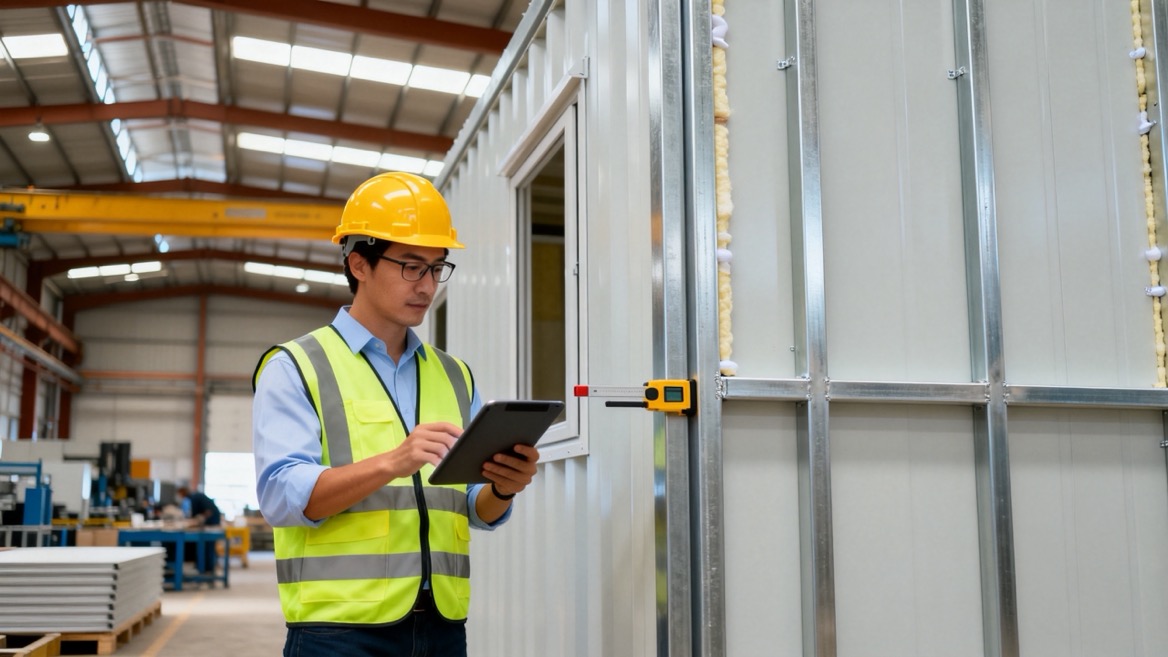
One of the most common but rarely discussed risks in pre fab container homes sourcing is not an obvious defect. It is specification drift between the approved sample and the bulk order.
A supplier may show a sample unit with thicker steel, higher-density insulation, better flooring, branded hardware, upgraded windows, and more careful finishing. The bulk production order may then use a less expensive equivalent unless every critical component is locked into the signed technical annex.
This can happen even with otherwise capable factories because container-house quotations contain many cost-sensitive components:
- Steel thickness.
- Coating or galvanization level.
- Panel core and density.
- Floor-board grade.
- Door and window profile thickness.
- Electrical cable gauge.
- Fastener grade.
- Sealant brand.
- Bathroom fixtures.
- Furniture boards.
- Packaging materials.
- Spare-parts quantity.
1. Approve a signed bill of materials, not only a sample photo.
2. Add tolerance limits for steel thickness, panel thickness, and insulation density.
3. Require a pre-production sample if the product is customized.
4. Conduct an in-production inspection before the factory completes all units.
5. Use a third-party inspector for critical orders.
6. Require batch-level material records for steel and panels where appropriate.
7. State that no substitutions are allowed without written buyer approval.
8. Include packing, labeling, and container-loading requirements in the purchase order.
A detailed technical annex can prevent more disputes than a long warranty clause.
Ask for:
- Business license.
- Company legal name in Chinese and English.
- Factory address.
- Export license or trading arrangement.
- Bank-account name matching the contract entity.
- Factory photos and production-line videos.
- Recent container-loading photos.
- Major equipment list.
- Organization chart for engineering, QC, sales, and after-sales functions.
A trading company is not automatically a problem, but buyers should know whether they are dealing directly with the actual manufacturer. If a trading company manages the order, require clear disclosure of the factory name and confirm who is responsible for warranty, replacement parts, technical support, and quality claims.
Before deposit payment, request:
- General arrangement drawing.
- Structural drawing.
- Electrical layout.
- Plumbing layout.
- Bill of materials.
- Material samples.
- Color chart.
- Installation manual.
- Packing list.
- Container-loading plan.
- Foundation requirements.
- Warranty terms.
- Spare-parts list.
For substantial projects, ask the supplier to mark every drawing revision with a revision number and date. This prevents confusion when different teams use outdated versions.
A serious factory should be able to explain its controls at each stage:
| Production Stage | Recommended Check |
|---|---|
| Incoming materials | Steel thickness, panel condition, hardware count, insulation type |
| Frame fabrication | Dimensions, weld quality, diagonal accuracy, surface preparation |
| Coating | Paint coverage, coating uniformity, corrosion-prone edges |
| Panel installation | Alignment, sealant application, joint tightness, fastener spacing |
| Electrical work | Cable labeling, grounding, breaker specification, functional test |
| Plumbing work | Leak test, drainage test, water inlet/outlet position |
| Final inspection | Door/window operation, roof drainage, dimensions, accessories |
| Packing and loading | Component count, protective wrapping, labels, loading sequence |
For new suppliers, the safest approach is usually:
- One sample unit or pilot batch.
- Independent inspection.
- Installation trial.
- Packaging review.
- Container-loading review.
- Feedback from the local installation team.
- Revised drawings before the larger order.
A pilot order may cost more per unit, but it can prevent a costly full-container problem, site delay, or warranty dispute.
The figures below are directional sourcing indicators based on publicly stated information. Buyers should confirm all capacity, minimum-order quantity, certificate scope, and current validity directly with each manufacturer before purchasing.
| Manufacturer | Stated Capacity or Scale | Typical MOQ Expectation | Publicly Stated Certification Signals | Procurement Strength |
|---|---|---|---|---|
| Welons Prefab | 300 units/day | Discuss by product and customization level | International standard compliance claimed; verify documents | Flexible OEM, full-cycle support, mixed modular applications |
| GS Housing | 70,000+ units/year; 8 automated lines | Often suited to project-volume orders | CE, ISO, SGS stated | Large modular camps and formal projects |
| Wellcamp | 20,000+ m²; three production lines | Often negotiable by product category | ISO, CE, UL, ASTM, BV, SGS stated | Folding houses and export-standard camp solutions |
| Lida Group | Multi-subsidiary engineering group; multiple production lines | Better suited to medium and large projects | ISO 9001, ISO 14001, OHSAS 18001, CE, SGS stated | Camps, steel structures, integrated project delivery |
| K-Home | 100,000 m²; 260 employees stated | Suitable for standard containers and project orders | CE EN 1090, ISO 9001:2015 stated | Accommodation, site offices, schools and dormitories |
| CBOX | 500+ sets/day; 200,000/year claimed | Often suitable for larger standard orders | Request current project-specific proof | High-volume flat-pack and modular units |
| Shanghe / Yichen | Scale not independently confirmed in this review | Often more flexible for cabins and custom models | ISO-system and CE-standard claims | Apple cabins, expandable homes and customized designs |
| Project-oriented suppliers | Varies substantially | Commonly project-based | Varies by company and product | EPC, camps, institutional procurement |
The shipping method has a major effect on landed cost, damage risk, customs documentation, and installation speed.
Flat-pack units are disassembled or partially disassembled for transport. Their main advantage is improved container utilization. Buyers should calculate how many units can fit in a 20-foot or 40-foot container after including doors, windows, hardware, furniture, and accessories.
Key questions:
- How many units fit per container?
- Are components packed in steel frames, plywood crates, or protective wrapping?
- Are screws and hardware packed by unit, building, or shipment?
- Is every component labeled to match the installation drawing?
- Are fragile items protected from steel-on-glass contact?
- Are spare parts included?
- Can the supplier provide a loading diagram and unloading sequence?
Folding units can reduce on-site assembly time, but buyers should assess:
- Crane or forklift requirements.
- Hinge and fold-line protection during shipping.
- Roof drainage after deployment.
- Panel damage risk during repeated folding.
- Whether the unit can be transported after assembly.
- Local road-width and delivery-access constraints.
Expandable homes can offer fast deployment but require careful shipping planning. Buyers should verify external dimensions in both folded and expanded positions, lifting points, trailer requirements, site access, and clearance for opening the side sections.
Before ordering, confirm:
- HS code with a qualified customs broker.
- Import duties and taxes.
- Local building permits.
- Fire and electrical rules.
- Required structural calculations.
- Quarantine or timber-packaging requirements.
- ISPM-15 requirements for wooden packaging.
- Labeling rules.
- Documentation required for utility connections.
The supplier may provide support documents, but the buyer remains responsible for ensuring local regulatory compliance.
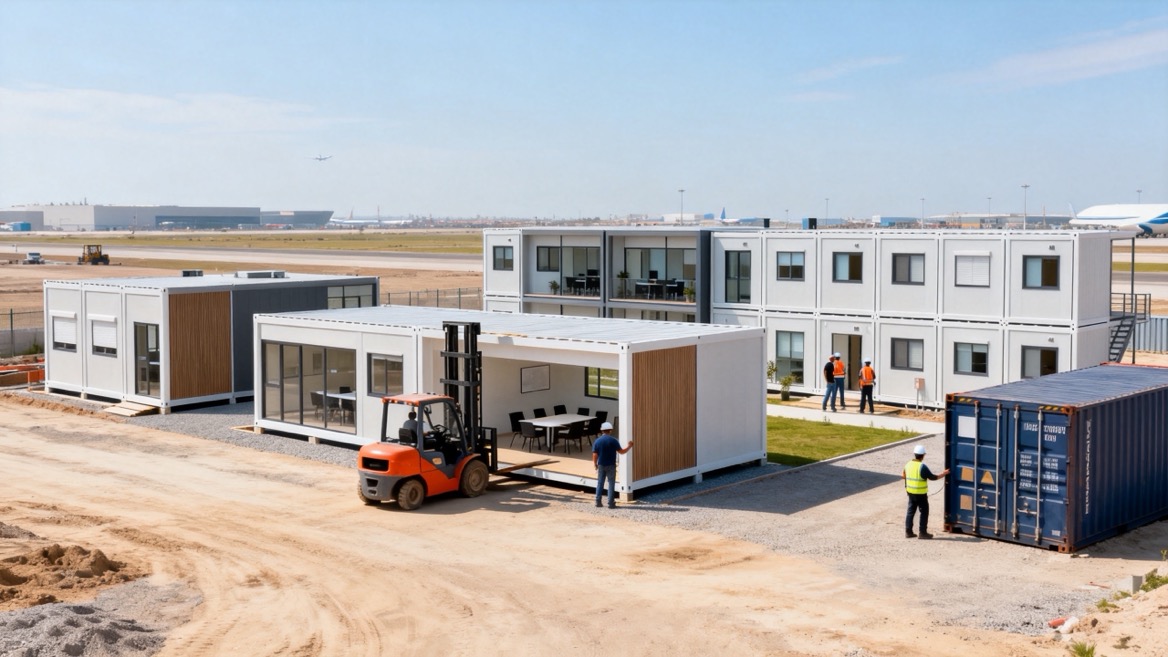
China offers a broad supplier base for pre fab container homes, from flexible OEM factories to high-volume modular-building groups. The strongest sourcing result comes from matching the supplier to the project rather than choosing the lowest initial quotation.
For a distributor, contractor, developer, or procurement team, the right manufacturer should demonstrate stable production, clear engineering documentation, transparent material specifications, controllable lead times, responsive communication, and a workable plan for inspection, loading, installation, and after-sales support.
Welons Prefab is a practical option for buyers seeking a China-based manufacturer that combines standard modular products with flexible customization, OEM support, project communication, and full-cycle service. With stated capacity of 300 units per day and a product range covering prefab container homes, fast-assembly units, panels, mobile facilities, and customized steel structures, it can be considered for both standardized procurement and tailored modular-building projects.
For your next container-home sourcing project, prepare a project brief covering destination country, intended use, quantity, dimensions, occupancy, climate conditions, wind and snow loads, electrical standard, plumbing requirements, interior level, target budget, delivery deadline, and required documentation. A detailed brief will produce more accurate quotations and reduce costly specification changes later.
Ask for the full certificate, not a cropped image. Check the certificate number, issue date, expiry date, certification body, company legal name, and certified scope. Then search the issuing certification body's public database or contact it directly. Confirm that the certified legal entity is the same company signing your contract and receiving payment.
No. CE-related documentation may apply to specific construction products or systems, but it does not automatically guarantee that a complete container home meets every local requirement for planning permission, foundation design, fire performance, energy efficiency, electrical installation, accessibility, or residential occupancy. Consult a local architect, engineer, building-control authority, or compliance specialist.
Create a single comparison sheet with identical specifications. Compare frame thickness, steel grade, corrosion protection, panel core, insulation density, floor structure, window type, door type, electrical system, plumbing, bathroom fixtures, furniture, packaging, freight terms, warranty, spare parts, and installation support. Do not compare only total price or price per square meter.
The inspection should cover dimensions, steel thickness where accessible, weld quality, coating condition, panel thickness, insulation type, doors, windows, waterproofing, electrical components, plumbing connections, accessories, labeling, packaging, and loading readiness. For a large order, conduct both an in-production inspection and a final random inspection before shipment.
Ask: "Can you provide a signed technical specification and bill of materials that will become part of the purchase contract?" This single document should identify the materials, dimensions, tolerances, fixtures, components, finish standards, approved drawings, testing requirements, packing method, and permitted substitutions. If a supplier cannot provide it, the risk of bulk-order variation is high.
- [China General Administration of Customs]
- [Ministry of Housing and Urban-Rural Development of the People's Republic of China]
- [China Association for Engineering Construction Standardization]
- [International Organization for Standardization]
- [European Commission: CE Marking]


