
Views: 220 Author: Welons Prefab Houses Publish Time: 2026-09-15 Origin: Site


Content Menu
● Outdoor Kitchen for Luxury Campsites
>> Why Outdoor Kitchens Create a Premium Experience
>> Essential Components of a Luxury Campsite Outdoor Kitchen
>> Suitable Luxury Campsite Applications
● Traditional Outdoor Cooking Station
>> The Strength of a Simpler Setup
>> Typical Traditional Cooking Station Features
>> Where Traditional Stations Fall Short
● Outdoor Kitchen vs Traditional Cooking Station: Cost and Return
● Safety, Hygiene, and Durability
>> Materials That Perform Outdoors
● The Hybrid Model: Often the Best Choice
>> Example Layout for a 20-Unit Glamping Site
● How to Choose the Right Option
>> Choose an Outdoor Kitchen When
>> Choose a Traditional Cooking Station When
>> Choose a Hybrid System When
● Design Checklist Before Ordering
● FAQ
>> 1. Is an outdoor kitchen worth it for a luxury glamping site?
>> 2. What should a luxury campsite outdoor kitchen include?
>> 3. Are traditional outdoor cooking stations cheaper than outdoor kitchens?
>> 4. Can a prefab container building support an outdoor kitchen?
>> 5. Which materials are best for an outdoor kitchen in a campsite?
>> 6. Do outdoor kitchens require special safety planning?
>> 7. Should each luxury campsite unit have a private kitchen?
For luxury campsites, the choice between an outdoor kitchen and a traditional outdoor cooking station is no longer just about where guests grill dinner. It influences guest satisfaction, booking value, operational workload, safety planning, brand positioning, and the long-term flexibility of the campsite.
As a manufacturer working with modular buildings, prefabricated accommodation projects, camp facilities, staff spaces, dining modules, and customized site infrastructure, we have seen a clear shift: premium glamping guests increasingly expect an outdoor experience without giving up practical comfort. A well-designed outdoor kitchen for luxury campsites can turn a standard stay into a memorable, shareable, higher-value experience. However, a traditional outdoor cooking station still has important advantages for low-maintenance, nature-focused, and budget-sensitive developments.
This guide compares the two options in detail and helps campsite owners, resort developers, glamping operators, architects, and procurement teams select the right solution for their project.
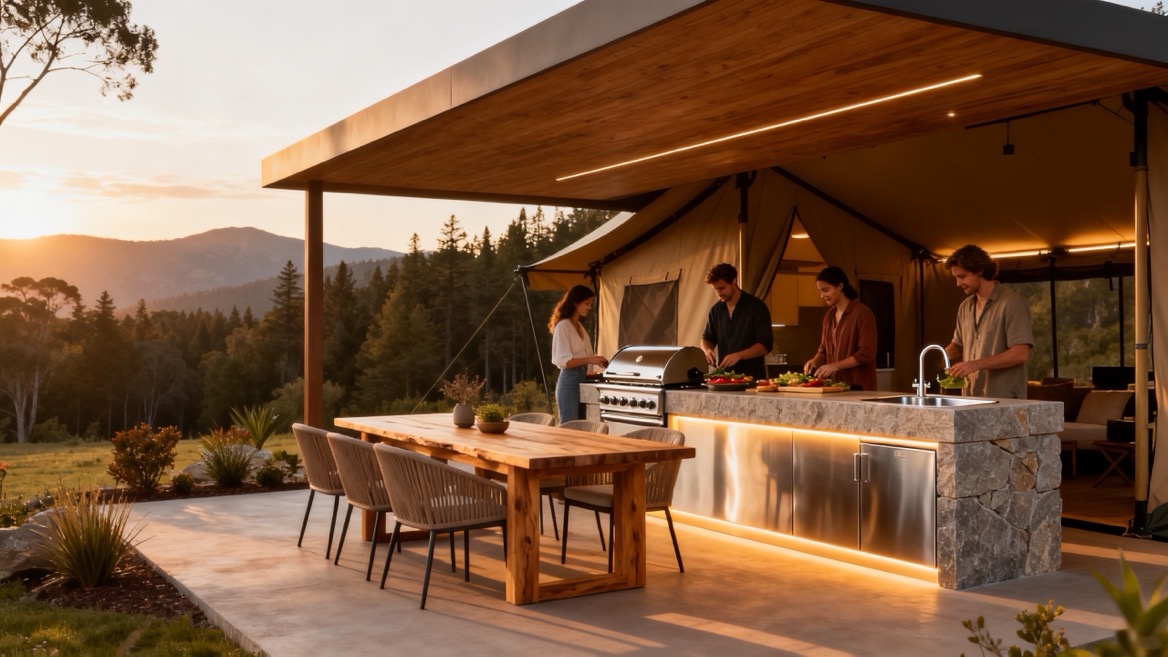
An outdoor kitchen is a dedicated cooking and food-preparation area. It may include worktops, a sink, storage cabinets, refrigeration, electricity, water supply, lighting, a gas or electric cooktop, grill, ventilation, and seating or serving zones.
A traditional outdoor cooking station is usually a simpler cooking point. It may include a barbecue grill, fire pit, charcoal grill, gas burner, picnic table, basic utensil hooks, and sometimes a small counter. Its purpose is direct outdoor cooking rather than full meal preparation.
The difference is not only about equipment. It is about the guest journey.
A luxury campsite outdoor kitchen supports a complete experience:
- Preparing breakfast, lunch, and dinner
- Washing vegetables and tableware
- Storing food and cold drinks
- Hosting family meals or group gatherings
- Using the space in different weather conditions
- Creating a premium hospitality atmosphere
A traditional camping cooking station supports a simpler experience:
- Grilling meat, vegetables, or seafood
- Making coffee or simple meals
- Gathering around a fire
- Enjoying a more rustic camping feeling
- Reducing site infrastructure requirements
For luxury glamping projects, the decision should reflect the property's target customer, climate, service model, accommodation type, local regulations, and available utility connections.
| Comparison Factor | Outdoor Kitchen | Traditional Outdoor Cooking Station |
|---|---|---|
| Guest experience | High-comfort, home-like, premium | Rustic, simple, activity-focused |
| Cooking capability | Full meal preparation | Basic grilling and open-fire cooking |
| Typical equipment | Sink, counter, cabinets, fridge, grill, lighting, power | Grill, fire pit, simple counter, picnic table |
| Initial investment | Higher | Lower |
| Daily maintenance | Moderate to high | Low to moderate |
| Water and power needs | Usually required | Often limited or optional |
| Weather resilience | Can be designed for year-round use | More exposed to weather |
| Best for | Luxury glamping, family resorts, group retreats, long stays | Eco-camps, adventure camps, seasonal sites |
| Revenue positioning | Supports premium rates and add-on packages | Supports value and authentic outdoor appeal |
| Customization potential | Very high | Moderate |
| Site footprint | Larger | Smaller |
| Food safety control | Easier with sink, surfaces, storage, and lighting | More limited |
| Brand impression | Upscale hospitality infrastructure | Traditional outdoor recreation |
The best solution is not automatically the most expensive one. It is the one that provides the right balance between guest expectations, operations, investment, and site identity.
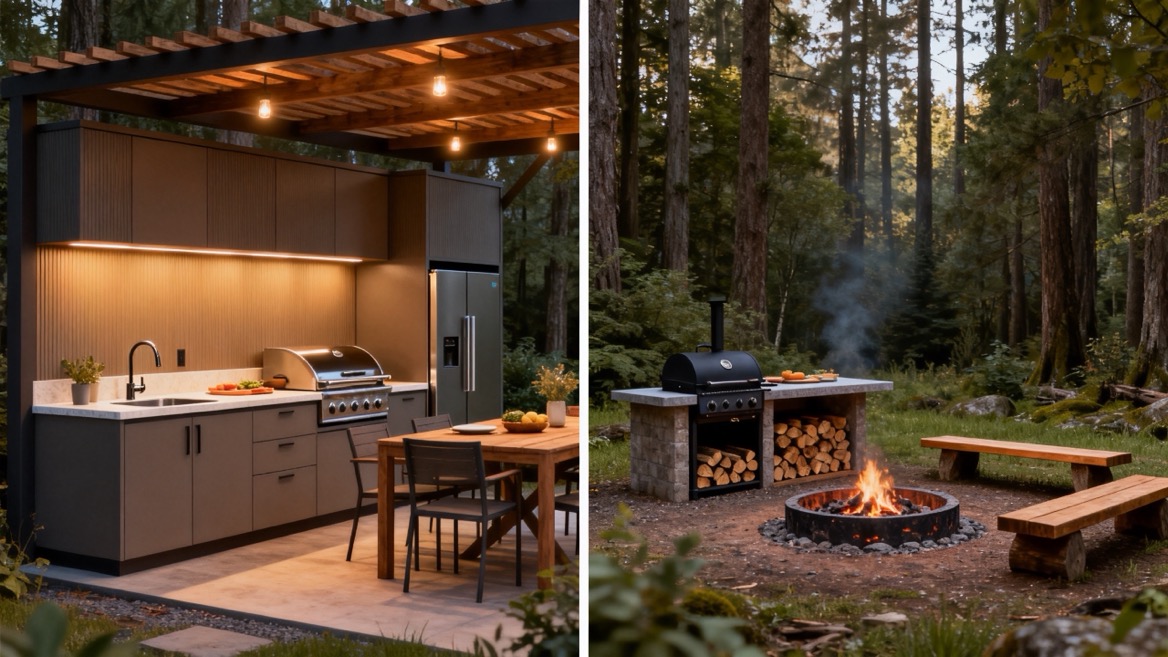
An outdoor kitchen gives guests more than a grill. It gives them independence.
Many luxury camping guests travel with partners, children, friends, or extended family. They may want to prepare breakfast before hiking, cook fresh local ingredients after visiting a market, organize a barbecue at sunset, or host a small celebration without leaving the campsite.
A complete outdoor kitchen makes these moments easier.
For a luxury campsite, convenience often becomes a visible part of the product value. Guests may be willing to pay more for a private deck, outdoor bath, high-quality bedding, climate control, and a functional cooking area because these features reduce friction during the stay.
Recent outdoor-hospitality data also indicates a stronger focus on higher-value accommodation and quality-driven stays. RoverPass reported that glamping grew 43.6% in 2025, making it the platform's fastest-growing accommodation type, even while total reservations declined and revenue reached a record high. This suggests that travelers are increasingly selecting differentiated experiences rather than simply choosing the lowest-cost campsite.
A high-quality outdoor kitchen does not need to be excessively large. It needs to be logical, durable, safe, and easy to clean.
A practical configuration may include:
- Weather-resistant worktop for food preparation
- Stainless-steel sink with clean-water and drainage connections
- Lockable storage cabinets for cookware and cleaning supplies
- Gas grill, electric grill, induction unit, or cooktop
- Mini refrigerator for drinks, fresh ingredients, and breakfast supplies
- Outdoor-rated sockets for small appliances and charging
- Task lighting over the cooking and wash-up areas
- Ambient lighting for evening dining
- Dining counter or serving bar
- Waste-sorting station for recyclable, food, and general waste
- Shelter roof, pergola, or canopy for sun and rain protection
- Fire extinguisher and clear emergency shutoff access
For a family glamping unit, the kitchen can be compact and private. For a shared campsite facility, the design may include multiple preparation stations, larger storage capacity, a washing zone, communal tables, and a covered dining pavilion.
The strongest outdoor kitchen designs follow the natural order of cooking.
1. Guests arrive with ingredients.
2. They place cold items in the refrigerator.
3. They wash produce at the sink.
4. They prepare food on the counter.
5. They cook using the grill or cooktop.
6. They serve meals at the adjacent dining table.
7. They wash dishes and dispose of waste in a clear, hygienic system.
This seems simple, but poor layout creates frustration. If guests must walk across a deck with raw food, search for a socket, carry water from another building, or wash dishes in a distant public restroom, the experience quickly feels less luxurious.
A prefabricated kitchen module can help solve this issue because electrical wiring, plumbing routes, cabinets, countertops, lighting, and appliance positions can be coordinated before delivery. This reduces site installation complexity and creates a more predictable construction schedule.
An outdoor kitchen is particularly suitable for:
- Private glamping tents and safari tents
- Prefab container cabins
- Family camping suites
- Luxury dome resorts
- Eco-lodges with private decks
- RV resorts with premium rental units
- Lakeside and beach resorts
- Vineyard accommodation projects
- Forest retreats
- Corporate retreat camps
- Long-stay worker accommodation parks
- Boutique hospitality developments
For modular accommodation projects, an outdoor kitchen can also be attached to a prefab container auxiliary building. For example, a container module may serve as a compact indoor support room, while a covered outdoor kitchen expands the usable hospitality area without requiring a large permanent conventional building.
A traditional outdoor cooking station should not be viewed as an inferior choice. In the right project, it can be the most authentic and commercially sensible solution.
Many travelers still want a genuine camping experience. They may prefer cooking over charcoal, gathering near a fire pit, and spending less time in a kitchen-like environment. A simple station can reinforce the feeling of being outdoors.
The traditional approach can also preserve visual openness. Instead of adding cabinets, appliances, plumbing lines, and roof structures, a campsite can use a fire ring, grill stand, timber table, wood storage, and carefully designed seating to create a natural social space.
This is especially effective for campsites that emphasize:
- Wilderness and outdoor adventure
- Minimal-impact tourism
- Seasonal operation
- Tent camping
- Youth groups
- Short stays
- Backpacking and hiking routes
- Lower-price accommodation
- Remote sites with limited utilities
A standard outdoor cooking station may include:
- Charcoal grill or gas barbecue
- Fire pit or designated campfire ring
- Grill grate
- Firewood storage
- Small prep shelf
- Picnic bench or outdoor table
- Waste bin
- Water point nearby
- Simple lighting
- Basic safety signage
- Fire extinguisher where required
The cost is lower because the system usually needs fewer built-in utilities. It can also be easier to repair, relocate, replace, or expand.
For remote campsites, this flexibility is valuable. If a site has limited power, no permanent plumbing, or restricted vehicle access, a traditional cooking station can offer an attractive solution without requiring extensive infrastructure work.
The main limitation is that simple cooking stations depend heavily on weather, guest skill, and shared facilities.
A rainy evening, strong wind, poor lighting, lack of counter space, or no accessible water point can turn cooking into a frustrating activity. This may not matter to experienced campers, but it can affect luxury travelers who expect comfort and convenience.
Traditional stations also create more variation in guest behavior. One group may clean the grill carefully, while another may leave ash, grease, packaging, or food waste behind. This creates cleaning and operational challenges.
Where commercial-scale food service is involved, cooking equipment that produces grease-laden vapors may require specialized ventilation and fire-protection measures. The exact obligations depend on local codes and the authority having jurisdiction, so operators should confirm requirements before selecting appliances or finalizing a layout.
A traditional station is usually more affordable at the beginning. It requires fewer materials, less utility work, and faster installation.
An outdoor kitchen has higher upfront cost because it may involve:
- Water supply and drainage
- Electrical installation
- Gas piping or appliance connections
- Countertops and cabinets
- Refrigeration
- Roof or canopy structures
- Higher-grade flooring
- Lighting and weatherproof components
- Fire and safety equipment
However, upfront cost should not be the only decision factor.
A premium outdoor kitchen can support higher nightly rates, longer stays, family bookings, group bookings, meal packages, local-produce partnerships, and better online presentation. It can also reduce pressure on a central communal kitchen or restaurant.
Outdoor kitchens need more regular attention. Staff may need to inspect appliances, sanitize worktops, check drainage, restock supplies, remove food waste, and maintain refrigeration equipment.
Traditional stations have lower equipment costs but may create higher cleaning variability, especially if guests use charcoal, wood, open flames, or shared grills.
The most effective strategy is often to standardize the cleaning process.
For example:
- Inspect gas connections before each operating period
- Clean grill surfaces after every checkout
- Remove grease and ash safely
- Check lighting and sockets weekly
- Record appliance maintenance
- Keep emergency shutoffs visible
- Train staff on fuel isolation and emergency response
Fire authorities commonly stress the importance of properly secured propane systems, leak checks, adequate ventilation, clear exits, and suitable extinguishers for mobile or outdoor food-preparation setups.
An outdoor kitchen can create direct and indirect revenue opportunities:
- Premium accommodation category
- Private barbecue package
- Local ingredient basket
- Chef-led outdoor dining event
- Family holiday package
- Group retreat meal package
- Long-stay guest upgrade
- Branded cooking class
- Private event rental
A traditional cooking station can still support revenue, especially when presented as a curated outdoor experience. A campsite can sell firewood bundles, grill kits, charcoal packs, local sausages, seafood boxes, vegetarian barbecue baskets, marshmallow kits, and guided campfire evenings.
The key difference is positioning.
An outdoor kitchen sells comfort and self-sufficiency.
A traditional station sells simplicity and atmosphere.
Cooking facilities must be planned around local building, fire, health, gas, and electrical requirements. This is particularly important for luxury campsites because premium accommodation often places decks, furniture, textiles, landscaping, and guest circulation areas close to cooking zones.
A responsible design should consider:
- Separation from tents, cabins, walls, and combustible materials
- Clear paths to exits
- Safe propane cylinder location
- Accessible emergency shutoff valves
- Non-combustible surfaces around heat-producing appliances
- Fire extinguishers suited to the cooking equipment
- Clear operating instructions
- Good lighting for nighttime use
- Routine inspection plans
The National Fire Protection Association advises that propane and charcoal grills should be used outdoors and positioned away from homes, railings, and overhanging branches.
For any project serving food commercially or operating high-output cooking equipment, obtain project-specific advice from qualified local professionals before construction. A beautiful outdoor kitchen is not successful if it creates avoidable operational or compliance risk.
Luxury does not mean fragile.
For outdoor kitchens and traditional cooking stations, prioritize materials that resist moisture, heat, ultraviolet exposure, grease, impact, and frequent cleaning.
Recommended material choices include:
- Powder-coated galvanized steel for frames and cabinets
- Stainless steel for sinks, counters, and food-contact zones
- Fiber-cement board or non-combustible cladding near heat sources
- Aluminum for lightweight weather-resistant elements
- Composite decking for selected deck areas
- Porcelain or sintered-stone worktops for high-end finishes
- Treated timber for non-heat-exposed decorative elements
- Marine-grade hardware for coastal or humid environments
Avoid designing around appearance alone. A timber countertop may look attractive on opening day, but may require more maintenance than stainless steel or engineered stone in wet, high-use environments.
For many luxury campsites, the strongest answer is not choosing one option exclusively. It is creating a hybrid outdoor cooking concept.
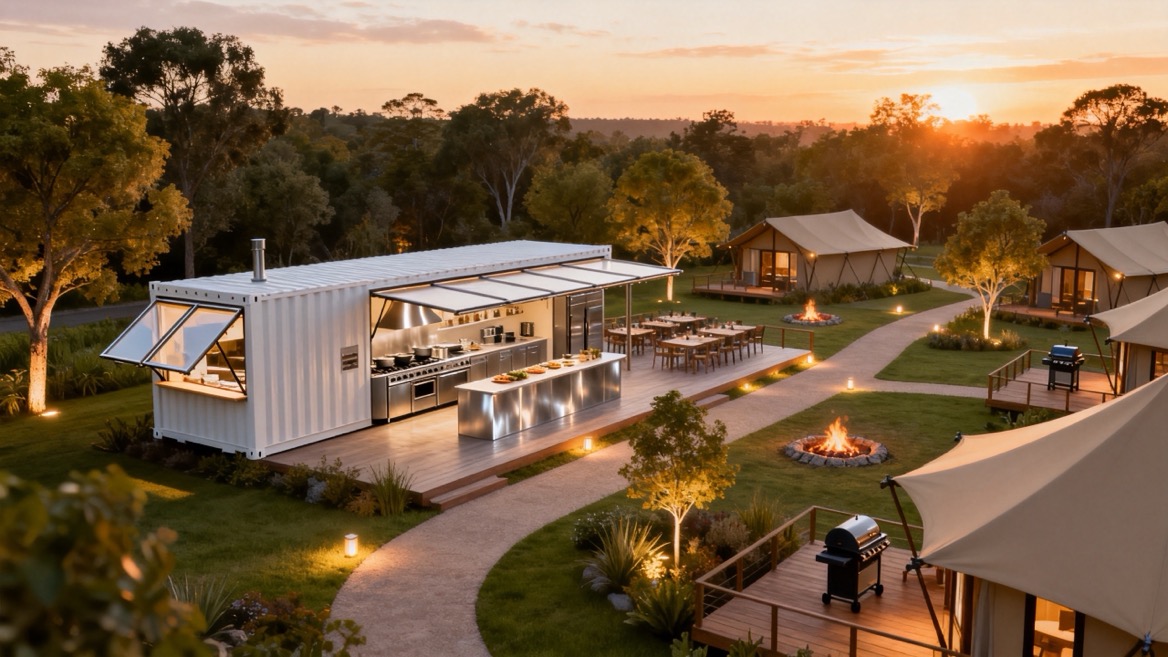
A hybrid model can include a private grill and fire pit at each accommodation unit, supported by a larger shared outdoor kitchen and dining pavilion.
This approach gives guests choice.
They can cook casually at their own cabin, enjoy a campfire at night, or use a better-equipped communal kitchen when preparing a full meal. It also allows the operator to centralize water, refrigeration, waste handling, cleaning, and safety systems.
A practical layout could include:
- 20 private outdoor grilling points
- 20 compact fire pits or controlled fire bowls
- 1 shared covered outdoor kitchen pavilion
- 4 food-preparation counters
- 2 washing sinks
- 2 refrigerators or cold-storage zones
- 1 accessible cooking station
- 1 central dining terrace
- 1 waste-sorting and cleaning zone
- 1 lockable staff storage room
- 1 prefab service module for electrical, plumbing, and equipment storage
This model supports privacy while keeping the project operationally manageable.
For modular construction projects, a prefabricated service building can be used as the back-of-house core. It can contain equipment storage, electrical controls, water management components, cleaning supplies, staff changing space, and food-service support areas. This can reduce on-site construction time and make later expansion more efficient.
Use the following questions before selecting an outdoor kitchen or traditional cooking station.
- Your campsite targets premium or luxury travelers
- Guests commonly stay for multiple nights
- Families and groups are core customer segments
- You want to support meal packages or local-food experiences
- Your site has stable access to water, drainage, and electricity
- Weather protection is important
- You want stronger visual content for booking platforms and social media
- You operate cabins, domes, container homes, or high-end tents
- You want to increase perceived accommodation value
- Your brand focuses on authentic camping or wilderness experiences
- The site has limited utilities
- Your guests primarily take short stays
- You need a lower initial investment
- You operate seasonally
- You want simple maintenance
- Your property has strict environmental or visual-impact limits
- Guests bring their own camping equipment
- Your business model prioritizes affordability and high turnover
- You serve several guest types
- You have both premium cabins and standard tent sites
- You want to create upgrade opportunities
- You need both privacy and centralized maintenance
- You plan phased project development
- You want to expand accommodation capacity over time
Before sourcing an outdoor kitchen module, container auxiliary building, or campsite cooking facility, prepare the following information.
1. Target guest profile
Define whether you serve couples, families, luxury travelers, group retreats, corporate events, or budget campers.
2. Expected occupancy
Calculate how many guests may cook at the same time during peak periods.
3. Site utilities
Confirm electricity capacity, water pressure, drainage routes, gas availability, and wastewater treatment requirements.
4. Local climate
Consider rain, snow, wind, coastal salt exposure, high humidity, strong sunlight, and seasonal temperatures.
5. Operating model
Decide whether the kitchen is private, shared, staff-managed, self-service, or part of a food-service program.
6. Cleaning plan
Establish who cleans grills, counters, sinks, waste areas, and refrigeration equipment after each guest departure.
7. Safety requirements
Consult qualified local professionals on appliance clearances, fire protection, gas systems, electrical requirements, accessibility, and food-service rules.
8. Future expansion
Choose modular layouts that can add more stations, storage, dining cover, or service capacity as occupancy grows.
For most luxury campsites, a well-planned outdoor kitchen offers stronger long-term value than a basic traditional outdoor cooking station. It supports comfort, private dining, family travel, longer stays, and premium brand perception.
However, traditional cooking stations remain highly effective when a site's appeal depends on simplicity, low environmental impact, rustic atmosphere, or limited utilities.
The smartest solution for many operators is a hybrid approach: provide private grills or fire features for atmosphere, then support them with a durable shared outdoor kitchen module for full meal preparation, sanitation, storage, and all-weather usability.
Welons Prefab can help turn this concept into a scalable hospitality solution. With experience in prefab container auxiliary buildings, modular accommodation facilities, staff buildings, dining areas, storage facilities, offices, exhibition spaces, and industrial structures, we can support customized layouts for luxury campsites, glamping resorts, eco-lodges, and outdoor hospitality projects. From OEM and wholesale requirements to one-stop modular planning, our daily production capacity of 300 units supports flexible delivery for projects of different sizes.
Contact Welons Prefab today to discuss your luxury campsite outdoor kitchen, modular dining pavilion, container service building, or customized glamping support facility.
Yes, especially for sites targeting families, couples, groups, and multi-night guests. An outdoor kitchen improves convenience, supports private dining, and can strengthen premium accommodation positioning. It is most valuable when it is durable, easy to clean, and designed around the actual guest workflow.
A practical luxury outdoor kitchen should include a food-preparation counter, sink, storage, grill or cooktop, lighting, weather-resistant materials, waste management, and safe access to power and water. Refrigeration, seating, and weather shelter are also valuable additions for premium projects.
Yes. Traditional stations generally cost less because they use fewer utilities and less built-in equipment. However, they may offer fewer opportunities for premium pricing, group dining, long-stay bookings, and all-weather use.
Yes. A prefab container auxiliary building can serve as a back-of-house support module for storage, refrigeration, electrical controls, water systems, staff facilities, cleaning supplies, and food-service equipment. It can be combined with a covered outdoor cooking and dining space.
Stainless steel, powder-coated galvanized steel, aluminum, non-combustible cladding, porcelain worktops, and weather-resistant hardware are widely suitable choices. The best combination depends on climate, maintenance capacity, cooking equipment, and the required design style.
Yes. Operators should evaluate fire separation, ventilation, fuel storage, electrical protection, emergency shutoffs, lighting, appliance placement, cleaning routines, and local approval requirements. Projects involving grease-producing commercial equipment may require more advanced ventilation and fire-protection measures.
Not always. Private kitchens are ideal for high-end cabins, large safari tents, family units, and premium glamping suites. For larger sites, a shared kitchen pavilion combined with private grills or fire pits can provide a better balance between investment, guest experience, and daily maintenance.
1. [RoverPass — 2026 Outdoor Hospitality Report: The Quality Shift]
2. [Maine Office of State Fire Marshal — Provisions for Food Service Operations]
3. [NBC16 — NFPA Safety Tips for Grilling Season]
4. [US Made Supply — NFPA 96 Kitchen Hood, Grease Duct and Exhaust Standard]
5. [City of Monroe, Ohio — Food Truck Inspections]
6. [Minooka Fire Protection District — Food Trucks Safety Guidance]
7. [Camping Business — 2025 State of Outdoor Hospitality Report]


