
Views: 248 Author: Welons Prefab Houses Publish Time: 2026-09-29 Origin: Site


Content Menu
● What Is the Difference Between an Outdoor Kitchen and a Mobile Outdoor Kitchen?
● Outdoor Kitchen vs Mobile Outdoor Kitchen: Side-by-Side Comparison
● When Does a Venue-Based Outdoor Kitchen Make More Sense?
>> Frequent events at the same location
>> A stronger connection to the venue experience
>> The main limitation: commitment to one site
● When Is a Mobile Outdoor Kitchen the Better Choice?
>> Catering takes place at changing venues
>> A repeatable service format
>> The main limitation: every event is a new site
● Which Kitchen Is Better for Food Safety and Workflow?
>> Try a peak-service walk-through
● How Should You Compare the Total Cost?
● What Should Be in Your Kitchen Project Brief?
● Where Can a Prefab Kitchen Unit Fit?
>> Is a mobile outdoor kitchen the same as a food truck?
>> Can a prefab unit be used as an event kitchen?
>> Which is cheaper: an outdoor kitchen or a mobile outdoor kitchen?
>> Does a mobile kitchen remove the need for permits?
>> What information should I send a prefab kitchen supplier?
>> Can one kitchen handle both intimate events and large crowds?
An outdoor kitchen can turn one venue into a dependable event-catering space. A mobile outdoor kitchen takes the cooking setup to different venues. Both can support memorable food service, but they solve different operational problems. The right choice depends on where you cater, how often you operate, what you cook, and what each site can safely accommodate.
For event organizers and catering businesses, the decision goes well beyond whether a kitchen looks permanent or portable. Staff need room to work. Deliveries need a clear route. Food needs appropriate storage and handling. Water, wastewater, power, ventilation, and fire protection must suit the menu and location. This guide compares the two options from planning through long-term use, including where a relocatable prefab kitchen may fit.
A venue-based outdoor kitchen is a cooking and preparation area installed at one site for repeated use. It may be an open-air cooking station, a sheltered service kitchen, or an enclosed prefab unit beside an event space. Its main advantage is that the layout and supporting services can be planned around a known location.
A mobile outdoor kitchen is designed to move between event sites. It may take the form of a catering trailer, food truck, or transportable kitchen unit. Its main advantage is that a caterer can bring a familiar setup to different customers instead of depending entirely on each venue's facilities.
There is a third possibility. A relocatable prefab kitchen can be delivered to a site, used for a season or series of events, and moved later. That does not necessarily make it a routinely mobile food operation. The distinction matters when planning transport, installation, and operating approvals.
Neither option is automatically suitable for every menu. A compact mobile unit used for reheating and final plating has different requirements from a kitchen preparing raw ingredients and cooking full meals. Start with the work the team must perform, then select the structure around it.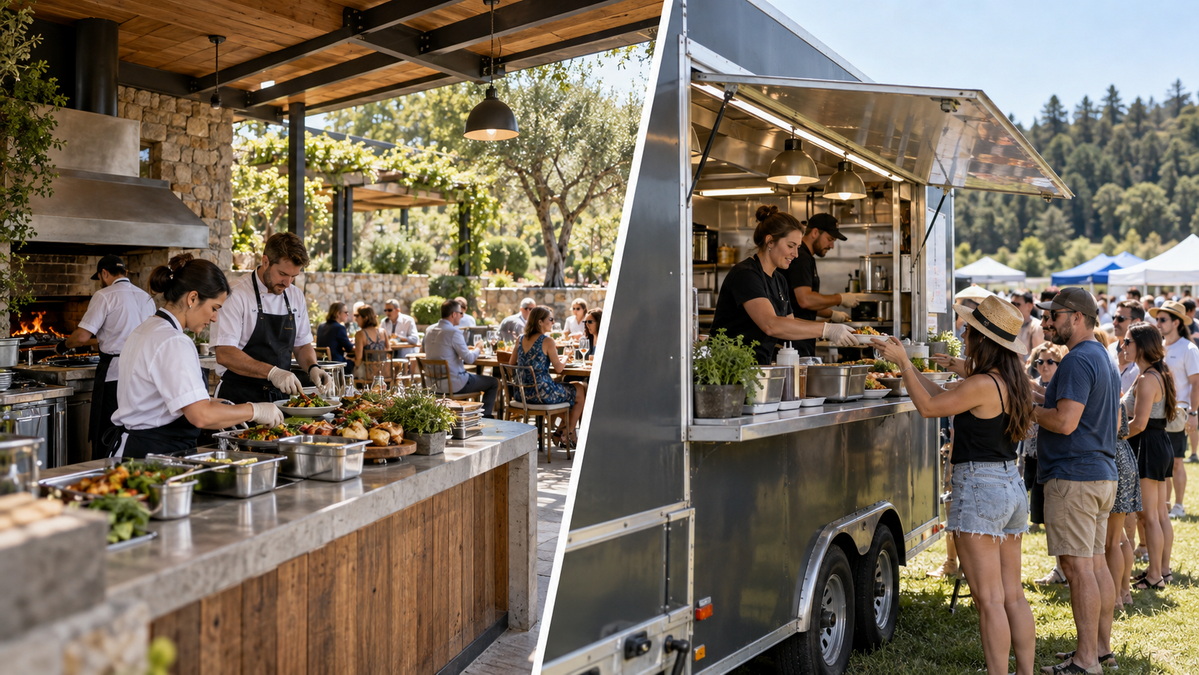
| Planning factor | Venue-based outdoor kitchen | Mobile outdoor kitchen |
|---|---|---|
| Best use | Regular events at one location | Catering across multiple locations |
| Setup pattern | Installed once and reused | Delivered, positioned, and prepared for each event |
| Layout | Can be tailored to a known site and recurring service style | Must balance usable workspace with transport needs |
| Utilities | May connect to planned site services | Requires suitable services or a properly designed self-contained setup |
| Transport | Limited after installation | A recurring operational consideration |
| Weather planning | Shelter can be designed for local conditions | Conditions must be assessed at each destination |
| Branding | Can become part of a venue's identity | Can present a consistent brand at different venues |
| Main risk | Investing in a layout that may not suit future events | Assuming a unit will work at every site without checking access and services |
The table highlights the central trade-off: consistency at one site versus flexibility across sites. In practice, the best solution may combine both. A caterer might use a permanent kitchen at its primary venue and a mobile or relocatable unit for off-site work.
A venue-based kitchen becomes more useful when events return to the same property. Examples include a resort lawn, exhibition venue, outdoor dining destination, or company campus that regularly hosts visitors. Because the site is familiar, the operator can refine a repeatable process for deliveries, preparation, cooking, plating, service, and cleaning.
This is particularly valuable during busy service periods. Staff should not have to carry finished plates across a delivery route or move waste through a guest queue. When the kitchen is planned for one site, the operator can place work zones in relation to the actual entrance, dining area, storage space, and service point.
A fixed or semi-permanent kitchen may also support a wider range of equipment than a compact mobile unit. That does not mean it should be filled with appliances from the outset. The menu and expected volume should determine the equipment schedule, not the available floor area.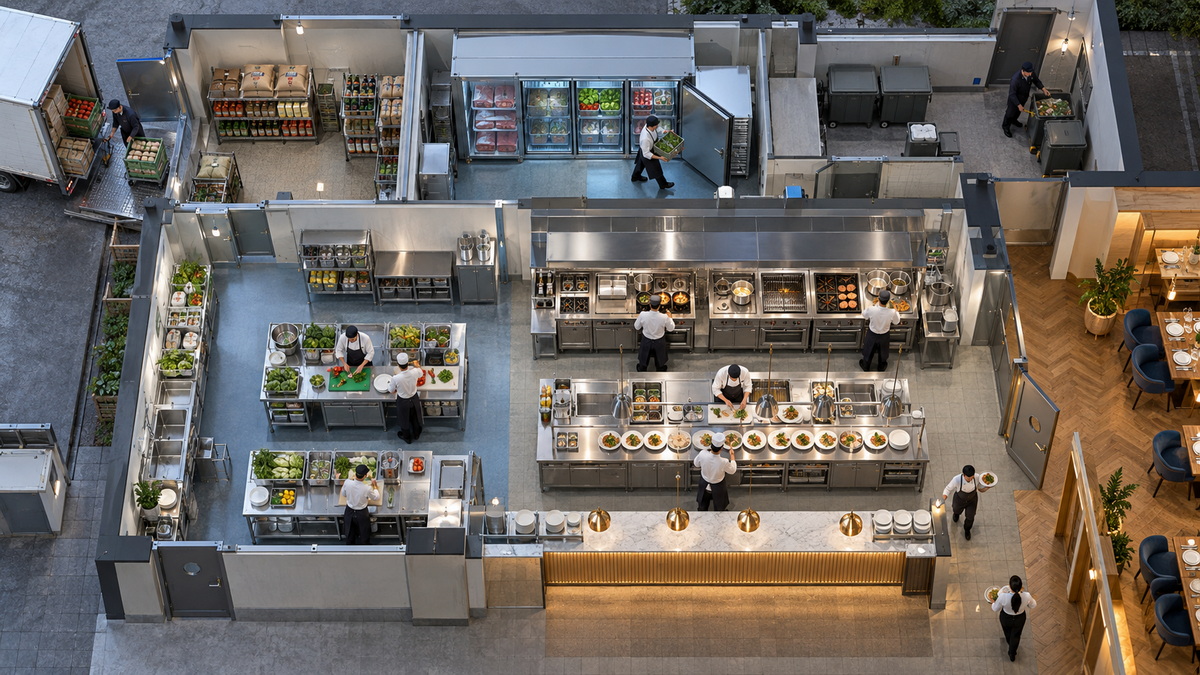
For some events, food preparation is part of what guests come to see. A sheltered cooking area near a dining space can make live preparation feel intentional rather than improvised. Alternatively, an enclosed kitchen can keep back-of-house activity separate while serving a nearby outdoor area.
Either approach should protect the operation. The serving opening, guest boundary, staff entrance, and weather shelter deserve as much attention as the exterior finish. A visually striking kitchen that forces staff into a narrow passage will be difficult to operate well.
The drawback is reduced flexibility. The kitchen may be well suited to today's menu but less effective if the venue later hosts larger events or different service formats. Site preparation and utility work can also make changes more involved.
Before choosing a venue-based solution, test the proposed layout against several likely events. A weekday staff lunch, a seated evening function, and a fast-moving exhibition crowd may place very different demands on the same kitchen.
A mobile outdoor kitchen is a strong option when the business follows the event calendar. It allows a team to work with a more familiar layout instead of adapting entirely to each client's available facilities.
That familiarity can make planning easier, but mobility does not make site checks optional. A unit still needs a practical route into the venue, a suitable position, and arrangements for the services it uses. The operator should confirm these details before promising a menu or service format to a client.
Useful site questions include:
- Can the unit reach and leave the proposed position?
- Is there enough room for unloading and safe staff movement?
- Where will guests queue, and will they block service access?
- What power, fuel, and potable-water arrangements are available?
- How will wastewater and other waste be managed?
- What shelter or ground protection is needed?
- Who will confirm the required food-service and fire-safety approvals?
A mobile kitchen that works smoothly at a paved exhibition site may be difficult to use on a narrow garden path. The unit's dimensions alone cannot answer that question; its access route matters too.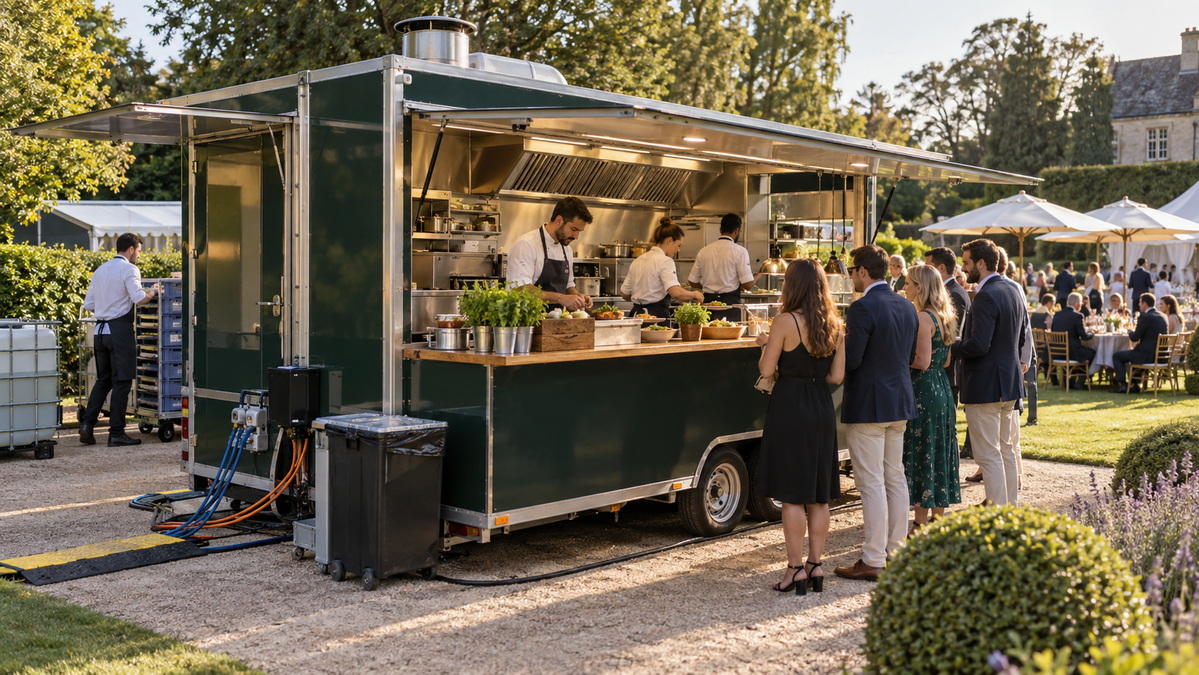
Mobile kitchens work especially well when a caterer offers a focused menu and can design the workspace around repeatable tasks. The team can decide which ingredients arrive prepared, what cooking happens on site, and how food moves to the serving point.
The key is to avoid overloading the unit. Adding one more appliance may reduce the preparation space or storage the crew needs more urgently. Likewise, a large serving hatch is less useful if the plating area behind it cannot keep pace with demand.
A mobile kitchen brings its own workspace, but it cannot bring identical conditions everywhere. Distance, unloading restrictions, weather, utilities, and local requirements can change from job to job. Those differences affect scheduling as well as cost.
Build site assessment into the booking process. It is easier to adapt a proposal before an event is confirmed than to discover on arrival that the kitchen cannot be positioned where the service plan expects it.
Neither format is inherently safer. The quality of the design and operation matters more than whether the kitchen moves. Both should support cleaning, separation of raw and ready-to-eat foods, appropriate cooking and holding practices, and access to safe water.
An effective layout follows the direction of the work:
1. Ingredients arrive and are checked.
2. Food moves to suitable storage.
3. Staff prepare and cook it in designated areas.
4. Finished food moves to holding, plating, or service.
5. Used items and waste leave without disrupting clean work.
This sequence is a planning tool, not a universal floor plan. The exact arrangement depends on the menu, equipment, staffing, and available space. What matters is identifying unnecessary crossings and long journeys before they become problems during service.
Before approving a drawing, run a simple exercise. Imagine the busiest part of the event. Have one person trace an ingredient's journey from delivery to the guest. Have another trace the path of used utensils and waste. Then follow a staff member who needs to wash their hands during service.
Where do their routes meet? Is the plating counter crowded? Can a delivery interrupt the service line? Would rain push guests toward a work entrance?
This exercise often reveals more than a list of equipment. It is especially useful for comparing a compact mobile layout with a larger venue-based kitchen: more space helps only when that space is arranged around the actual work.
A purchase price alone will not show which option offers better value. Use the same planned number of events, service volume, and period of ownership when comparing proposals.
For a venue-based outdoor kitchen, consider the structure, equipment, site preparation, service connections, maintenance, and any later changes. For a mobile outdoor kitchen, consider the unit and equipment along with delivery, setup, storage between events, maintenance, and site-specific arrangements.
A simple comparison is:
> Total operating cost = kitchen and equipment + site work + transport and setup + utilities + maintenance + storage + approval-related costs.
The figures should come from project-specific quotations, not a generic online cost-per-guest estimate. A venue that hosts frequent functions may spread its installation costs across many events. A caterer serving changing locations may gain more value from a unit it can use throughout its service area.
Also consider the cost of a mismatch. A cheaper kitchen that cannot support the planned menu or peak service may lead to an extra preparation area, more staff travel, or a revised event offer. Clear requirements make quotations easier to compare and reduce the chance of paying for features the operation does not need.
Whether you choose a fixed, mobile, or relocatable kitchen, begin with an operating brief rather than an exterior image. It gives designers and suppliers a practical basis for recommending a layout.
Include the following:
1. Event schedule: How often will the kitchen operate, and will it serve one venue or many?
2. Menu: Which foods will be stored, prepared, cooked, held, and served on site?
3. Peak demand: How many guests are expected during the busiest service period?
4. Equipment: Which appliances, sinks, refrigeration units, work surfaces, and storage areas are required?
5. Staffing: How many people will work inside and immediately outside the kitchen at once?
6. Site conditions: What are the access route, available services, ground conditions, and weather exposure?
7. Scope of supply: Which party supplies the structure, equipment, utility connections, and installation?
8. Review responsibilities: Who will prepare the necessary drawings and confirm local operating requirements?
This brief also helps uncover a common procurement problem: the handoff between suppliers. A structure manufacturer may supply the enclosure, while another specialist supplies cooking equipment or service connections. Ask every supplier to identify what is included, what is excluded, and where its work connects to another party's.
A prefab kitchen unit may serve as a sheltered kitchen at a permanent event venue or as a structure intended for relocation. Its suitability depends on the proposed layout, construction, equipment, transport method, utility interfaces, and destination requirements.
Welons Prefab is a China-based manufacturer of quick-assembly prefab units, modular buildings, and prefab container structures. According to the company information supplied for this article, it has 11 years of industry experience and a stated production capacity of 300 units per day. It offers customized, OEM, wholesale, and one-stop solutions for international customers.
For an event-catering project, those manufacturing capabilities are a starting point for discussion, not a substitute for a kitchen specification. Buyers should provide the menu, target service volume, site conditions, and destination market. They should then confirm which food-service systems are included in the proposed unit and which require separate design, installation, or local review.
A useful proposal should show more than an attractive exterior. Ask for a layout that makes equipment positions, staff movement, service access, and utility interfaces clear. If the unit will move, discuss how it will be delivered, positioned, connected, and prepared for use at each site.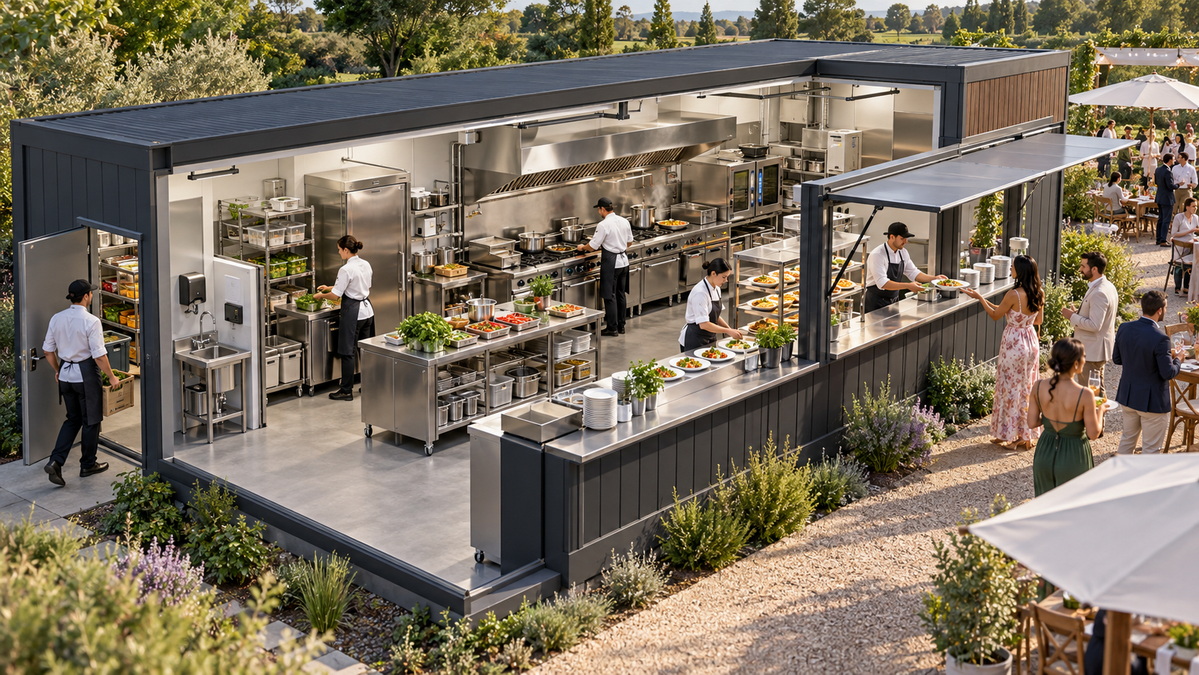
Choose a venue-based outdoor kitchen when you regularly cater at one property and want to design a dependable service flow around that location. Choose a mobile outdoor kitchen when events take you to different venues and the unit can be accommodated at each one. Consider a relocatable prefab kitchen when you need a longer installation period but may move the operation later.
The best decision starts with the menu, the busiest service period, and the realities of the site—not the kitchen's exterior. If you are planning a custom prefab solution, share your operating brief with Welons Prefab. Request a proposed layout and a clearly defined scope of supply, then have the catering operator and relevant local authorities review the project's food-service and safety requirements before placing an order.
Not necessarily. A food truck is one type of mobile food operation. The broader term "mobile outdoor kitchen" may also describe a trailer or transportable catering unit. Confirm how the specific unit will be classified in the place where it operates.
Potentially. The structure must be planned around the intended food-service operation, including its layout, equipment, water, waste, ventilation, and safety needs. Its proposed use should be reviewed under the requirements that apply at the destination.
There is no universal answer. A venue-based kitchen may offer better value when it is used frequently at one site. A mobile kitchen may be more useful when the business serves many locations. Compare itemized costs over the same number of events and years of use.
No. Requirements depend on the location, menu, cooking methods, and operating arrangement. Check the applicable food-service, site-use, and fire-safety requirements before confirming an event.
Send your menu, expected peak service volume, equipment list, staffing plan, site drawings, destination market, and intended deployment pattern. Ask the supplier to identify what its proposal includes and which systems require another specialist or local review.
Possibly, but design around the busiest realistic service period. A kitchen that has enough floor space may still fall behind if its storage, preparation, plating, or serving area becomes a bottleneck. Test the proposed workflow against different event formats before approving the layout.
1. U.S. Food and Drug Administration. [Food Code 2026]. Background on the model framework for retail and food-service safety.
2. U.S. Food and Drug Administration. [Summary of Changes in the 2026 FDA Food Code]. Includes the definition of "mobile food establishment."
3. National Fire Protection Association. [Keeping Food Trucks Safer from Fires and Explosions]. Guidance relevant to mobile and temporary cooking operations.
4. City of Seattle. [Food Service — Special Events]. An example of location-specific event food-service and permit requirements.
5. World Health Organization. [Five Keys to Safer Food]. Core principles relevant to food-handling workflow.
6. Welons Prefab. Company background supplied for this article. Source for the stated years of experience, product range, services, and daily production capacity; no public verification link was provided.


