
Views: 258 Author: Welons Prefab Houses Publish Time: 2026-09-24 Origin: Site


Content Menu
● Why Outdoor Dining Matters for Modern Resorts
● Outdoor Kitchen vs Built-In Outdoor Kitchen: Core Differences
● What Is an Outdoor Kitchen for a Hotel Resort?
>> Typical Outdoor Kitchen Applications
>> Strengths of a Prefabricated Outdoor Kitchen
>> When an Outdoor Kitchen Is the Better Choice
● What Is a Built-In Outdoor Kitchen?
>> Where Built-In Outdoor Kitchens Perform Best
>> Advantages of Built-In Outdoor Kitchens
● Outdoor Kitchen vs Built-In Outdoor Kitchen: Cost and ROI Thinking
>> A Practical Decision Matrix
● The Best Option for Food Safety and Operations
>> Essential Outdoor Kitchen Planning Checklist
● A Hybrid Strategy: The Most Practical Resort Solution
● Design Priorities for Different Resort Types
>> Tropical and Island Resorts
>> Urban Rooftop Resorts and Hotels
● Expert Recommendation for Resort Buyers
● FAQ
>> 1. What is the main difference between an outdoor kitchen and a built-in outdoor kitchen?
>> 2. Is a modular outdoor kitchen suitable for a luxury hotel resort?
>> 3. Which solution is better for a beach resort kitchen?
>> 4. Can a prefab container kitchen include refrigeration and dishwashing areas?
>> 5. How long does it take to install a prefabricated outdoor kitchen?
>> 6. Can a resort use both a built-in and modular outdoor kitchen?
>> 7. What information should a resort provide before requesting a kitchen quotation?
For hotel resorts, the choice between an outdoor kitchen and a built-in outdoor kitchen is not simply a design decision. It affects guest experience, food-service capacity, seasonal flexibility, staffing efficiency, site construction, maintenance planning, and long-term asset value.
An outdoor kitchen is often the faster and more flexible choice for pool decks, beach clubs, glamping areas, temporary events, staff dining zones, and phased resort expansions. A built-in outdoor kitchen is generally better suited to permanent destination restaurants, premium villas, rooftop bars, all-day dining terraces, and high-volume resort food-and-beverage operations. The right solution depends on the resort's operating model—not just its available budget.

Food and beverage is increasingly a core part of how travelers evaluate a resort. Guests do not only want a room and a pool. They want memorable spaces where they can gather, dine, socialize, watch food being prepared, and connect with the local setting.
Recent hospitality research shows that hotel dining is becoming more influential in travel decisions. OpenTable reported that 60% of surveyed travelers had booked a hotel specifically because of its restaurant, while hotel-restaurant dining from travelers rose 13% year over year in the measured U.S. market. This means an outdoor restaurant, barbecue terrace, poolside kitchen, or open-air dining pavilion can become a commercial destination rather than a supporting amenity.
For resort operators, the opportunity is clear:
- Create additional food-service points without expanding the main restaurant.
- Turn underused outdoor areas into revenue-generating guest spaces.
- Support poolside, beachfront, rooftop, garden, and event dining.
- Improve the visual appeal of dining experiences for social sharing.
- Offer local cooking demonstrations, live grilling, and chef-led events.
- Reduce pressure on indoor kitchens during peak occupancy periods.
- Support future resort expansion with modular or phased facilities.
However, the kitchen format must match the property's traffic, climate, menu, safety requirements, and desired guest positioning.
An outdoor kitchen is a broad category. It may include a modular kitchen unit, container kitchen, mobile cooking station, prefabricated kitchen pavilion, standalone grill zone, or semi-permanent food-preparation facility located outdoors.
A built-in outdoor kitchen is a permanent, site-integrated installation. It is typically constructed directly into a terrace, patio, pool bar, villa courtyard, restaurant deck, or landscape zone. The structure commonly uses masonry, concrete, stone, stainless steel, tiled counters, permanent plumbing, fixed electrical systems, and integrated cooking equipment.
| Comparison Area | Outdoor Kitchen | Built-In Outdoor Kitchen |
|---|---|---|
| Installation speed | Fast, especially with prefabricated or modular units | Slower because of civil works and on-site coordination |
| Flexibility | High; can be relocated, expanded, or repurposed | Low; designed for one fixed location |
| Upfront construction disruption | Usually limited | Can be substantial |
| Best for | Seasonal service, events, beach clubs, expansion projects, temporary operations | Permanent restaurants, premium villas, rooftop dining, high-volume venues |
| Customization | Strong with modular layouts and OEM production | Strong aesthetically, but changes after construction are expensive |
| Utility integration | Can be self-contained or externally connected | Usually deeply integrated into permanent utilities |
| Weather resilience | Depends on enclosure, materials, and site preparation | Can be highly durable when designed properly |
| Future expansion | Easier to add modules or relocate capacity | Often requires renovation or new construction |
| Capital risk | Lower for pilot projects or uncertain demand | Higher because changes are costly |
| Brand presentation | Can range from practical to highly branded | Often delivers a premium, seamless architectural look |
The decision should not be framed as "temporary versus premium." A properly designed prefabricated outdoor kitchen can be attractive, durable, code-conscious, and guest-facing. Likewise, a built-in kitchen is not always the best investment if the resort needs to test demand, open quickly, or adapt its layout over time.
For hotel resorts, an outdoor kitchen is usually an operational food-service facility placed near the guest activity it supports. It may be open-sided, covered, partially enclosed, or fully enclosed depending on climate and food-preparation needs.
At Welons Prefab, a resort-oriented outdoor kitchen can be planned as a prefabricated container-based unit, a modular kitchen building, or a connected set of auxiliary buildings. This format is particularly useful where a property needs rapid deployment, flexible layout planning, or standardized quality across several locations.
Outdoor kitchens can support many resort scenarios:
- Poolside snack and beverage service
- Beach barbecue stations and seafood-grill areas
- Outdoor breakfast or brunch preparation zones
- Garden wedding and banquet catering kitchens
- Seasonal ski-resort or summer-resort dining points
- Staff canteens and employee meal facilities
- Glamping camp kitchens and communal dining areas
- Remote island or mountain-resort support kitchens
- Event kitchens for festivals, corporate retreats, and destination weddings
- Temporary food-service capacity during renovation of a main kitchen
For example, a beachfront resort may install a modular outdoor kitchen beside a bar and dining deck. During the day, the unit can serve grilled seafood, salads, drinks, and quick meals. At night, it can support live-cooking experiences and private group dinners. If the resort later develops a permanent beach restaurant, the same modular kitchen can be moved to another zone, converted into staff catering support, or expanded as a back-of-house prep facility.
The most important advantage is operational adaptability.
A modular outdoor kitchen can be configured around the resort's menu, kitchen workflow, and available site area. Instead of building every element from scratch, the resort can choose the required modules before production.
A practical layout may include:
- Hot cooking line with grill, fryer, range, or oven
- Cold preparation counter
- Refrigerated storage
- Dry storage and shelving
- Handwashing station
- Dishwashing area
- Food pass or service window
- Staff changing area
- Mechanical and electrical zone
- Waste handling area
- Covered guest-facing counter or bar
For international resort projects, prefabrication also helps reduce uncertainty. The unit can be designed, manufactured, inspected, packed, and transported as a coordinated system. Site work still matters, but the construction process is often more predictable than a fully site-built kitchen.
Choose a modular or prefabricated outdoor kitchen when the resort needs one or more of the following:
1. Fast launch capability. A resort opening, reopening, or expanding its food service may need an operational kitchen much faster than conventional construction allows.
2. Seasonal flexibility. Beach resorts, ski resorts, safari lodges, and destination event venues may have dramatic changes in guest volume throughout the year.
3. A lower-risk market test. Before investing in a full permanent restaurant, operators can test whether poolside dining, live grilling, or a specialty food concept attracts sufficient demand.
4. Remote-site practicality. Island resorts, mountain properties, construction camps, and emerging tourism areas may face labor shortages, difficult site conditions, or limited local construction capacity.
5. Future repositioning. If a resort may later modify its master plan, a relocatable kitchen reduces the risk of stranded investment.
6. Standardization across multiple properties. Hotel groups can repeat kitchen modules and operating systems across resorts while adapting finishes, branding, and equipment to each destination.
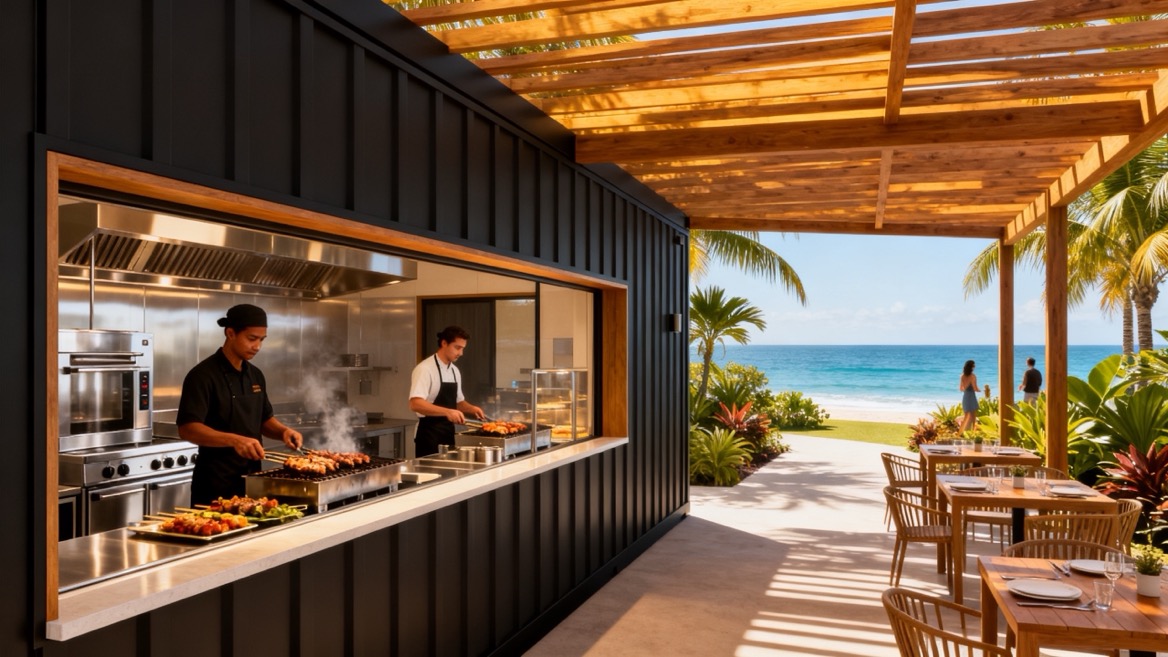
A built-in outdoor kitchen is a permanent food-preparation and service area designed as part of the resort's architecture and landscape. It often feels like an extension of the restaurant, pool club, villa, terrace, or entertainment area.
The concept is common in luxury resorts because it creates a highly polished guest environment. Counters, cabinets, cooking equipment, bars, sinks, and storage are integrated into fixed structures. The kitchen may be concealed behind stonework, timber finishes, tiled cladding, landscaping, or architectural screens.
Built-in outdoor kitchens are especially effective in locations where permanence and visual continuity are central to the guest experience:
- Luxury pool bars and poolside restaurants
- Private villa entertainment terraces
- Rooftop restaurant and cocktail concepts
- Permanent beachfront dining venues
- Golf-resort clubhouses
- Courtyard restaurants
- Fine-dining chef's tables
- Premium barbecue and teppanyaki zones
- Large banquet terraces
- Signature destination dining concepts
For a luxury villa resort, a built-in outdoor kitchen can improve the perceived value of private accommodation. A villa may include a grilling station, preparation sink, beverage refrigerator, stone counter, and shaded dining area. This supports private chef experiences, family meals, celebration packages, and longer stays.
Hilton's 2026 travel research found that 86% of families prioritize dining together while traveling, while 48% of travelers reported cooking their own meals during a trip. These behaviors make guest-accessible outdoor kitchen facilities particularly relevant for villas, extended-stay accommodations, glamping properties, and family-oriented resorts.
The main advantage is architectural integration.
A well-designed built-in kitchen can make outdoor dining feel permanent, refined, and exclusive. It can strengthen the resort's brand image, improve photography, and support a premium average spend per guest.
Other benefits include:
- Strong visual integration with the property's architecture.
- Durable finishes selected for a specific climate and design language.
- Concealed plumbing, wiring, storage, and service infrastructure.
- Better opportunities for custom landscaping and guest circulation.
- A high-end atmosphere for private events and premium dining.
- Greater perceived exclusivity in villas and club areas.
- Long-term consistency when the dining concept is stable.
In high-traffic flagship venues, a built-in kitchen can also support complex guest-facing culinary theatre. Open-fire cooking, chef's counters, pizza ovens, seafood displays, and cocktail stations can become part of the destination experience.
The right investment is not always the one with the lowest initial price. Resort operators should assess the full ownership picture: site works, installation, utilities, maintenance, operational downtime, future upgrades, and revenue potential.
A built-in outdoor kitchen may cost more upfront because it can require excavation, foundations, drainage, custom countertops, permanent utility runs, structural supports, decorative finishes, and longer construction coordination. It may be justified when the resort expects stable, high-volume demand for many years.
A modular outdoor kitchen may reduce construction time and make capacity easier to redeploy. It can be especially valuable where the operator needs to protect cash flow, manage seasonal demand, or avoid interrupting a live resort environment.
| Resort Situation | Recommended Solution | Why |
|---|---|---|
| New resort opening with limited time | Modular outdoor kitchen | Faster deployment and less site disruption |
| Luxury villa with a stable premium guest profile | Built-in outdoor kitchen | Stronger aesthetic integration and perceived value |
| Seasonal beach club | Prefabricated outdoor kitchen | Flexible capacity and easier off-season reconfiguration |
| Remote eco-resort or island property | Modular kitchen building | Controlled manufacturing and fewer on-site construction demands |
| Established destination restaurant | Built-in outdoor kitchen | Best for a long-term, highly branded dining environment |
| Hotel renovation requiring temporary food service | Container kitchen or modular kitchen | Keeps operations running during construction |
| Multi-property resort group | Standardized modular system | Easier replication, planning, and supply consistency |
| Event-heavy resort with weddings and conferences | Hybrid model | Permanent guest-facing bar plus modular back-of-house kitchen |
Outdoor food service requires careful planning. A beautiful kitchen that lacks proper sanitation, refrigeration, storage, drainage, pest control, ventilation, lighting, and staff workflow can create operational risk.
The kitchen concept should be reviewed together with local regulations, equipment specifications, utility capacity, climate conditions, and the resort's food-safety procedures. Requirements vary by country and jurisdiction, so the final design must be validated by qualified local professionals and relevant authorities.
Before selecting either format, confirm the following:
- Required production volume per meal period
- Menu type and cooking methods
- Guest service style: counter service, buffet, table service, or private chef
- Hot and cold food holding requirements
- Refrigeration and freezer capacity
- Handwashing and dishwashing needs
- Potable water supply and wastewater drainage
- Electrical load and backup power needs
- Gas storage, fuel supply, and fire protection
- Exhaust, smoke control, and heat management
- Weather protection from rain, wind, salt air, sand, humidity, or snow
- Pest-control strategy
- Waste collection and grease-management plan
- Staff entry, food delivery, and service circulation
- Accessibility and guest queue management
- Cleaning access for floors, walls, equipment, and drainage points
A resort kitchen should not be selected only from a visual rendering. The best projects begin with a workflow map: how food arrives, where it is stored, where it is prepared, how it is cooked, how it reaches guests, and how dishes and waste return to back-of-house areas.
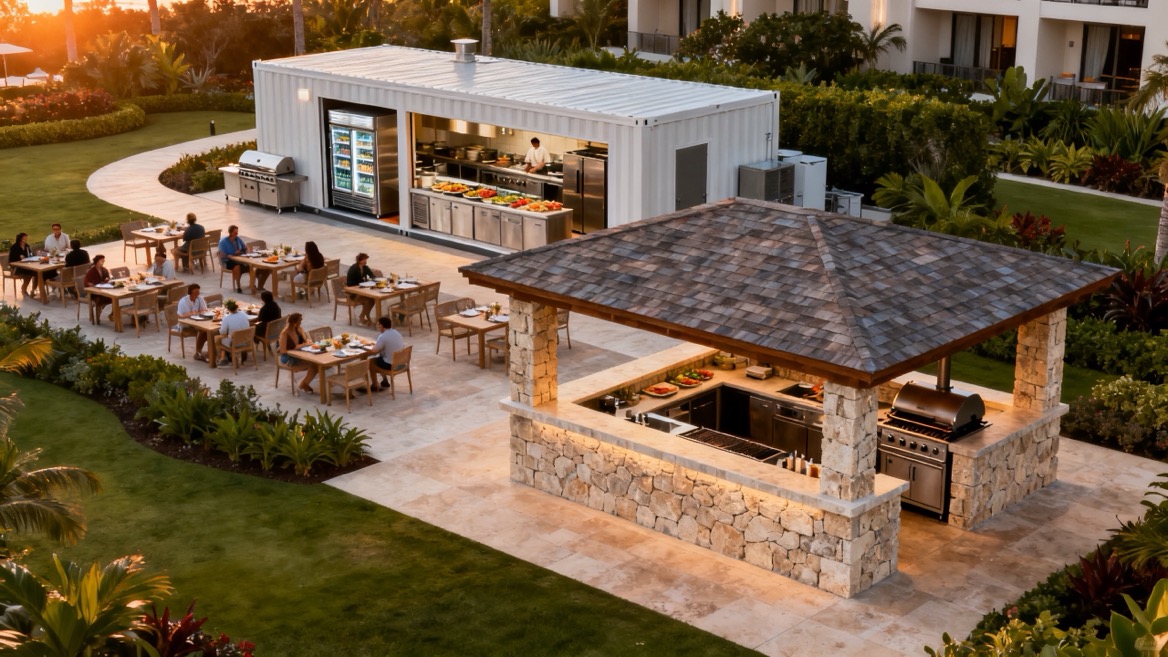
Many resorts do not need to choose only one model. A hybrid layout can combine the guest appeal of a built-in outdoor kitchen with the speed and flexibility of a prefabricated support unit.
For example:
- A permanent stone-front bar, pizza oven, and guest-facing grill area can serve as the visual centerpiece.
- A nearby prefabricated kitchen module can handle cold prep, dishwashing, storage, staff facilities, refrigeration, and production support.
- The visible space remains elegant and uncluttered.
- The operational space can be expanded or adapted as demand changes.
This approach is particularly valuable for beach resorts, golf resorts, destination wedding venues, and large properties with dispersed dining areas. It separates the experience layer from the production layer.
The experience layer must look exceptional. The production layer must work efficiently, remain hygienic, and be easy for staff to manage. Combining the two can protect both guest satisfaction and operating performance.
Beach properties need materials and systems that account for salt air, humidity, windblown sand, storms, and corrosion. Stainless-steel grades, protective coatings, drainage design, secure shutters, shaded service areas, and carefully selected exterior panels are important.
A modular outdoor kitchen may be ideal for beach clubs, temporary beach restaurants, and seasonal dining points. A built-in kitchen is more appropriate for a permanent landmark restaurant with reliable infrastructure and a stable long-term concept.
Mountain locations often require insulation, snow-load considerations, heating, winterized plumbing, and secure storage. A fully enclosed prefabricated kitchen building can support seasonal service while maintaining better operational control in cold weather.
Built-in outdoor kitchens may work in sheltered après-ski terraces, but the design must account for winter shutdown periods, frozen pipes, snow removal, and equipment protection.
For tropical destinations, airflow, shade, drainage, pest control, mold prevention, and corrosion resistance become central priorities. Open cooking can create an attractive atmosphere, but heat and humidity can affect both staff comfort and food handling.
A well-planned modular unit can provide enclosed prep and storage zones while allowing the guest-facing grill or bar to remain open and visually engaging.
Rooftop kitchens require careful engineering, fire planning, utility coordination, wind analysis, structural load review, and access planning. A built-in outdoor kitchen often delivers the strongest design outcome for a permanent rooftop bar or restaurant.
However, a compact modular kitchen may be useful where the rooftop needs lightweight, rapidly installed support capacity or where structural and construction access constraints make conventional building work difficult.
From a manufacturing and project-planning perspective, the best decision begins with the operating brief—not the building type.
Choose an outdoor kitchen when speed, mobility, expansion capacity, controlled manufacturing, and lower construction disruption are your primary needs. This option is especially strong for new developments, remote resorts, seasonal operations, event spaces, and phased food-service expansion.
Choose a built-in outdoor kitchen when your resort has a stable long-term location, a clear premium dining concept, substantial guest demand, and a need for seamless architectural presentation. It is the stronger option for signature restaurants, luxury villas, rooftop venues, and permanent pool clubs.
Choose a hybrid solution when you want both visual impact and operational flexibility. This is often the most commercially balanced approach for modern hotel resorts.
For projects requiring rapid supply, custom layouts, OEM production, wholesale support, or integrated auxiliary buildings, a capable prefab manufacturer can help transform a resort dining concept into a scalable operational facility. With daily output capacity of up to 300 units, Welons Prefab can support customized container kitchen buildings, modular dining facilities, staff canteens, storage areas, meeting spaces, offices, dormitories, and related resort infrastructure for international projects.
An outdoor kitchen gives hotel resorts the freedom to launch faster, serve more areas, and adapt capacity as guest demand changes. A built-in outdoor kitchen gives resorts a permanent, premium, architecturally integrated dining destination.
The stronger choice depends on whether your priority is flexibility, speed, and scalability or permanence, visual integration, and long-term brand impact.
If you are planning a beach club kitchen, poolside food station, villa barbecue area, resort staff canteen, outdoor restaurant, event-catering kitchen, or modular hospitality complex, share your site plan, target capacity, menu concept, climate conditions, and required functions with Welons Prefab. Our team can help develop a customized modular solution that supports efficient operations and a memorable guest dining experience.
An outdoor kitchen is a broader category that can include modular, prefabricated, movable, semi-permanent, or standalone kitchen facilities. A built-in outdoor kitchen is permanently constructed into the property's terrace, patio, landscape, villa, or restaurant structure.
Yes. A modular outdoor kitchen can be designed with premium cladding, branded finishes, glazed service windows, stainless-steel equipment zones, shaded terraces, and integrated guest-facing counters. It can support luxury service while preserving the ability to expand, relocate, or reconfigure the facility.
A modular outdoor kitchen is often better for seasonal beach clubs, temporary dining areas, and phased resort developments. A built-in kitchen is preferable for a permanent beach restaurant with stable demand and established utilities. In both cases, corrosion resistance, drainage, wind protection, and salt-air durability are essential.
Yes. A customized container kitchen can include refrigeration, freezer space, preparation counters, cooking equipment, handwashing stations, dishwashing areas, dry storage, electrical systems, plumbing connections, ventilation arrangements, and staff-access zones. The final configuration should match the menu, expected meal volume, local regulations, and site utilities.
Installation time depends on the kitchen size, local permits, foundation requirements, utility connections, transportation access, and equipment commissioning. Compared with a fully site-built kitchen, a prefabricated solution can reduce on-site construction work because much of the production is completed before delivery.
Yes. This is often an effective model. The built-in area can focus on guest-facing cooking, bars, and presentation, while the modular unit handles storage, preparation, refrigeration, dishwashing, and staff operations.
Provide the project location, target guest capacity, menu type, service hours, climate conditions, available site dimensions, utility information, preferred materials, required equipment, local compliance requirements, and whether the kitchen will be temporary, seasonal, or permanent.
1. Hilton. "[More Travelers Seek Home Comforts: 2026 Trends Report]" — Traveler preferences relating to familiar food, family dining, and cooking while traveling.
2. OpenTable. "[OpenTable Reveals the 2026 Top 100 Hotel Restaurants in America]" — Hotel restaurant booking behavior, traveler dining growth, and survey findings on restaurant-led hotel choices.
3. SiteMinder. "[Food and Beverage in the Hospitality Industry]" — Hotel food-and-beverage revenue context, sustainability trends, food-waste considerations, and operational value.
4. WATG Advisory. "[Hospitality Trends 2026]" — Insights into the growing importance of distinctive food-and-beverage concepts within luxury hospitality.
5. Hospitality Net. "[Five Trends Every Hotel Leader Needs to Watch in 2026]" — Commentary on food and beverage as an experiential differentiator for hotel guests.
6. Grand View Research. "[Resort Market Size, Share and Trends Report, 2026–2033]" — Global resort market context and projected industry growth.


