
Views: 254 Author: Welons Prefab Houses Publish Time: 2026-11-12 Origin: Site


Content Menu
● Who Owns Shipping Containers in the Global Supply Chain?
>> Shipping Lines and Container Leasing Companies
>> Shippers, NVOCCs, and Freight Forwarders
● Carrier-Owned vs. Shipper-Owned Containers: What Is the Difference?
● How to Identify a Shipping Container Owner
>> Understand the Container Identification Number
>> Check the Register, Then Verify the Transaction
● Buying a Used Container: A Practical Due-Diligence Checklist
>> Confirm the Condition of the Exact Unit
>> Separate Cargo Fitness from Building Fitness
● Shipping Containers vs. Prefab Container Houses
● Three Often-Overlooked Risks in Container Building Projects
>> 1. A Safety Plate Does Not Approve a Building
>> 2. Structural Modifications Need Assessment
>> 3. Factory Supply Is Not the Complete Project
● How to Compare Total Project Cost
● A Six-Step Procurement Process for Prefab Container Houses
>> Step 1: Define the Application
>> Step 2: Establish Destination Requirements
>> Step 3: Agree on Drawings and Specifications
>> Step 4: Define the Contract and Inspection Plan
>> Step 5: Confirm Shipping and Installation
● Planning Your Project with Welons Prefab
>> Who owns most shipping containers?
>> Can a private individual buy a shipping container?
>> Does a container number prove legal ownership?
>> Can I convert a rented container into an office?
>> Is a prefab container house the same as a shipping container?
>> Do prefab container houses need local approval?
Who owns shipping containers—and why does ownership matter when buying one for storage, transport, or prefab container houses? Shipping lines and container leasing companies are major owners. Shippers, logistics providers, and independent businesses also own containers. However, the company whose logo appears on a container is not necessarily its legal owner.
For buyers, the important questions go beyond identifying a name: Can the seller legally transfer the unit? Is it suitable for your intended use? And are you purchasing a freight container or a purpose-built modular building?
At Welons Prefab, our manufacturing perspective starts with one principle: ownership and suitability must be checked separately. A container can be legally available for sale without being appropriate for an office, dormitory, or permanent building.
Several types of businesses own containers, but their roles sometimes overlap.
| Owner category | Main reason for ownership | What buyers should understand |
|---|---|---|
| Shipping lines | Support cargo transport across their networks | A carrier may operate both owned and leased equipment |
| Leasing companies | Lease containers to carriers and other operators | The operator and legal owner may be different businesses |
| Shippers and cargo owners | Control equipment for particular shipments | Ownership brings maintenance and logistics responsibilities |
| NVOCCs and freight forwarders | Support specialized transport services | Not every logistics provider owns its equipment |
| Independent businesses and individuals | Provide storage, rental, resale, or building space | Purchase documentation and condition require verification |
Shipping lines use containers to move cargo between ports and inland destinations. Owning equipment gives them direct control, while leasing provides another way to access containers without purchasing every unit.
Consequently, a container carrying a shipping line's branding may belong to a leasing company. Branding helps identify an operating relationship, but it does not conclusively establish title.
For a buyer, this distinction matters when a container leaves transport service. The seller should demonstrate authority to sell that specific unit.
Some cargo owners purchase containers for specialized equipment, remote destinations, or extended use at a project site.
Non-vessel-operating common carriers, or NVOCCs, provide ocean transportation services without operating the vessels themselves. Freight forwarders organize shipments. Some businesses perform both roles and may own containers, but these categories should not be treated as separate, non-overlapping ownership groups.
The practical lesson is simple: verify the individual container rather than assuming ownership from a company's business description.
Carrier-owned container, commonly shortened to COC, generally describes equipment supplied through the ocean carrier's service. That equipment may be owned outright or leased by the carrier.
Shipper-owned container, or SOC, describes equipment supplied by the shipper rather than drawn from the carrier's equipment fleet. The shipper may own it or arrange its use through another provider.
These terms describe transport arrangements; they are not substitutes for legal ownership documents.
| Consideration | Carrier-supplied equipment | Shipper-supplied equipment |
|---|---|---|
| Equipment sourcing | Arranged through the carrier | Arranged by the shipper |
| Return arrangements | Governed by carrier instructions | Depend on ownership and transport agreements |
| Maintenance obligations | Allocated under carrier terms | Must be checked in the shipper's agreements |
| Ocean transport acceptance | Part of the carrier's equipment process | Requires confirmation against carrier requirements |
| Building conversion | Requires purchase or explicit authorization | Still requires title verification and engineering assessment |
Using an SOC can change exposure to equipment detention charges. It does not automatically eliminate terminal storage, demurrage, handling charges, or other shipment costs.
A container number is a useful starting point, but it is not a certificate of ownership.
The identification system maintained through the Bureau International des Containers, or BIC, includes:
- Three letters identifying the registered owner or principal operator.
- One equipment-category letter.
- Six serial-number digits.
- One check digit used to detect recording errors.
For freight containers, the equipment-category letter is "U."
This corrects a common misunderstanding: the first four letters are not four owner-code letters. They combine a three-letter owner/operator code with an equipment identifier.
Use the BIC register to identify the organization associated with the prefix. Next, compare that information with the seller's explanation and documentation.
A prefix may identify a principal operator rather than the underlying legal owner. Likewise, a check digit confirms number consistency, not whether a container is stolen, released for sale, or free from competing claims.
Before payment, request:
1. The complete container number and current photographs.
2. Seller identification and business details.
3. A purchase invoice or sale agreement identifying the unit.
4. Evidence that the seller owns it or is authorized to sell it.
5. Depot release instructions and collection conditions, where applicable.
Resolve discrepancies before arranging transport.
A low purchase price is only one part of the decision. Buyers should assess the transaction, physical condition, and intended application together.
Ask for dated photographs of the roof, floor, underside, corner posts, doors, and identification markings. Where the project justifies it, arrange an independent inspection.
Check for:
- Significant corrosion or deformation.
- Water ingress and failed door seals.
- Damaged corner fittings or structural members.
- Previous repairs and cut openings.
- Unexplained odors, residues, or uncertain cargo history.
Descriptions such as "used" or "refurbished" are not detailed specifications. Put the agreed inspection and acceptance criteria in writing.
A container accepted for freight transport is not automatically approved for human occupation.
Conversely, a unit suitable for stationary storage may not meet an ocean carrier's acceptance requirements. A building conversion introduces another set of questions, including structural alterations, fire performance, ventilation, sanitation, and local approvals.
Define the intended use before choosing the inspection scope.
A freight container and a prefab container house can look similar while serving different purposes.
A freight container is designed primarily for cargo handling and transportation. A purpose-built modular unit is manufactured around a building brief, which may include insulation, internal finishes, electrical services, plumbing, and connected room layouts.
| Project issue | Converted freight container | Purpose-built prefab container house |
|---|---|---|
| Starting point | Existing transport equipment | Specified building module |
| Condition assessment | Depends on previous service and repairs | Depends on manufacturing specifications and inspection |
| Openings and layout | May require substantial structural modification | Can be incorporated into the agreed design |
| Thermal performance | Requires a suitable insulation and moisture strategy | Must still be specified for the destination climate |
| Transport | Depends on dimensions, condition, and acceptance | Depends on packing method and shipping arrangement |
| Approval | Subject to applicable local requirements | Also subject to applicable local requirements |
Neither approach is universally better. The right choice depends on occupancy, project duration, site conditions, transport costs, and approval requirements.
From our perspective, procurement should begin with the space people need—not simply the steel box available for purchase.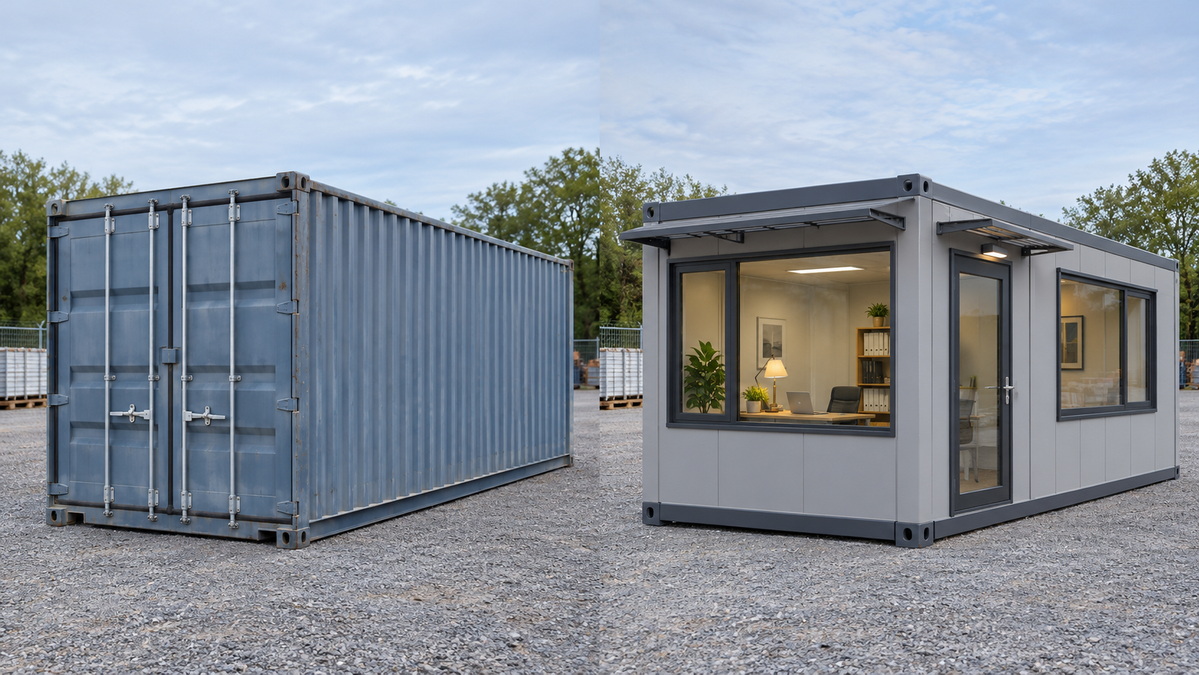
A Convention for Safe Containers plate relates to container safety within its transport framework. It does not replace planning permission, building approval, or an assessment of suitability for occupancy.
Hapag-Lloyd's published SOC procedure, for example, specifies documentation, markings, dimensions, and structural criteria for transport acceptance. Those requirements should not be confused with building regulations.
Cutting large doors, windows, or connected-room openings can change how a freight container carries loads.
Do not assume that a container's original stacking capability remains unchanged after modification. A qualified professional should assess the proposed configuration and any reinforcement required under applicable rules.
This is especially important for stacked units, wide openings, and projects exposed to substantial wind or seismic loads.
The module is only part of a functioning building.
Buyers should identify responsibility for foundations, drainage, utility connections, lifting, installation, inspections, and final handover. A quotation that excludes these items may still be valid, but it should not be compared directly with a more comprehensive offer.
Clear scope boundaries prevent attractive unit prices from becoming misleading project budgets.
Compare alternatives against the same functional brief: occupancy, floor area, climate requirements, finishes, and service life.
A useful budget includes:
- Container purchase or modular-unit supply.
- Inspection, design, and engineering.
- Modification and internal fit-out.
- Freight, inland delivery, and unloading.
- Foundations and site preparation.
- Electrical, water, and wastewater connections.
- Permits and required inspections.
- Maintenance and potential relocation.
For example, a contractor planning a worker dormitory should compare complete sleeping accommodation—not an empty used container against a finished modular room.
Prepare a scope matrix showing which party supplies each item. Record exclusions alongside prices, rather than leaving them in separate correspondence.
Specify whether the project involves offices, dormitories, dining facilities, meeting rooms, storage, exhibition space, or industrial support buildings.
Include occupancy, room sizes, furniture, sanitation needs, and accessibility requirements where applicable.
Provide the installation location and available site information. Confirm applicable structural, fire, electrical, and energy requirements with local professionals.
Avoid relying on an undefined claim of "international standards."
Request layouts and relevant technical details covering the structure, envelope, insulation, services, finishes, and connection interfaces.
Document permitted substitutions and the approval process for changes.
Specify payment milestones, inspection rights, acceptance criteria, warranty scope, and procedures for shortages or defects.
For used containers, identify the exact units or an agreed selection procedure.
Clarify packing dimensions, shipping method, unloading needs, lifting instructions, and installation responsibilities.
Do not assume that a container-shaped building can travel as a standard freight container without additional checks.
Agree on the documents required at completion, including applicable drawings, inspection records, installation guidance, and maintenance instructions.
Assign responsibility for resolving outstanding items.
Welons Prefab is a Chinese manufacturer of prefab container houses and modular buildings. According to our company-provided profile, we bring 11 years of professional experience and a stated daily production capacity of 300 units.
We support customized, OEM, wholesale, and one-stop supply arrangements for applications including offices, dormitories, cafeterias, meeting rooms, warehouses, exhibition halls, and industrial facilities.
Capacity figures should be considered alongside the selected configuration, order schedule, inspection requirements, and delivery arrangements.
Send Welons Prefab your destination, intended use, quantity, layout, and performance requirements. Request a proposal that clearly separates module supply, customization, shipping, installation support, and exclusions. That creates a more reliable basis for evaluating the complete project.
Shipping lines and specialist leasing companies are the principal ownership groups discussed in the container industry. This guide does not assign a current percentage because ownership-share figures require a dated, clearly defined dataset.
Yes. However, the buyer should verify the seller's authority, inspect the unit, and confirm delivery and site-use requirements before purchase.
No. Its prefix identifies a registered owner or principal operator. Legal title and authority to sell require supporting transaction documents.
Do not make permanent alterations without the owner's written authorization. The agreement should address approved modifications, restoration obligations, liability, and the container's eventual return or purchase.
Not necessarily. A prefab container house may be purpose-built for occupancy rather than converted from freight equipment. Ask the manufacturer to identify its construction system and transport method.
Requirements depend on the location and intended use. Factory production does not automatically remove planning, structural, fire-safety, utility, or occupancy obligations.
1. [CIMC TLC — "Who Own the Containers? Container Factory Tell You," January 18, 2022]. Original article reviewed for the ownership topic and category structure. Its historical statistics have not been presented as current figures, and its ownership-identification explanation has been refined. No customer reviews were visible in the retrieved article, so no testimonials or customer experiences have been invented. [tlc-yz]
2. [Bureau International des Containers — Container BIC Code Lookup Tool]. Primary reference for the official owner/operator register, identification-number components, and the distinction between an owner and principal operator. [bic-code]
3. [Bureau International des Containers — Container Check Digit Calculator]. Reference for the three-letter prefix, equipment-category identifiers, serial number, and check digit. [bic-code]
4. [Hapag-Lloyd — Procedure for Booking Shipper's Own Container, February 3, 2025]. Carrier-specific reference for SOC documentation, identification, dimensions, and transport acceptance. Its requirements should not be generalized to every carrier or building project. [hapag-lloyd]
5. [International Code Council — Significant Changes to the California Residential Code, 2022 Edition, Chapter 3 Sample]. Jurisdiction-specific reference explaining structural evaluation and provisions for shipping containers repurposed as buildings. It is not presented as a universal approval framework. [shop.iccsafe]


