
Views: 276 Author: Welons Prefab Houses Publish Time: 2026-11-04 Origin: Site


Content Menu
● How Does a Container Substation Work?
● Main Components of a Containerized Substation
● Container Substation vs. Prefabricated Substation vs. E-House
● Where Container Substations Provide Practical Value
>> Industrial Facilities and Production Expansion
>> Construction Sites and Modular Accommodation
>> Remote Operations and Temporary Supply
● Why Choose a Prefabricated Container Substation?
● Safety Requirements Buyers Should Verify
>> Confirm the Applicable Standards and Test Evidence
>> Examine Internal-Arc Protection Carefully
>> Design Cooling Around Real Heat Loads
● A Seven-Step Container Substation Procurement Checklist
>> 1. Establish the Electrical Design Basis
>> 2. Define the Site Environment
>> 3. Agree on Maintenance Access
>> 4. Coordinate Transport and Lifting
>> 5. Assign Interface Responsibilities
>> 6. Approve Inspection and Testing Plans
>> 7. Require Complete Handover Documents
● An Illustrative Modular-Site Planning Scenario
● Welons Prefab's Role in a Coordinated Modular Project
● Plan the Buildings and Power Infrastructure Together
● Frequently Asked Questions About Container Substations
>> Is a container substation the same as a shipping container?
>> How quickly can a containerized substation be installed?
>> Can a container substation be relocated?
>> Is a container substation suitable for hot climates?
>> How much does a container substation cost?
>> Does Welons Prefab supply the complete electrical package?
A container substation is a factory-integrated electrical installation housed in a transportable enclosure. It combines equipment for switching, voltage transformation, protection, and power distribution in a coordinated package.
For industrial facilities, construction projects, and remote operations, this approach can reduce on-site assembly and simplify equipment integration. However, a steel enclosure alone does not make a safe, complete substation.
From a modular-building procurement perspective, the essential question is not simply whether the container can be delivered quickly. It is whether the enclosure, electrical equipment, site infrastructure, and maintenance arrangements work together throughout the installation's service life.
This guide explains how containerized substations work, where they fit, and what buyers should specify before requesting quotations.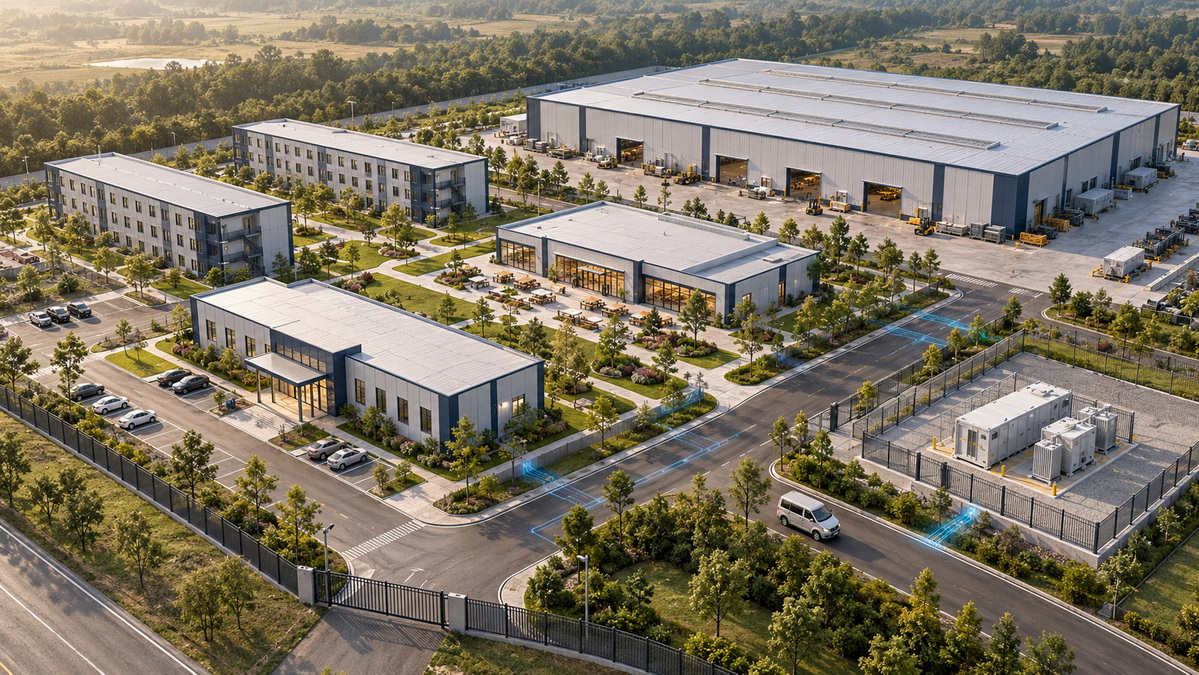
A typical medium-voltage/low-voltage installation receives electricity from a distribution network. Switchgear controls the incoming supply, a transformer changes the voltage, and an outgoing distribution board delivers power to connected loads.
Protection devices detect abnormal conditions and initiate disconnection where required. Auxiliary systems support lighting, ventilation, monitoring, and control.
The basic sequence is:
1. Incoming electricity enters through the designated cable connection.
2. Medium-voltage switchgear provides switching, isolation, and protection.
3. The transformer changes voltage to suit downstream equipment.
4. Low-voltage distribution equipment supplies individual circuits.
5. Monitoring systems report operating conditions and alarms.
Not every project follows this arrangement. Some containerized electrical installations house switchgear and controls while locating the transformer outside. The approved single-line diagram should define the actual configuration.
A substation also does not generate electricity. Emergency deployment still requires an available utility connection or an appropriately engineered generation source.
Understanding the equipment helps buyers compare complete systems rather than superficially similar enclosures.
| Component | Main function | Buyer's verification point |
|---|---|---|
| Medium-voltage switchgear | Switches, isolates, and protects incoming circuits | Voltage rating, fault duty, interlocks |
| Transformer | Changes voltage | Capacity, losses, cooling, impedance |
| Low-voltage switchboard | Distributes outgoing power | Current rating, protection coordination |
| Protection and control | Detects faults and manages operation | Relay settings, communication requirements |
| Enclosure | Supports and protects the installation | Structure, access, corrosion protection |
| Ventilation or cooling | Controls operating temperature | Heat-load calculation and service access |
| Earthing system | Bonds conductive parts and supports fault protection | Integration with the site earthing design |
The enclosure is part of the engineering solution, not merely packaging. Doors, ventilation openings, internal partitions, cable entries, and equipment supports can all affect performance.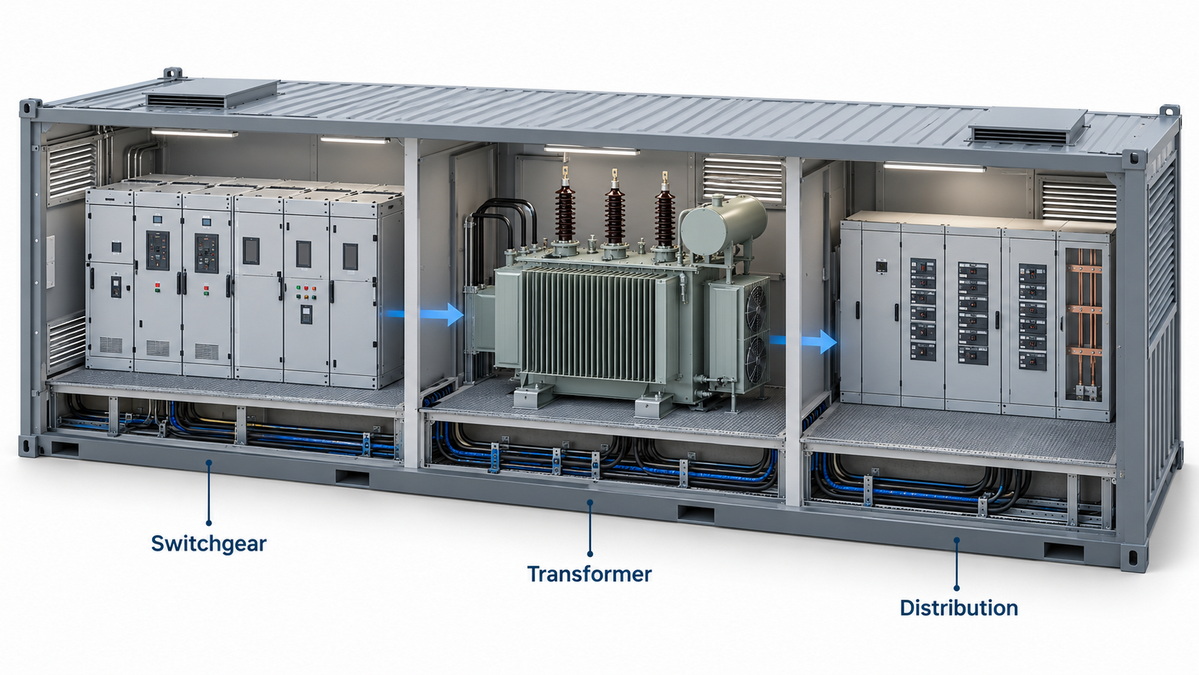
These terms overlap, but they should not be treated as identical purchasing specifications.
A prefabricated substation describes an integrated installation assembled before delivery. Its enclosure may use metal, concrete, or another engineered construction.
A containerized substation emphasizes a transportable, container-like format. It may use a modified freight container or a purpose-built modular enclosure. Buyers should not assume that every design retains standard freight-container handling or shipping approvals.
An electrical house, often called an e-house, generally accommodates electrical distribution and control equipment. Depending on the project, transformers may sit inside, in separate compartments, or outside.
The practical distinction is scope. Confirm exactly which equipment, connections, tests, and site services the quoted package includes.
Factories need electrical infrastructure that matches production demand. A modular installation can support a new workshop or production line while reducing some equipment assembly work at the operating site.
Future expansion still requires planning. Spare feeder positions, transformer capacity, cable routes, and upstream network limits determine whether additional loads can actually be connected.
Projects with offices, dormitories, dining halls, warehouses, and workshops may benefit from coordinated power distribution and building layouts.
The substation location must account for vehicle access, occupied buildings, maintenance routes, cable distances, and applicable safety requirements. Convenience alone should not determine placement.
Transportable designs can support remote industrial sites or temporary network requirements. Their value depends on road access, lifting arrangements, environmental conditions, and the availability of compatible electrical connections.
Portability is therefore an engineered capability—not a promise that any installed unit can be moved immediately.
The principal advantage is shifting suitable assembly and verification activities into a controlled manufacturing environment.
Potential benefits include:
- Less electrical assembly at the destination.
- Better coordination between equipment and enclosure layouts.
- Opportunities to overlap factory work with site preparation.
- A consolidated delivery package.
- Easier replication of an approved design across multiple locations.
These benefits are project-dependent. Long equipment lead times, utility approvals, transport restrictions, or incomplete foundations can still delay energization.
Likewise, lower total cost is possible but not automatic. Compare the installed system, including transport, foundations, commissioning, cooling energy, maintenance, and future modifications.
A low enclosure price can become expensive if it creates restricted access or requires electrical equipment to be rearranged after delivery.
IEC 62271-202 addresses AC prefabricated substations within its defined scope, including installations with rated voltages above 1 kV and up to and including 52 kV.
Applicability depends on the actual configuration. The electrical designer must identify relevant equipment standards, local installation rules, and utility requirements.
Ask for evidence covering the specified assembly, rather than accepting individual component certificates as proof of complete-system performance.
Important verification areas include:
- Temperature performance.
- Enclosure protection.
- Insulation performance.
- Mechanical strength.
- Earthing continuity.
- Internal-arc performance, where specified.
- Oil retention, where applicable.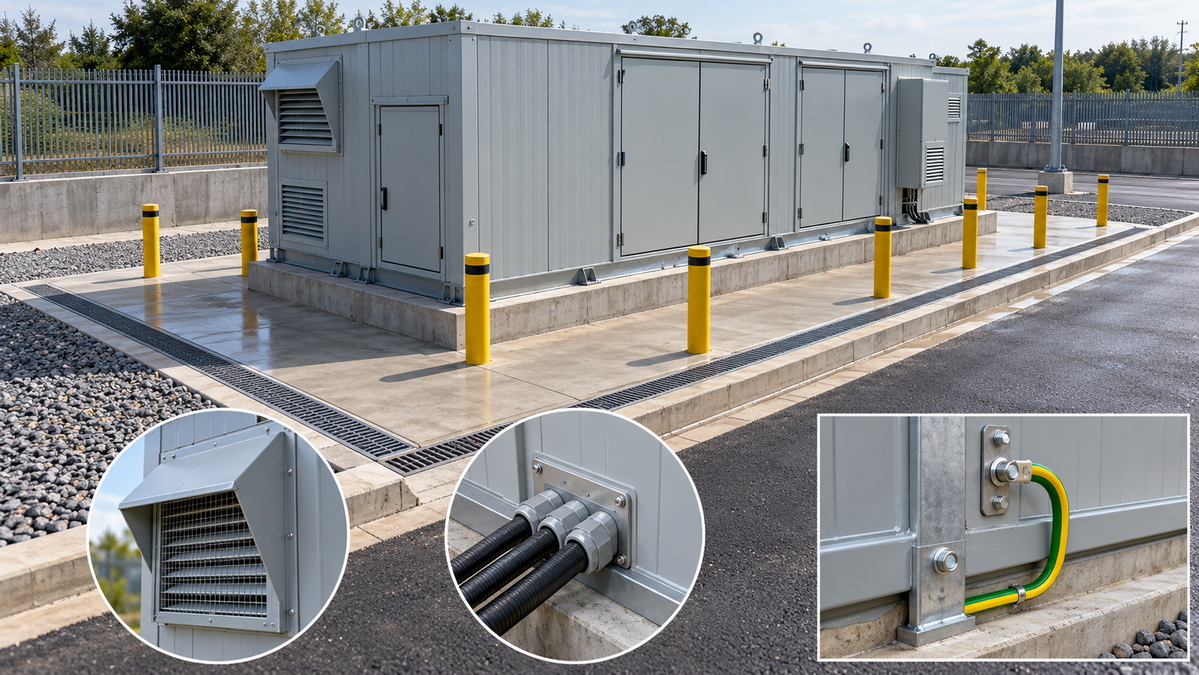
An internal arc can produce extreme heat, pressure, and hazardous gases. Equipment arrangement and pressure-relief paths therefore require specialist attention.
For substations assessed under the relevant classification framework, accessibility A concerns authorized personnel, while accessibility B concerns public accessibility.
Ask which configuration was tested, what current and duration were used, and which operating conditions apply. A classified switchgear panel does not automatically establish equivalent protection for the entire container installation.
Ventilation should reflect transformer and equipment losses, ambient temperature, solar exposure, and permitted operating temperatures.
A hot, dusty site may require a different solution from a mild coastal location. Filters, cooling equipment, and ventilation openings also need inspection and maintenance access.
Request documented thermal assumptions. Avoid treating a generic fan specification as evidence that the complete installation will operate satisfactorily.
Provide the incoming voltage, frequency, required output voltage, load schedule, operating pattern, and expected expansion.
Include large motors, variable-speed drives, and other loads that may affect system design. The responsible electrical engineer should determine ratings and protection requirements.
State the temperature range, altitude, humidity, dust exposure, corrosion conditions, flood risk, and relevant structural loads.
"Outdoor use" is too broad to serve as a complete specification.
Review working spaces, door openings, equipment withdrawal paths, and replacement arrangements.
A transformer that fits during factory assembly may still be difficult to replace after the unit is installed between other buildings.
Confirm overall dimensions, operating and shipping weights, lifting points, center of gravity, and route restrictions.
State whether equipment ships installed or separately. Transport configuration can affect lifting plans, final assembly, and site testing.
Identify who supplies foundations, cable trenches, external cables, earthing connections, fire interfaces, and communication links.
Also define who obtains utility approval and who is authorized to energize the installation. Unassigned interfaces frequently become late project disputes.
Agree on factory acceptance activities before production. Depending on scope, these may include document review, dimensional inspection, wiring checks, interlock verification, and functional testing.
Factory acceptance does not replace site checks or utility authorization.
Request approved drawings, equipment data, test records, maintenance instructions, spare-parts recommendations, and warranty terms.
Documentation should identify the supplied configuration and responsible parties, not merely describe a generic product family.
Consider a project combining worker accommodation, a dining facility, offices, and a workshop. This is a planning example, not a completed customer case.
Selecting a transformer by adding equipment nameplates alone would leave important questions unanswered.
The design team should examine operating schedules, simultaneous demand, motor starting, future buildings, and supply reliability requirements.
The building and electrical teams should then coordinate:
- Substation placement outside everyday pedestrian activity.
- Cable routes that avoid planned foundations.
- Access for maintenance vehicles and lifting equipment.
- Separation requirements determined by the relevant design.
- Drainage and equipment protection.
- Space for future distribution changes.
This coordination can prevent a common modular-project mismatch: buildings arrive ready for installation, but the electrical interfaces remain unresolved.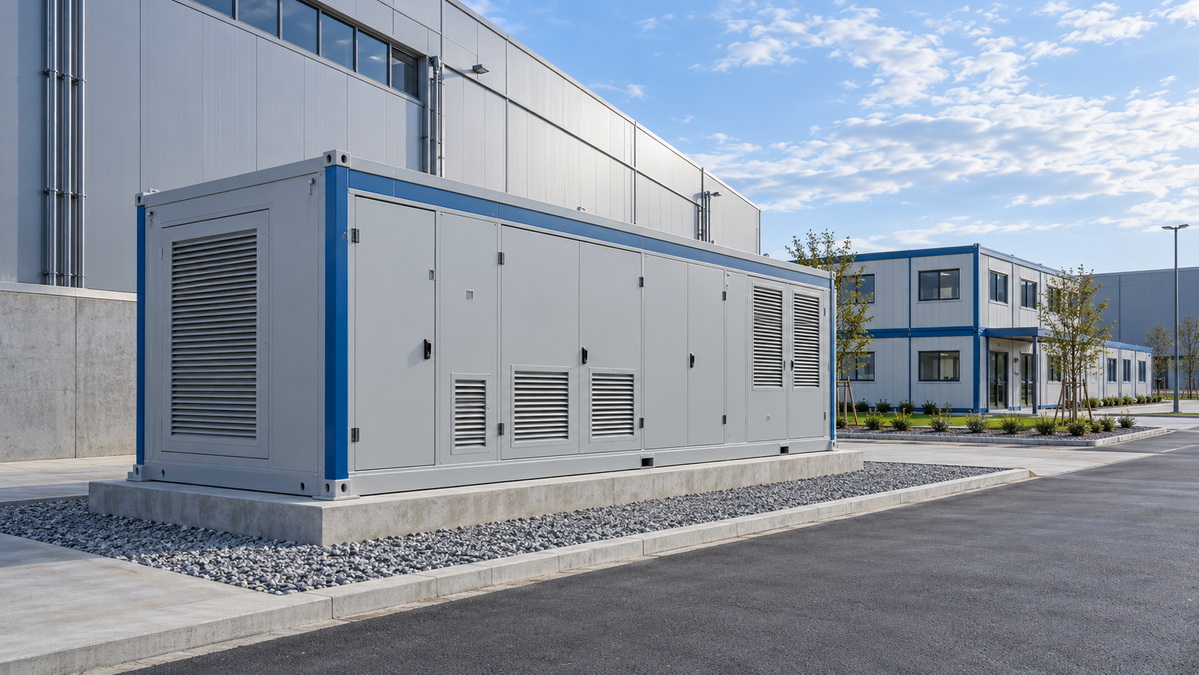
Welons Prefab is a Chinese manufacturer with 11 years of experience in quick-assembly prefab units and modular container buildings.
Its stated production capacity is 300 prefab units per day, supporting customized, OEM, wholesale, and one-stop building solutions for offices, dormitories, dining halls, meeting rooms, warehouses, exhibition spaces, and industrial facilities.
That building-production capacity should not be interpreted as daily substation production capacity or electrical certification.
For projects requiring both modular buildings and a containerized substation, procurement should distinguish the building or enclosure scope from electrical design, equipment integration, testing, and commissioning.
Ask Welons Prefab to confirm the available scope before placing an order. Where specialist electrical partners are required, responsibilities should be documented from the quotation stage.
A successful container substation project depends on coordinated engineering, clearly assigned responsibilities, and verifiable performance—not simply a transportable steel shell.
Send Welons Prefab your building schedule, destination, site layout, environmental conditions, and required electrical interfaces. Request a coordinated proposal that clearly separates prefab-building supply, enclosure requirements, specialist electrical work, and site responsibilities.
No. A shipping container is a transport structure. A container substation is an engineered electrical installation. Modifying a freight container does not, by itself, establish electrical safety or system compliance.
There is no universal installation period. Factory integration can reduce site assembly, but foundations, cables, approvals, testing, and network availability determine when the installation can be energized.
Potentially, if relocation has been considered in the design. Equipment restraint, lifting provisions, disconnection procedures, transport limitations, and recommissioning requirements must be reviewed before movement.
Yes, provided the complete installation is designed for the specified conditions. Equipment losses, ambient temperature, solar gain, cooling reliability, and maintenance needs must be evaluated together.
Cost depends on electrical ratings, transformer specification, switchgear, enclosure construction, cooling, testing, transport, and site works. Comparable quotations require a shared technical specification and clearly defined supply boundaries.
The company information provided establishes modular-building capabilities, not a verified turnkey substation offering. Buyers should request written confirmation of electrical scope, specialist partners, testing responsibilities, and certification evidence.
1. CIMC TLC RYC. "What Is a Container Substation?" Original article supplied for restructuring; background on components, applications, advantages, and limitations. [tlc-yz]
2. Schneider Electric, Electrical Installation Guide. "Outdoor Substations." Updated August 5, 2026. Technical reference for prefabricated substation verification, enclosure arrangements, earthing, temperature performance, and installation benefits. [electrical-installation]
3. International Electrotechnical Commission. *IEC 62271-202:2022 — High-voltage switchgear and controlgear — Part 202: AC prefabricated substations for rated voltages above 1 kV and up to and including 52 kV.* Standard preview supporting the stated scope and classification framework. [cdn.standards.iteh]
4. ABB. *UniSec for Compact Secondary Substation Tested According to IEC 62271-202.* Technical brochure explaining internal-arc testing, accessibility categories, and pressure-relief arrangements for the described tested configuration. [library.e.abb]B_1VCP000577%20-%20Digiprint.pdf)
5. Schneider Electric. "Low Voltage/Medium Voltage Prefab Substations." Manufacturer reference illustrating configurable prefabricated substation product scope and space-constrained applications. [se]


