
Views: 273 Author: Welons Prefab Houses Publish Time: 2026-11-11 Origin: Site


Content Menu
>> When Tricon Containers Make Sense
● What Is a Quadcon Container?
>> When Quadcon Containers Make Sense
● Tricon vs Quadcon Containers: Comparison Table
● Does a Quadcon Offer More Capacity Than a Tricon?
>> Compare Internal Volume, Not Just Container Count
>> Keep Payload and Gross Weight Separate
● How Do Tricon and Quadcon Containers Connect?
● How to Choose the Right Modular Freight Container
>> Step 1: Measure the Complete Cargo Package
>> Step 2: Map the Distribution Pattern
>> Step 3: Check the Entire Transport Route
>> Step 4: Compare Total Delivered Cost
● Practical Example: Planning Storage for a Construction Site
● Tricon and Quadcon Containers vs Prefab Container Houses
>> Cargo Approval Is Not Building Approval
>> When Purpose-Designed Prefab Buildings Are More Appropriate
● Planning a Complete Site with Welons Prefab
>> What is the main difference between Tricon and Quadcon containers?
>> Are Quadcon containers always larger in total capacity?
>> Are all Quadcon containers the same height?
>> Can Tricon and Quadcon containers be mixed in one assembly?
>> Can a Tricon or Quadcon become an office?
>> Does Welons Prefab manufacture Tricon and Quadcon freight containers?
The main difference between a Tricon container and a Quadcon container is how many individual modules connect to form a standard 20-foot shipping footprint: three Tricons or four Quadcons. A Tricon generally provides a larger individual compartment, while a Quadcon divides the shipment into smaller, independently accessible units.
However, four modules do not automatically provide more total storage than three. Internal dimensions, container height, tare weight, and approved operating limits determine the actual result.
For buyers planning equipment storage, construction logistics, or prefab container houses, this distinction matters. Selecting the right system starts with understanding whether your priority is moving cargo, distributing supplies, or creating usable building space.
A Tricon is a compact freight container designed to operate independently or connect with two compatible units into a 20-foot intermodal footprint.
Common external dimensions are approximately 6 feet 5½ inches long, 8 feet wide, and 8 feet high. Individual specifications vary by manufacturer and configuration.
Its larger compartment can accommodate equipment that would be difficult to fit inside a smaller Quadcon. Typical features include steel construction, cargo doors, lifting provisions, and forklift pockets.
Tricons are worth considering when you need:
- Larger tools, maintenance equipment, or bulky spare parts.
- Separate storage for three teams or destinations.
- Fewer individual modules to identify and manage.
- Consolidated transport followed by independent distribution.
From a procurement perspective, the critical question is not simply whether an item fits inside. It must also pass through the door and leave enough clearance for securing, loading, and removal.
A Quadcon is a smaller modular freight container. Four compatible units connect to occupy a standard 20-foot transport footprint.
Common external dimensions are approximately 4 feet 9⅜ inches along the shorter footprint dimension and 8 feet across. Available heights include 6 feet 10 inches and 8 feet.
Suppliers sometimes label length and width differently. Compare dimensioned drawings rather than relying on dimension labels alone.
Quadcons suit operations that benefit from smaller, separately assigned storage units, including:
- Tools organized by trade or work crew.
- Spare parts divided between maintenance locations.
- Supplies prepared for several delivery points.
- Equipment requiring controlled departmental access.
Their advantage is finer distribution, not automatically greater capacity. Smaller compartments can improve organization, but they may also prevent long or bulky items from fitting.
The following comparison describes common configurations, not universal specifications.
| Selection factor | Tricon container | Quadcon container |
|---|---|---|
| Modules per 20-foot footprint | Three | Four |
| Typical individual footprint | Approximately 6′5½″ × 8′ | Approximately 4′9⅜″ × 8′ |
| Common external heights | 8′ | 6′10″ or 8′ |
| Individual compartment | Generally larger | Generally smaller |
| Distribution pattern | Three independently assigned units | Four independently assigned units |
| Typical planning advantage | Accommodating larger equipment | Separating smaller equipment packages |
| Main dimensional concern | Actual door and internal clearances | Shorter compartment and height variation |
| Weight limits | Verify the selected model | Verify the selected model |
| Building suitability | Requires a separate design assessment | Requires a separate design assessment |
Both systems support modular logistics. Neither is automatically the better choice for every project.
No. Module count alone cannot establish total usable volume or payload.
Four smaller boxes can provide less combined internal space than three larger boxes. Additional walls, frames, and differences in height influence the result.
One published Tricon specification lists approximately 348 cubic feet of internal capacity per unit.
A supplier's Quadcon specifications list approximately 220 cubic feet for a lower-height version and 260 cubic feet for a taller version.
Using those examples:
- Three Tricons provide approximately 1,044 cubic feet.
- Four lower-height Quadcons provide approximately 880 cubic feet.
- Four taller Quadcons provide approximately 1,040 cubic feet.
These figures illustrate why the original "33% more volume" claim is unreliable. They compare particular published configurations, not every product available.
Usable space may decrease further after adding shelving, protective cases, restraints, or access aisles.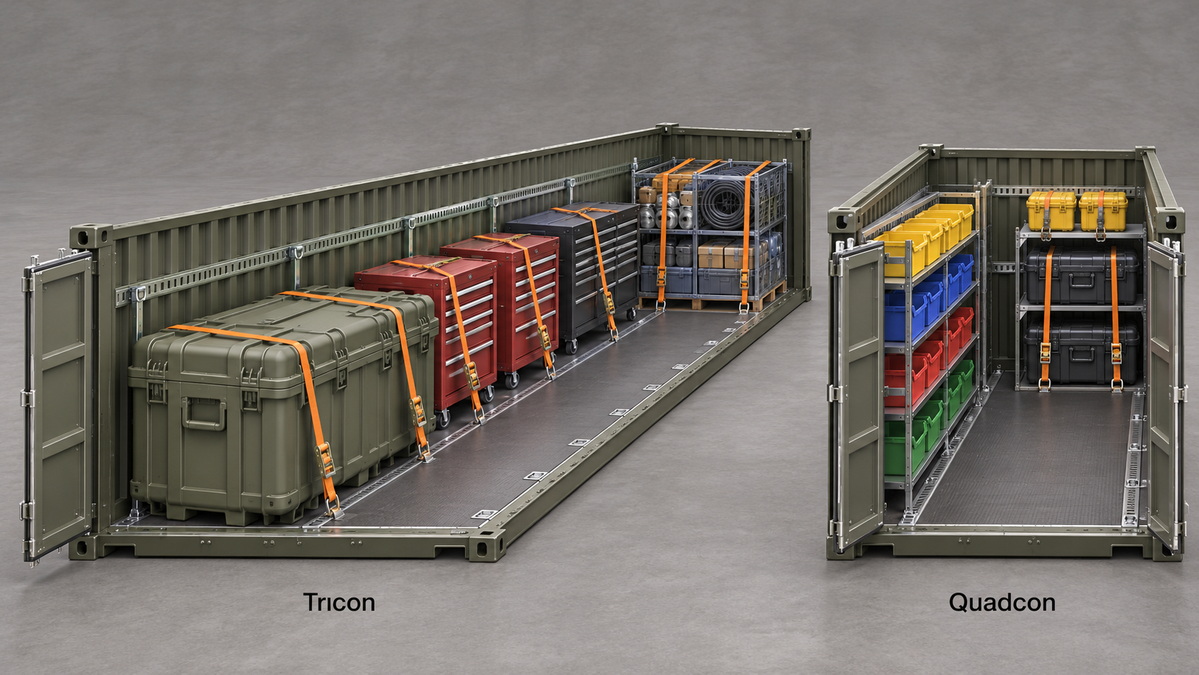
Tare weight is the empty container's weight. Payload is the permitted cargo weight. Maximum gross weight includes both.
Do not assume that multiplying individual payload ratings establishes the permitted load for a connected assembly. Confirm the assembly's approved configuration, connector requirements, handling limits, and transport restrictions.
Ask the supplier to provide these details in writing before booking transport.
Compatible modules use connecting hardware to create the required transport configuration.
However, connector systems are not interchangeable simply because two containers look similar. Corner geometry, hardware condition, operating instructions, and approval documentation all matter.
Before assembly, verify:
1. The containers belong to a compatible system.
2. The specified connectors are available and serviceable.
3. Contact points and corner fittings are undamaged.
4. Operators follow the manufacturer's assembly procedure.
5. The completed assembly is approved for the intended handling method.
A practical rule is to treat the connected assembly as an engineered system, not a group of boxes fastened together.
Likewise, forklift pockets do not mean every forklift can safely handle every loaded unit. Equipment capacity, load center, fork dimensions, and ground conditions must be checked.
A useful purchasing process starts with your cargo and destination, not the product name.
Record the dimensions and weight of the largest item, including its pallet, protective packaging, and lifting attachments.
Then compare:
- Door opening width and height.
- Internal length, width, and height.
- Space required for restraints.
- Clearance for loading equipment.
- Access needed during unloading.
A container can have sufficient cubic capacity while still being unsuitable for one oversized item.
Identify how many teams, departments, or locations need independent access.
Three larger equipment packages may favor Tricons. Four smaller packages may favor Quadcons.
Also consider whether each destination can receive and handle an individual module. Smaller size does not remove the need for suitable unloading equipment.
Confirm requirements with your carrier and logistics provider before ordering.
Review the consolidated shipping arrangement, destination handling equipment, road access, storage conditions, and any planned return journey.
Do not assume that a familiar footprint guarantees acceptance of every configuration.
Purchase price is only one part of the decision.
Include connectors, internal fittings, inspection, loading, unloading, inland transport, maintenance, and repositioning.
An additional compartment may improve inventory control. It may also create more separate loading and inspection tasks. The better option depends on your workflow.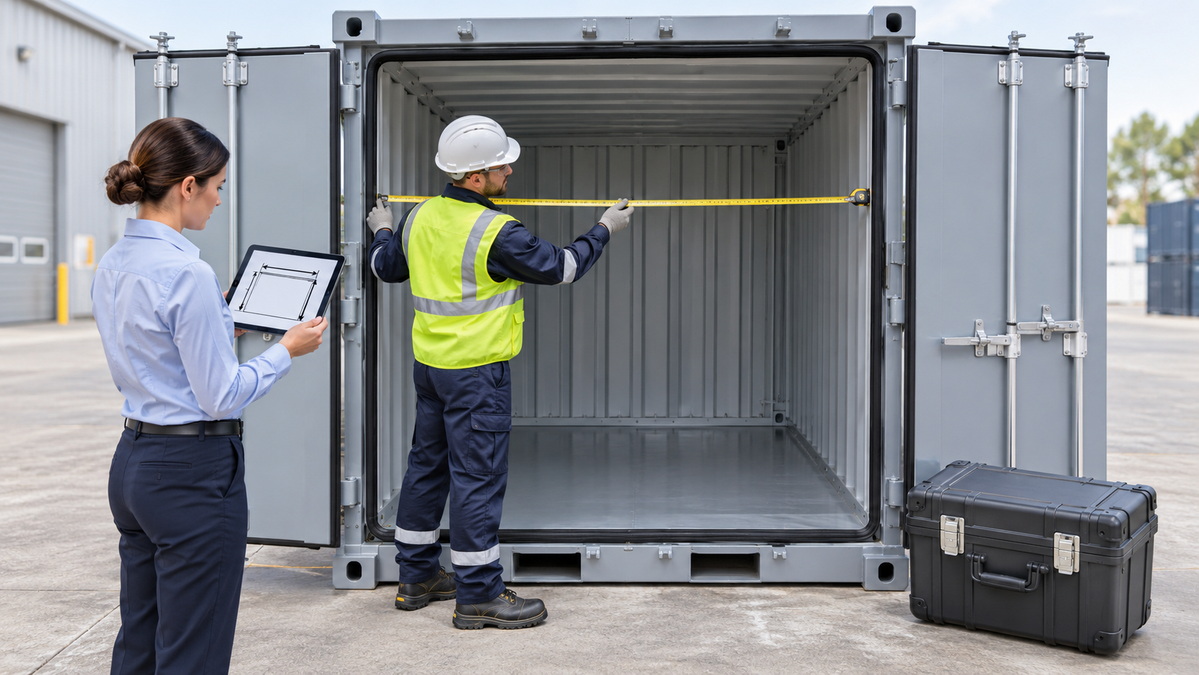
Consider a contractor supporting four installation crews.
Each crew needs a separate set of tools and consumables. Four Quadcons could provide one assigned storage unit per crew, reducing the need to separate supplies after arrival.
Now consider another contractor transporting three larger maintenance packages. Tricons may provide a more suitable compartment size, provided the equipment clears the doors and remains within the selected model's limits.
These are planning examples, not reported customer results.
The lesson is straightforward: choose the compartment arrangement around the equipment and its users. Do not select four modules merely because four sounds like greater capacity.
For a project that also needs offices, accommodation, and dining facilities, storage selection becomes only one part of a broader site plan.
Freight containers and prefab container houses solve different problems.
Tricons and Quadcons primarily organize and transport cargo. Purpose-designed prefab buildings create spaces for people, work, services, and daily operations.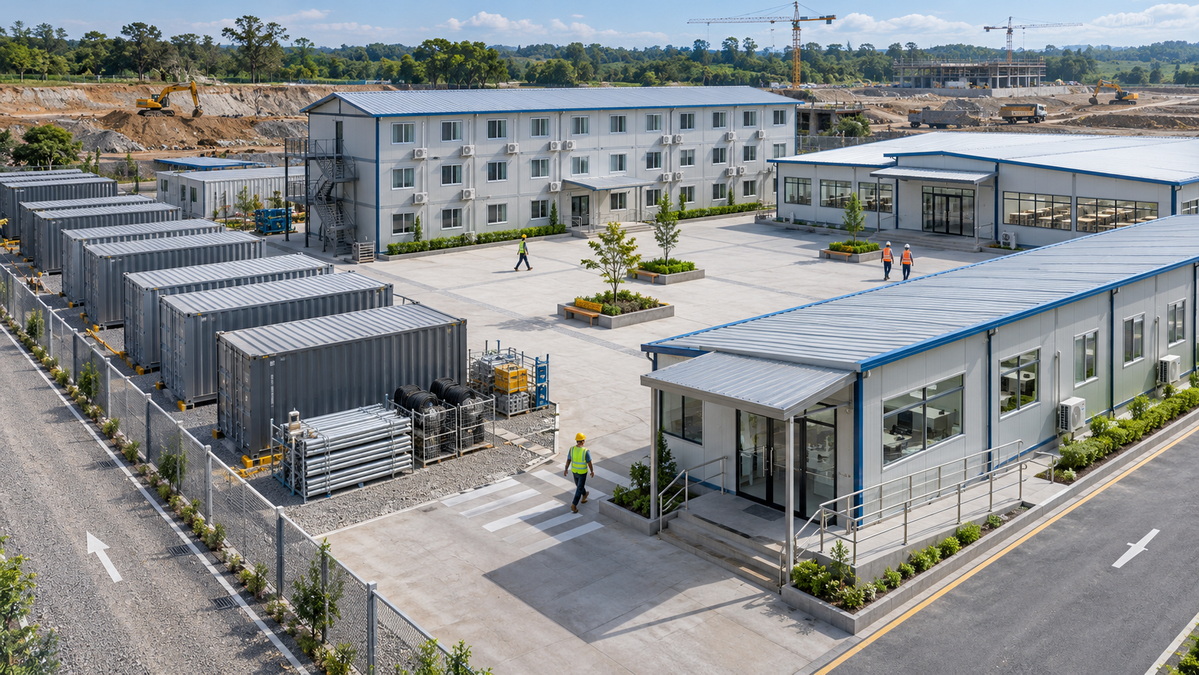
A container's transport documentation does not establish that it is suitable for use as an office, dormitory, or meeting room.
Building use introduces additional requirements, potentially including:
- Structural design for local wind, snow, and seismic conditions.
- Foundations and anchorage.
- Fire safety and emergency escape.
- Insulation, ventilation, and moisture control.
- Electrical and plumbing systems.
- Accessibility and occupancy requirements.
Applicable rules depend on the project location and intended use.
Cutting openings or removing wall sections can also change structural behavior. Such modifications require an appropriate engineering review rather than assumptions based on the original cargo rating.
For occupied spaces, begin with the room requirements and applicable building rules.
Offices need comfortable layouts and service integration. Dormitories require appropriate sleeping arrangements and sanitation. Canteens introduce additional ventilation, hygiene, and utility considerations.
Purpose-designed prefab container houses allow these requirements to guide the design from the beginning.
Larger warehouses, showrooms, and industrial facilities may require different spans and structural systems. A modular room unit should not be assumed to replace an industrial building without project-specific assessment.
At Welons Prefab, our approach is to distinguish cargo movement from occupied-space requirements before recommending a building solution.
With 11 years of professional experience, we manufacture prefab container houses and modular building solutions for offices, dormitories, canteens, meeting rooms, warehouses, showrooms, and industrial applications.
Our stated production capacity is 300 units per day. Actual delivery schedules depend on specifications, customization, order quantity, production allocation, and shipping arrangements.
We support customization, OEM manufacturing, wholesale procurement, and one-stop project requirements.
To prepare a useful proposal, send us:
- Project location and intended applications.
- Required room quantities and occupancy.
- Preliminary layouts or available site dimensions.
- Climate and design-load requirements.
- Insulation, finish, and utility preferences.
- Delivery schedule and site-access restrictions.
For your next project, ask Welons Prefab for a configuration-based proposal that separates storage needs from building needs and clearly defines specifications, supply scope, exclusions, and installation responsibilities.
Three Tricons or four Quadcons connect into a standard 20-foot transport footprint. A Tricon generally provides a larger individual compartment; a Quadcon provides smaller, more finely divided storage.
No. Combined capacity depends on the actual internal dimensions and height of the selected models. Four smaller modules do not automatically provide more volume than three larger ones.
No. Published product ranges include 6-foot-10-inch and 8-foot-high versions. Confirm external height, internal clearance, and door opening dimensions before ordering.
Do not assume so. Only use combinations specifically approved by the relevant manufacturer or system documentation. Similar-looking fittings do not establish compatibility.
Potentially, but transport suitability alone is insufficient. The proposed conversion needs assessment for structure, usable dimensions, insulation, ventilation, utilities, fire safety, and applicable local requirements.
The company information supplied for this article establishes Welons Prefab's prefab housing and modular building capabilities. Buyers should request separate confirmation of any Tricon or Quadcon freight-container offering and its supporting documentation.
1. CIMC TLC — "What Is the Difference Between a Tricon Container and Quadcon Container?" Original article reviewed for topic coverage and claims requiring correction. Its generalized capacity comparison is not adopted here. [tlc-yz]
2. Pro Box — "Tricon — Dimensions & Specifications." Source for representative Tricon dimensions, published internal volume, and configuration variability. [proboxinc]
3. SEA BOX — "Quadcon Dry Freight Containers." Manufacturer information confirming four-unit consolidation, available heights, and configuration options. [seabox]
4. W&K Container — "Quadcon Shipping Containers." Supplier specifications for lower-height and taller Quadcon models, including internal capacities and door dimensions. [oceancontainer]
5. U.S. Transportation Command — "Defense Transportation Regulation, Part VI, Appendix B: Department of Defense Intermodal Container Standards." Official reference identifying the Tricon dimensional configuration; not used here to establish a universal payload rating. [business.ustranscom]
6. UpCodes — "Section 3114: Intermodal Shipping Containers." Jurisdiction-specific building-code provisions illustrating the distinction between freight-container specifications and requirements for containers repurposed as buildings. Local applicability must be checked. [up]


