
Views: 285 Author: Welons Prefab Houses Publish Time: 2026-10-06 Origin: Site


Content Menu
● How a Reefer Container Controls Temperature
>> Why Airflow and Loading Matter
● Complete a Pre-Trip Inspection Before Loading
● Troubleshoot Common Reefer Container Problems
>> What to Check When Cooling Is Weak
>> What to Check When Frost Appears
● Interpret Temperature Changes in Context
● Plan Power Handoffs and Preserve Alarm Data
● Build a Maintenance Schedule Around Operating Risk
● Respond to a Temperature Excursion
● Define Cold-Chain Responsibilities in Modular Projects
● Reefer Container Maintenance FAQs
>> How often should a reefer container be inspected?
>> What should I check first if a reefer is not cooling?
>> Can a pre-trip test be run with cargo inside?
>> Does a temperature alarm mean the cargo is damaged?
>> Should refrigerant be added when cooling is weak?
>> Does a prefab container-house supplier automatically provide reefer systems?
A reefer container can be running while its cargo is still at risk. Learn how to complete a pre-trip inspection, investigate cooling problems, interpret temperature trends, manage power handoffs, and respond to alarms. The guide also explains how to define cold-chain responsibilities in a modular building project.
A reefer container can appear to operate normally while a blocked airflow channel, damaged door gasket, incorrect setpoint, or missed power interruption puts its cargo at risk. Effective reefer container maintenance and troubleshooting therefore begins before loading and continues through every power handoff and temperature check.
This guide helps operators identify safe first checks, preserve useful records, and recognize when a qualified technician is needed. It also explains an important distinction: restoring the refrigeration unit does not, by itself, establish that the cargo remains acceptable.
A refrigerated shipping container combines a refrigeration unit with insulated walls, sealed doors, fans, sensors, and a controller. The system is generally intended to maintain cargo prepared to its required shipping condition, not to serve as a substitute for the shipper's product-preparation process.
Operators should distinguish between four values:
- Setpoint: The temperature entered into the controller.
- Supply-air temperature: Air measured as it leaves the refrigeration unit.
- Return-air temperature: Air measured as it returns to the unit.
- Product temperature: A measurement taken from the cargo using an appropriate procedure or independent device.
These readings may differ without indicating that every part of the load is at the same temperature. When investigating a problem, identify the sensor and time stamp before drawing conclusions.
In many reefer designs, conditioned air travels through floor channels before circulating around the load. Debris in the channels or cargo stacked against a required airflow path can reduce effective cooling. Door openings introduce warm, moist air and add to the work the unit must do.
Loading requirements vary by container, commodity, and shipping plan. Follow the applicable equipment instructions and the shipper's loading specification rather than relying on a universal clearance rule.
A pre-trip inspection (PTI) checks more than whether the controller lights up. Depending on the unit, its diagnostic routine may assess sensors, electrical functions, and refrigeration performance. Some tests alter normal operation, so complete the required model-specific procedure before loading. Do not assume a diagnostic test is safe to run with critical-temperature cargo inside.
Use this sequence to organize the inspection:
1. Confirm the shipment specification. Record the container ID, refrigeration-unit model, cargo description, setpoint, permitted temperature range, and any ventilation or humidity instructions. Identify who receives alarms.
2. Inspect the enclosure. Check door alignment, gaskets, walls, roof, floor channels, drains, cleanliness, odors, standing water, and visible damage. Record defects before the container is loaded.
3. Confirm the power arrangement. Verify the approved supply and connection procedure. If the journey involves a generator or a change of power source, establish who will check that the unit is operating after the transfer.
4. Make safe external checks. Look for condenser obstruction, damaged cables, loose panels, and impact damage. Do not open electrical panels or reach into moving machinery without authorization.
5. Verify the controller. Check the setpoint and configured options, review alarm history, run the required PTI, and save its result with the shipment record.
6. Prepare for loading. Precondition the empty container if the shipping procedure requires it. Verify product condition as specified, preserve the airflow path, and minimize the time the doors remain open.
The checklist is a planning aid, not a replacement for the installed unit's manual or a cargo-specific handling procedure.
A symptom tells you where to investigate, not which component has failed. Before clearing an alarm, capture its exact code, time, and accompanying temperature readings. Use the manual for the installed controller to interpret it.
| Symptom | Safe first checks | Likely area for further investigation |
|---|---|---|
| Unit will not start or stops repeatedly | Confirm authorized power status, controller display, and alarm history | Power supply, protective trip, or electrical fault |
| Temperature rises beyond the shipment limit | Check the reading, setpoint, doors, loading pattern, and power history | Warm cargo, restricted airflow, incorrect settings, or equipment fault |
| Unit runs continuously with slow pull-down | Look for external condenser obstruction, door leakage, and temperature trends | High heat load or a refrigeration-performance problem |
| Frost or water accumulates | Check door closure, visible drains, and defrost history | Moisture ingress, blocked drainage, or a defrost-related fault |
| Unusual noise or vibration occurs | Keep clear of moving parts; record when the sound occurs | Loose, damaged, or failing components |
| An alarm appears while one reading looks normal | Save the code and compare other readings and logs | Sensor, controller, or intermittent fault |
If a safe external check does not explain the issue, give a qualified technician the alarm history, temperature trend, and PTI record. Avoid diagnosing a compressor failure or refrigerant leak from a single symptom.
Work from the simplest verifiable conditions toward specialist diagnosis. First, confirm that the displayed setpoint matches the shipment specification and that you are reading the intended sensor. Then review power continuity, door closure, loading, and accessible airflow paths.
A unit that runs for a long time may be responding to warm incoming cargo or a high heat load; it may also have a fault. The records and operating context matter. Do not add refrigerant simply because a container feels warm. Refrigerant-circuit testing and charging require proper diagnosis and qualified service personnel.
Frost or excess water can be associated with moisture entering through open doors or damaged seals, drainage problems, or a defrost issue. Check the door condition and relevant operating history without dismantling the unit.
If icing persists, report when it began and whether it followed loading, repeated door openings, or an alarm. A technician can then assess the defrost system and other possible causes using the model-specific procedure.
A temperature excursion should be investigated as a sequence of events, not judged from one screenshot. Compare the setpoint, supply-air and return-air readings, independent logger data where available, and the time each measurement was taken.
Ask when the change began. Did it follow loading, a door opening, a power transfer, or a defrost event? Was the unit operating in a mode appropriate for the shipment? These details help distinguish a temporary change in measured air temperature from a sustained problem requiring cargo assessment.
Next, look for conditions an operator can verify safely: obstructed floor channels, an unsuitable loading pattern, door leakage, or an externally blocked condenser. Confirm that any fresh-air vent position matches the commodity instructions. There is no single vent setting for every load.
If readings remain outside the shipment's limits, notify the designated cargo decision-maker while a technician investigates the equipment. The person repairing the reefer and the person deciding whether to accept the goods have different responsibilities.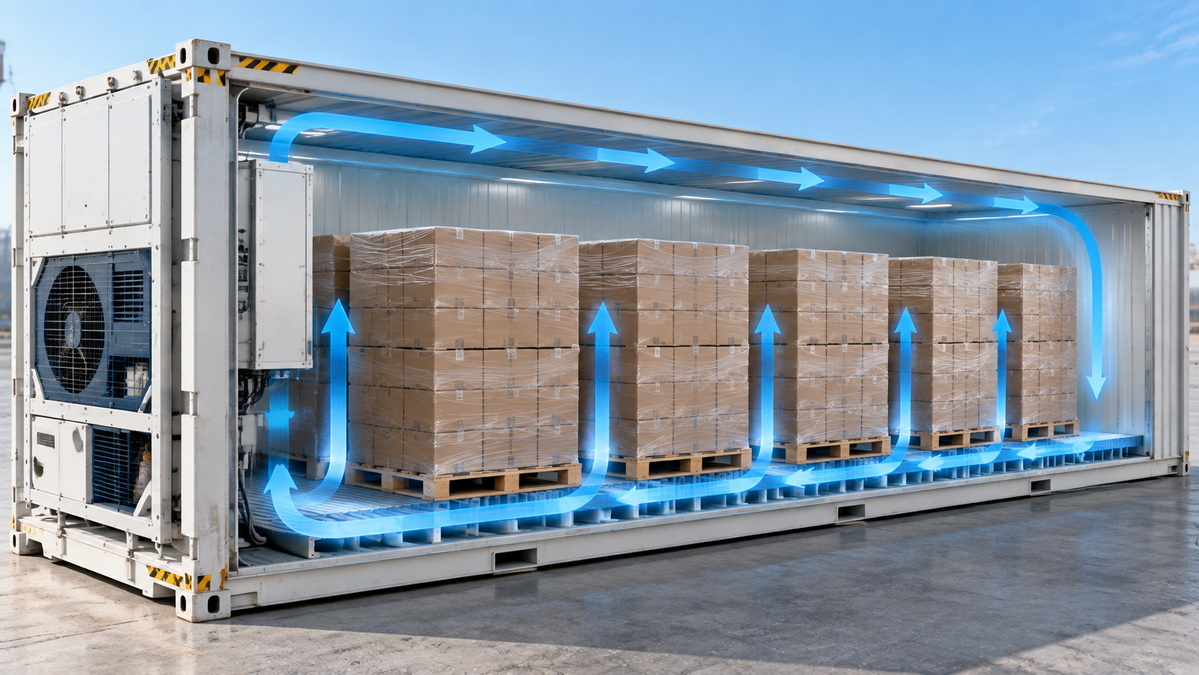
A reefer depends on suitable power throughout its journey. A yard, terminal, vehicle, and destination facility may each handle a connection. A reliable plan names the person responsible for connecting, checking, and monitoring the unit at every handoff.
If backup generation is part of that plan, specify the equipment, fuel arrangements, testing, and operator responsibility. Do not assume that a generator or battery automatically maintains full refrigeration unless the installed system has been designed and verified to do so.
When an alarm occurs, record:
- Container ID, location, date, and time.
- Exact alarm code and controller status.
- Setpoint and available supply-air and return-air readings.
- Recent loading, door-opening, and power-transfer events.
- Corrective action, responsible person, and follow-up readings.
Export the unit's data log when the installed controller supports it. After service, confirm that the fault has been addressed and monitoring has resumed. Clearing an alarm is not proof of repair.
A single service interval cannot account for every reefer, climate, and operating pattern. Salt exposure, dusty yards, frequent door openings, and extended stationary use may increase inspection needs. Use the manufacturer's instructions as the foundation, then review recurring defects and operating records.
- Before each load: Inspect the enclosure, drainage, accessible airflow paths, external condition, settings, alarms, and PTI results.
- During operation: Check power status, temperature trends, and alarm acknowledgments at the frequency set by the shipment plan.
- After unloading: Clean and dry the interior using a method suitable for the previous cargo; document new impact damage, gasket defects, or leaks.
- At scheduled service: Have qualified personnel inspect relevant sensors, electrical components, fans, defrost functions, and suspected refrigerant leaks.
Keep a record of what was checked, what was repaired, and whether the same defect returned. Do not assume that every fan motor needs lubrication or that every cooling problem calls for refrigerant: service requirements depend on the exact components and fault found.
A useful response plan separates equipment recovery from cargo acceptance. If an alarm or trend suggests a possible excursion, take these steps in order:
1. Protect people. Keep unqualified personnel away from damaged electrical equipment, exposed machinery, or a suspected leak. Follow site safety procedures.
2. Preserve the record. Save alarms, temperature trends, the setpoint, power-transfer times, and relevant photos. Describe observations without assigning an unconfirmed cause.
3. Stabilize the operation. Confirm safe power and closed doors. Follow the approved plan for continued monitoring, backup generation, or cargo transfer.
4. Notify the responsible parties. Contact the refrigeration service provider and the shipper or cargo-quality team. Share the event history, not just the latest display reading.
5. Document the outcome. Record the diagnosis, work completed, functional check, subsequent trend, and cargo disposition decision.
A repaired unit does not automatically make its cargo acceptable. Equally, a brief rise in measured air temperature does not automatically establish product damage. The shipment's limits, time-stamped evidence, and applicable product-assessment procedure should guide the decision.
If a project needs both refrigerated cargo space and modular site facilities, specify each system separately. A proposal should identify the reefer-unit model, electrical requirements, airflow arrangement, drainage, monitoring interface, alarm process, service support, spare parts, and handover documentation.
For a fixed-site installation, also plan power capacity, condenser ventilation, drainage, safe maintenance access, and applicable local approvals before procurement. A setpoint alone is not a complete cold-chain specification.
The division of responsibility becomes especially important when a site also requires prefabricated offices, dormitories, canteens, meeting rooms, warehouses, exhibition areas, or industrial facilities. Ask who supplies and warrants the refrigeration equipment, who designs the electrical interface, and who performs commissioning. A modular building and a refrigerated cargo unit are different product scopes.
Welons Prefab is a China-based manufacturer of prefab container houses and modular buildings. According to its company information, it has 11 years of professional experience and production capacity of 300 units per day. Buyers considering a combined project should request a written proposal that clearly distinguishes Welons Prefab's modular facilities from any specialist reefer equipment and services.
Reliable reefer operation depends on more than a working compressor. A documented pre-trip inspection, unobstructed airflow, dependable power, useful alarm records, and a clear escalation plan all help protect temperature-sensitive cargo. When a problem occurs, preserve the evidence, address the equipment fault, and let the responsible cargo team assess the goods.
If your cold-chain project also requires modular offices, dormitories, canteens, meeting rooms, warehouses, or other site facilities, share your layout, location, quantities, and interface requirements with Welons Prefab for a tailored OEM or wholesale proposal. Confirm the specialist reefer supply, commissioning, and service arrangements separately before placing an order.
Inspect the container before loading and monitor it throughout operation under the shipment plan. Base deeper service intervals on the installed unit's instructions, operating environment, and fault history rather than an interval copied from another model.
Confirm the shipment setpoint and the temperature reading you are viewing. Then check authorized power status, doors, alarms, and accessible airflow obstructions. If the problem remains unexplained, call a qualified refrigeration technician.
Do not assume that it can. Some pre-trip routines change normal operating conditions and are unsuitable for critical-temperature cargo. Check the installed unit's instructions and complete required testing before loading.
Not necessarily. An alarm calls for prompt investigation. Compare time-stamped air-temperature data with available product evidence and the shipment's acceptance rules. The responsible cargo-quality team should make the disposition decision.
No—not without a diagnosis. Power problems, restricted airflow, controls, sensors, and other faults can also affect cooling. Have qualified personnel assess the system before any refrigerant work.
No. Confirm the written supply and service scope, including the refrigeration unit, electrical interface, monitoring, commissioning, warranty, and maintenance responsibilities.
1. [CIMC Yangzhou Base, "Common Maintenance and Troubleshooting Issues for Reefer Containers"] — Original article used to identify the topic and common maintenance concerns; its company-specific claims are not attributed to Welons Prefab. [tlc-yz]
2. [Carrier Transicold, *Operations and Service Manual for 69NT40-561-300 to 399 Container Refrigeration Units*, T-365 Rev D] — Technical reference for pre-trip procedures, operating modes, alarms, data recording, troubleshooting, and service precautions. [shareddocs]
3. [Carrier Transicold, "Container Refrigeration—Mobile Manuals"] — Directory for identifying applicable container refrigeration and generator-set documentation. [transcentral.carrier]
4. [U.S. Food and Drug Administration, "Guidance for Industry: Sanitary Transportation of Food"] — Guidance on temperature control, loading, sanitation, maintenance, and communication risks in food transport. [fda]
5. Welons Prefab company information supplied for this article — Source for the stated manufacturing experience, product applications, and daily production capacity; these company claims should be verified against current records before publication.


