
Views: 210 Author: Welons Prefab Houses Publish Time: 2026-09-22 Origin: Site


Content Menu
● Why Coastal Conditions Change Everything
>> Salt, humidity, and crevice corrosion
>> A practical coastal exposure scale
● Outdoor Kitchen: Benefits and Limitations
>> Main limitations near the sea
● Stainless Steel Outdoor Kitchen Advantages
>> Stronger corrosion resistance
>> Hygienic and easy-to-clean surfaces
>> Better fit for customization
>> 1. Specify the steel grade clearly
● Coastal Maintenance Checklist
● Build a Coastal Kitchen That Lasts
● FAQ
>> Is 304 stainless steel suitable for an outdoor kitchen near the beach?
>> Why is 316 stainless steel called marine grade?
>> Will a stainless steel outdoor kitchen rust in coastal areas?
>> What parts of an outdoor kitchen should use 316 stainless steel?
>> Can a stainless steel outdoor kitchen be installed in a prefab container building?
>> How often should a coastal stainless steel kitchen be cleaned?
>> Is a powder-coated finish necessary on stainless steel outdoor cabinets?
An outdoor kitchen can transform a patio, resort terrace, beachside villa, staff recreation area, or modular accommodation project into a more practical and valuable living space. However, when the installation is near the coast, choosing between a general outdoor kitchen and a stainless steel outdoor kitchen for coastal areas is not simply a design decision—it is a long-term material, durability, maintenance, and lifecycle-cost decision.
For projects exposed to salt air, high humidity, wind-driven rain, intense sunlight, and seasonal storms, a well-specified stainless steel outdoor kitchen—especially one built with 316 or 316L marine-grade stainless steel—usually provides the more reliable solution. The key is to evaluate not only the visible cabinet finish, but also the grade of steel, frame structure, welding quality, hardware, drainage design, countertop interfaces, and installation environment.
For Welons Prefab customers, this distinction matters because outdoor kitchens are increasingly integrated into prefab container auxiliary buildings, modular offices, workforce accommodation, food-service areas, exhibition spaces, resort units, and industrial support facilities. A kitchen module must be designed as part of the complete building system, not treated as a standalone cabinet purchase.
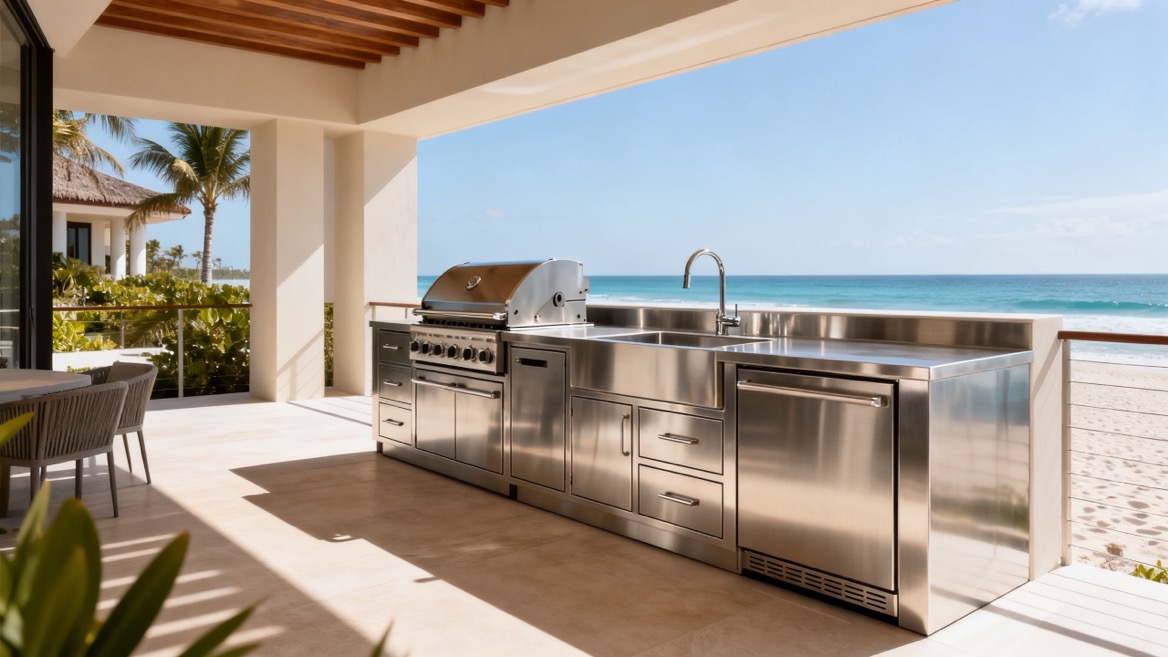
A general outdoor kitchen is a broad category. It may include masonry cabinets, powder-coated steel, aluminum, wood, composite panels, concrete, stone cladding, polymer cabinets, or stainless steel components. Its performance varies greatly according to the materials selected and the local climate.
A stainless steel outdoor kitchen is a more specific solution. Its cabinet body, doors, drawers, work surfaces, frames, sinks, and often internal structures use stainless steel. For coastal locations, the material specification becomes particularly important because not all stainless steel performs equally under chloride exposure.
| Comparison Area | General Outdoor Kitchen | Stainless Steel Outdoor Kitchen for Coastal Areas |
|---|---|---|
| Main materials | Can include wood, masonry, aluminum, coated steel, polymer, stone, or mixed materials | Primarily stainless steel cabinets, frames, doors, drawers, and work surfaces |
| Salt-air resistance | Depends heavily on material and coating quality | High when built with 316 or 316L stainless steel |
| Moisture resistance | Can be inconsistent, especially at joints and exposed edges | Strong resistance when seams, welds, and drainage are properly designed |
| Maintenance demand | Often higher in humid or marine environments | Lower, but regular salt removal remains essential |
| Appearance over time | May fade, crack, peel, swell, or stain | Retains a clean commercial appearance when maintained correctly |
| Customization potential | Wide range of styles and finishes | High flexibility for module sizes, appliances, storage, sinks, and commercial layouts |
| Best application | Mild climates, covered patios, low-exposure residential projects | Coastal homes, resorts, container buildings, beach clubs, staff facilities, and marine-adjacent projects |
The most important point is simple: "stainless" does not mean maintenance-free or corrosion-proof. It means the material has a protective chromium-rich surface layer that can resist corrosion under suitable conditions. Salt deposits, trapped moisture, poor drainage, low-grade hardware, dissimilar metals, and neglected cleaning can still create staining, pitting, or localized corrosion over time. Marine-grade material reduces that risk; it does not eliminate the need for correct design and upkeep.
A coastal outdoor kitchen faces a more aggressive service environment than an inland patio kitchen. Salt can travel in airborne mist, settle on cabinet surfaces, collect inside drawer tracks, remain in door gaps, and concentrate in crevices as water evaporates.
In my experience reviewing modular and outdoor facility specifications, the most expensive failures rarely begin with the visible front panel. They often begin at overlooked locations:
- Door hinges and drawer slides
- Cabinet-to-countertop joints
- Screw heads and fasteners
- Weld seams and corners
- Drainage channels
- Appliance cutouts
- Cabinet bases that trap standing water
- Areas where stainless steel touches carbon steel, aluminum, or untreated metal
These details determine whether a kitchen looks professional after years of coastal use—or begins developing tea staining, corrosion spots, swelling panels, loose hardware, and difficult-to-clean surfaces.
Salt contains chlorides. Chlorides are particularly challenging because they can attack the protective oxide layer on stainless steel, especially where moisture remains trapped. This may lead to pitting corrosion, which appears as small localized holes or dark corrosion marks, and crevice corrosion, which develops in narrow gaps with poor airflow or drainage.
Grade 304 stainless steel is widely used in food equipment, indoor kitchens, and ordinary outdoor applications. It offers good general corrosion resistance. However, it has more limited resistance when it is continuously exposed to salt-laden air or seawater-related chlorides.
Grade 316 stainless steel contains molybdenum, typically around 2–3%, which improves resistance to chloride-related pitting and crevice corrosion. This is why 316 is commonly described as marine-grade stainless steel.
Not every property near water needs the same kitchen specification. Use the following project-based approach.
| Exposure Level | Typical Site Conditions | Recommended Kitchen Approach |
|---|---|---|
| Low | Inland property with occasional coastal humidity | High-quality 304 stainless steel may be suitable with regular cleaning |
| Moderate | Coastal city, covered terrace, limited direct salt spray | 304 may work in protected areas; upgrade critical hardware and exposed components |
| High | Near shore, open patio, frequent salt air, strong wind, high humidity | 316 or 316L stainless steel for cabinets, hardware, sinks, and exposed components |
| Severe | Beachfront site, marina, direct spray zone, tropical coast, poolside chloride exposure | 316L minimum for key components; consider higher-resistance materials and enhanced protection for extreme exposure |
For many coastal projects, the safest commercial decision is to specify 316/316L stainless steel for exposed cabinetry, door hardware, sink assemblies, fasteners, and appliance-facing components. Industry guidance notes that 304 can be used for exposed fittings only where it is frequently washed with fresh water, while 316 is better suited to more demanding marine exposures.
A non-stainless outdoor kitchen can still be attractive and functional. For the right location, it can offer design freedom and lower initial investment.
- A wide choice of finishes, including stone, ceramic tile, wood-look surfaces, masonry, and powder-coated metals
- Easier visual matching with gardens, patios, restaurant terraces, and residential architecture
- Potentially lower initial cost for mild-climate projects
- Suitable for enclosed courtyards, covered rooftop spaces, or low-exposure inland installations
- Flexible construction methods for site-built kitchens
For an inland hospitality garden or a fully covered staff dining patio, a general outdoor kitchen may be sufficient. If the space is protected from wind-driven rain and salt, material options expand significantly.
The problem appears when a product designed for a typical patio is installed in a coastal environment without adaptation.
Common failure risks include:
- Wood swelling, splitting, or mold growth
- Powder-coating damage that exposes the metal underneath
- Masonry cracking caused by water intrusion and temperature movement
- Low-grade steel rusting beneath coatings
- Aluminum oxidation and corrosion at incompatible metal connections
- Polymer discoloration under long-term ultraviolet exposure
- Cheap hinges and fasteners failing before cabinet bodies do
A lower purchase price can become misleading if replacement, repainting, repair labor, and downtime occur repeatedly. For commercial prefab projects, replacement work can also disrupt guest use, staff operations, or food-service schedules.
A well-designed stainless steel outdoor kitchen offers several practical benefits for coastal installations, especially when it is built around a marine-grade specification rather than simply a shiny exterior finish.
The biggest advantage is material resilience. Grade 316 stainless steel performs better than 304 in salt-rich environments because molybdenum helps improve resistance to chloride attack. It is widely recommended for outdoor cabinetry in coastal locations.
This matters for more than cabinet doors. The same standard should extend to:
- Door hinges
- Drawer runners
- Handles
- Screws and bolts
- Sink bowls
- Drain fittings
- Grill surrounds
- Structural brackets
- Adjustable legs and base frames
One weak component can undermine the performance of the entire system.
Stainless steel has a smooth, non-porous surface that supports practical cleaning. This is particularly useful for:
- Resort food-preparation zones
- Employee dining facilities
- Outdoor barbecue stations
- Container café units
- Temporary event kitchens
- Construction-camp dining areas
- Beach-club service counters
For modular buildings, stainless steel also fits naturally with a clean, industrial, contemporary appearance. It can be fabricated into cabinets, worktops, splashbacks, shelving, sinks, service counters, and appliance housings with consistent dimensions.
A stainless steel kitchen is highly adaptable when planned at the manufacturing stage. Welons Prefab can support customized layouts that align the kitchen with a prefab container auxiliary building or modular facility.
Typical customization options include:
- Single-wall, L-shaped, U-shaped, or island layouts
- Integrated sinks and drainage boards
- Lockable storage cabinets
- Gas-grill or electric-grill cutouts
- Refrigerator and ice-maker openings
- Waste-bin compartments
- Adjustable shelving
- Commercial worktops
- Outdoor serving counters
- Ventilation openings
- Utility access panels
- Foldable counters for compact container units
- Branded panels for resorts, dealers, distributors, and project developers
A modular approach also supports OEM, wholesale, and project-based production, allowing buyers to standardize a kitchen model across multiple accommodation units, resort villas, labor camps, retail kiosks, or construction-site facilities.
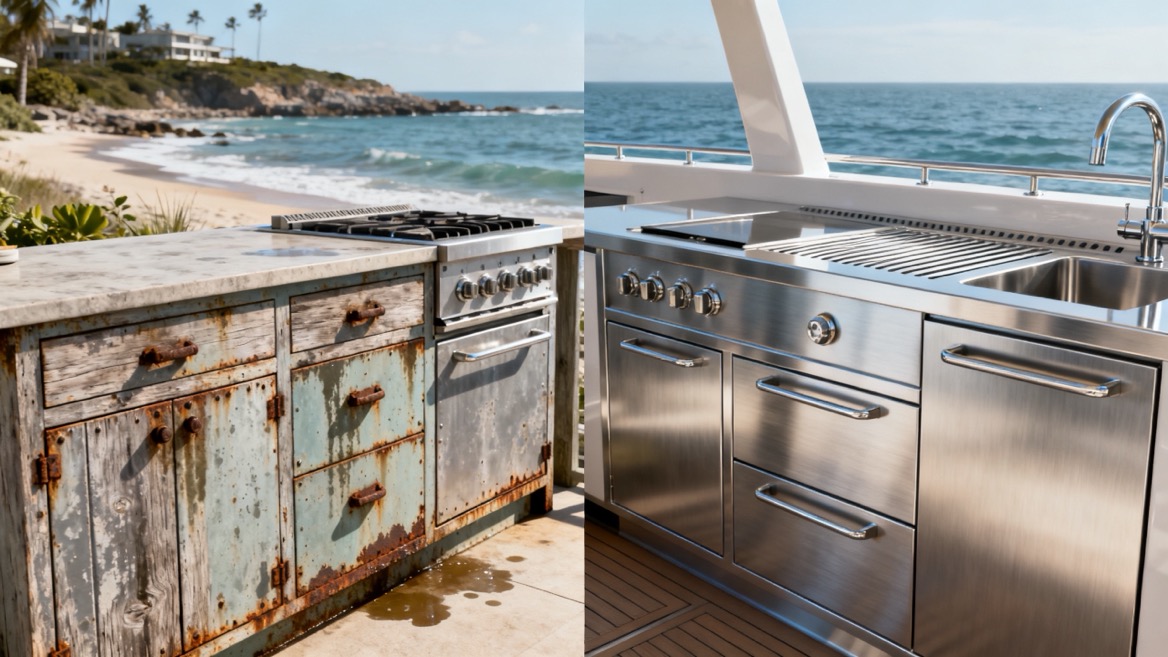
The most useful comparison for a coastal buyer is not simply "steel versus no steel." It is 304 versus 316/316L stainless steel.
| Material Feature | 304 Stainless Steel | 316 / 316L Stainless Steel |
|---|---|---|
| General use | Indoor kitchens, food equipment, mild outdoor settings | Coastal, marine-adjacent, salt-air, and chloride-rich environments |
| Molybdenum content | No meaningful molybdenum addition | Usually around 2–3% molybdenum |
| Resistance to salt air | Moderate; can stain or pit without frequent cleaning | Higher resistance to salt, humidity, and chloride exposure |
| Coastal suitability | Better for protected or lower-exposure areas | Better for open coastal sites and high-exposure installations |
| Initial cost | Lower | Higher |
| Long-term value | Can be economical in mild climates | Often more economical over the lifecycle in coastal areas |
| Recommended use | Covered patios, inland projects, controlled environments | Beachfront kitchens, marinas, resorts, coastal container buildings |
Grade 316 is not automatically necessary for every project. If a kitchen is fully enclosed, well ventilated, far from the shore, and cleaned frequently, 304 may be a reasonable option. But for an open-air kitchen exposed to marine air, choosing 304 to reduce initial cost can create a higher maintenance burden later.
A useful procurement question is: What is the cost of avoiding material upgrades now compared with the cost of repair, replacement, and customer dissatisfaction later?
Material selection is only the beginning. The most durable stainless steel outdoor kitchen for coastal areas is designed to prevent salt and water from sitting where they can cause damage.
Do not accept vague descriptions such as "high-quality stainless steel" or "marine style finish." Request a clear specification for:
- Cabinet-body material grade
- Door and drawer-front material grade
- Sink material grade
- Hardware material grade
- Fastener material grade
- Countertop thickness
- Frame thickness
- Weld finishing method
For high-exposure projects, specify 316 or 316L stainless steel in the purchase documentation for components that directly face the environment.
Good drainage is an essential engineering feature. Cabinet tops should not create standing-water zones. Bases should avoid direct contact with wet ground. Horizontal edges should be minimized or sloped where practical.
A strong coastal design includes:
- Raised legs or a stable elevated plinth
- Drainage paths below sinks
- Sealed but serviceable utility penetrations
- Weather-resistant seals at countertop joints
- Smooth internal cabinet corners
- Accessible areas for cleaning and inspection
- Adequate ventilation around appliances
When different metals contact each other in a wet, salty environment, galvanic corrosion can occur. For example, a stainless steel cabinet connected to unprotected carbon-steel brackets can create avoidable corrosion problems.
Specify compatible fasteners and isolate dissimilar metals where necessary. This is especially important in modular buildings, where kitchen units may connect to container frames, utility supports, roofing structures, or external decking systems.
Poorly finished welds can become corrosion-prone zones. Ask whether welds are ground, cleaned, passivated, and finished consistently. A clean weld is not merely cosmetic; it supports better long-term resistance and easier cleaning.
For a commercial or export project, request sample photos, material certificates where applicable, fabrication drawings, and quality-control records before finalizing mass production.
Even premium 316 stainless steel benefits from regular care. Maintenance is straightforward, but it should be planned rather than ignored.
- Wipe surfaces using fresh water and a mild detergent
- Remove salt deposits, food residue, grease, and bird droppings
- Dry cabinet faces, handle areas, and countertop edges
- Check that drains remain clear
- Remove standing water from appliance surrounds
- Inspect hinges, handles, drawer slides, and screws
- Clean beneath countertop lips and inside cabinet edges
- Check seals around sinks and appliances
- Look for early tea staining, scratches, or trapped debris
- Confirm that adjustable feet and cabinet bases remain stable
- Rinse the full kitchen with fresh water
- Remove windblown sand and organic debris
- Inspect doors for alignment changes
- Check electrical covers, gas connections, and drainage
- Dry enclosed compartments before prolonged closure
Avoid harsh steel wool, chlorine bleach, and abrasive cleaners that can damage the stainless steel surface or leave contamination behind. A regular freshwater rinse is one of the simplest ways to reduce salt accumulation.
A stainless steel outdoor kitchen is usually the better choice for coastal areas when durability, cleanliness, customization, and lifecycle value are priorities. However, the best specification should reflect the actual site exposure, budget, use frequency, and maintenance capacity.
Choose a general outdoor kitchen when:
- The installation is inland or very well protected
- The project prioritizes decorative finishes over industrial durability
- The kitchen has limited use
- Regular repair or refinishing is acceptable
- The budget is strongly focused on initial cost
Choose a stainless steel outdoor kitchen when:
- The project is close to the sea, marina, beach, or saltwater pool
- The kitchen faces open air, rain, humidity, and wind-driven salt
- The site is commercial, hospitality-focused, industrial, or high-traffic
- Hygiene and cleanability are important
- Long service life matters more than the lowest initial price
- The kitchen must integrate into a prefab container building or modular project
For the most exposed environments, specify 316 or 316L stainless steel, corrosion-resistant hardware, professional welding, drainage-focused details, and a practical maintenance plan.
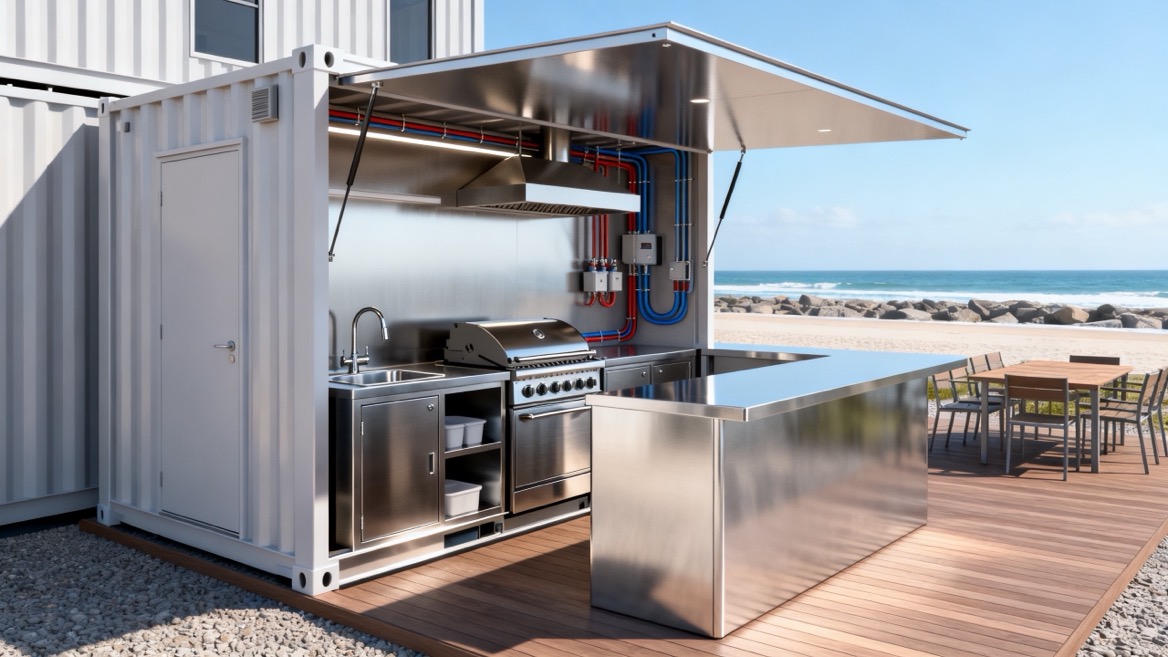
A coastal outdoor kitchen should be treated as a long-term asset, not a short-term decorative feature. The right material, engineering details, and modular layout can reduce maintenance, improve hygiene, protect visual quality, and create a more dependable outdoor service area.
Welons Prefab can help developers, distributors, contractors, hospitality operators, and project buyers create customized stainless steel outdoor kitchen solutions that integrate with prefab container auxiliary buildings, modular offices, dormitories, dining areas, exhibition units, warehouses, and industrial facilities. With 11 years of manufacturing experience and daily production capacity of 300 units, we support flexible customization, OEM production, wholesale supply, and integrated project solutions.
Contact Welons Prefab with your site location, preferred kitchen layout, appliance list, dimensions, material requirements, and project quantity. Our team can help develop a practical coastal-ready modular kitchen specification for your project.
It can be suitable for a protected, lower-exposure installation if it is cleaned frequently with fresh water. However, for open coastal areas, beachfront projects, and locations with constant salt air, 316 or 316L stainless steel is the more reliable choice because it offers stronger resistance to chloride-related corrosion.
Grade 316 stainless steel contains molybdenum, which improves its ability to resist chloride-related pitting and crevice corrosion. Chlorides are common in seawater, salt spray, coastal air, and saltwater pool environments, which is why 316 is widely used for marine-related applications.
High-quality 316 stainless steel is highly resistant to corrosion, but no material should be considered completely maintenance-free. Salt deposits, poor drainage, contamination from carbon steel, damaged surfaces, and neglected cleaning can still create staining or localized corrosion. Regular freshwater rinsing and inspection are important.
For coastal projects, prioritize 316 or 316L stainless steel for cabinet doors, drawer fronts, handles, hinges, fasteners, sinks, worktops, structural brackets, exposed frames, and appliance surround panels. Using 316 cabinet panels with low-grade screws or hinges can create weak points.
Yes. Stainless steel kitchens are particularly suitable for prefab container auxiliary buildings because they can be manufactured in modular sizes, integrated with plumbing and electrical access points, customized for appliance cutouts, and prepared for rapid installation. They work well in container offices, staff dining rooms, resort units, food-service areas, temporary camps, and exhibition facilities.
For an exposed coastal kitchen, wipe-down cleaning and freshwater rinsing should generally occur weekly or biweekly, depending on salt exposure and use frequency. Perform more thorough inspections monthly and always inspect the kitchen after storms or strong coastal winds.
It is not always necessary, but it can provide an additional protective and decorative layer when correctly specified and applied. The underlying material grade, fabrication quality, drainage, and maintenance practice remain more important than coating alone. For severe coastal exposure, start with 316 or 316L rather than relying on a surface coating to compensate for a weaker substrate.
1. [Australian Stainless Steel Development Association — Corrosion Resistance in Marine Environments]
2. [Brown Jordan Outdoor Kitchens — 304 vs. 316 Stainless Steel for Outdoor Kitchens]
3. [Brown Jordan Outdoor Kitchens — Coastal Outdoor Kitchen Designs and Tips]
4. [Kalamazoo Outdoor Gourmet — Marine-Grade Stainless Steel]
5. [Charleston Design Center — How to Weatherproof an Outdoor Kitchen]
6. [SMETALS — Stainless Steel 304 vs 316: A Comparison for Marine Applications]


