
Views: 224 Author: Welons Prefab Houses Publish Time: 2026-09-19 Origin: Site


Content Menu
● Outdoor Kitchen vs Portable Outdoor Kitchen: Quick Comparison
● What Is a Fixed Outdoor Kitchen?
>> When a Fixed Outdoor Kitchen Makes Sense
● What Is a Portable Outdoor Kitchen?
>> Common Portable Outdoor Kitchen Formats
● Guest Experience: Destination Amenity vs Flexible Convenience
● Cost Considerations Beyond the Purchase Price
>> Fixed Outdoor Kitchen Cost Factors
>> Portable Outdoor Kitchen Cost Factors
● Utility Planning: Water, Power, Drainage, and Fuel
● Safety and Compliance Considerations
>> Practical Safety Priorities
>> Accessibility Should Be Planned Early
● Fixed Outdoor Kitchen Advantages
● Portable Outdoor Kitchen Advantages
● Expert Decision Framework for RV Park Owners
>> A Simple Three-Step Selection Process
● Why Modular Prefab Construction Works for RV Parks
● Recommended Hybrid Solution for Growing RV Parks
● FAQ
>> 1. Is an outdoor kitchen a good amenity for an RV park?
>> 2. What is the difference between an outdoor kitchen and a portable outdoor kitchen?
>> 3. Can a portable outdoor kitchen have water and electricity?
>> 4. Which is more cost-effective for a small RV park?
>> 5. What materials are best for an RV park outdoor kitchen?
>> 6. Can a prefab container building be used as an RV park kitchen?
>> 7. How should RV parks manage propane cooking equipment?
For RV park owners, developers, and operators, the choice between an outdoor kitchen and a portable outdoor kitchen affects far more than meal preparation. It shapes guest experience, site revenue potential, maintenance workload, safety planning, accessibility, seasonal operations, and the overall character of the park.
A fixed outdoor kitchen can become a high-value shared amenity or a premium site feature. A portable outdoor kitchen, by contrast, provides flexibility for changing occupancy, special events, temporary expansions, and mixed-use sites. The right decision depends on whether your RV park needs a long-term destination amenity, a flexible operational tool, or a combination of both.
At Welons Prefab, we work from a modular-building perspective: outdoor food-preparation spaces should be designed as durable, serviceable, scalable operational assets, not simply as a grill under a roof. With 11 years of prefab manufacturing experience and production capacity of up to 300 units per day, we help customers develop custom container-based auxiliary buildings for hospitality, recreation, workforce accommodation, commercial sites, and RV park facilities.
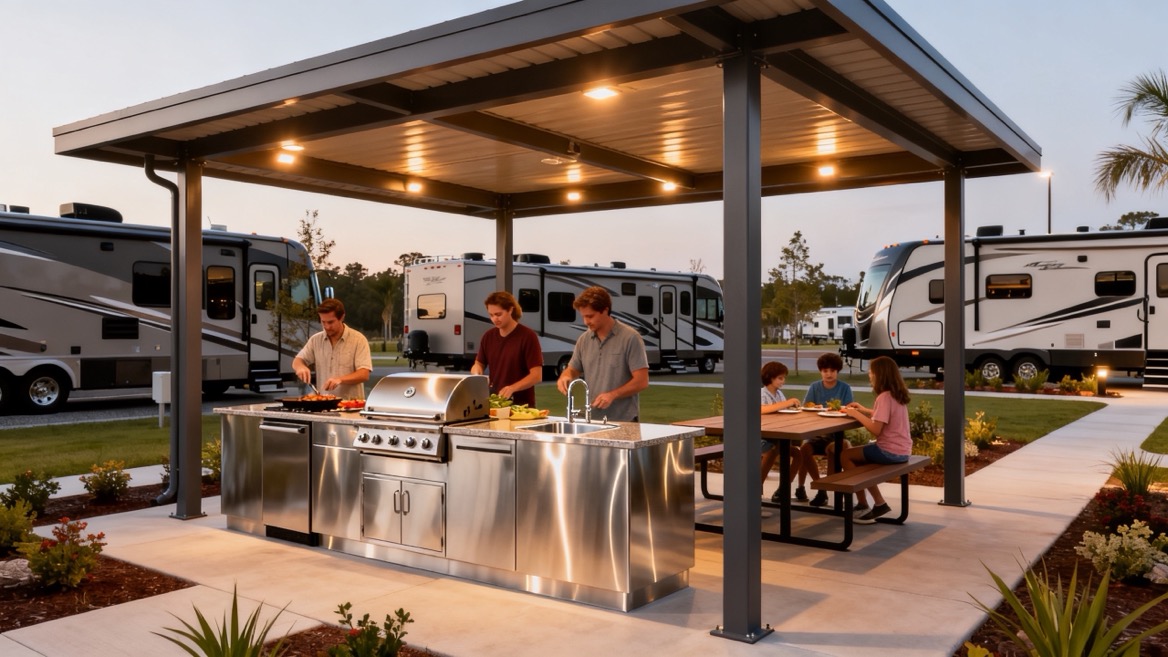
The key difference is simple: a traditional outdoor kitchen is usually fixed in one location, while a portable outdoor kitchen is designed to be moved, relocated, folded, wheeled, containerized, or installed temporarily.
| Comparison Factor | Fixed Outdoor Kitchen for RV Parks | Portable Outdoor Kitchen for RV Parks |
|---|---|---|
| Installation | Permanent or semi-permanent construction | Temporary, movable, modular, or mobile setup |
| Best use | Shared amenity areas, premium RV sites, resort-style parks | Events, seasonal operations, temporary sites, flexible use |
| Initial investment | Usually higher | Usually lower for a basic unit |
| Long-term durability | High when built with commercial materials | Varies greatly by frame, appliances, wheels, and storage design |
| Utility connection | Can support fixed water, drainage, power, gas, and lighting | Often uses portable propane, plug-in power, tanks, or quick-connect services |
| Guest experience | More polished and destination-oriented | More practical and flexible, but may feel less premium |
| Capacity | Can serve multiple RV families or group gatherings | Usually supports one family, one event station, or a small group |
| Relocation | Difficult after installation | Easy to reposition, store, or deploy elsewhere |
| Weather protection | Can include roof, walls, awnings, drainage, and wind screens | Often requires separate canopy or limited weather protection |
| Maintenance | Centralized but continuous | Easier to replace or remove, but requires transport and storage management |
| Branding opportunity | Strong: can become a signature park amenity | Moderate: can be branded for events or rental programs |
| Suitable for prefab integration | Excellent | Excellent when built as a mobile module or container-based unit |
A fixed outdoor kitchen is usually the stronger choice when a park wants to create a memorable common area. A portable outdoor kitchen is often better when flexibility, speed, lower site disruption, or seasonal deployment matters more than architectural permanence.
A fixed outdoor kitchen is a dedicated cooking and dining area installed at a permanent RV park location. It may be placed beside a clubhouse, recreation area, swimming pool, pavilion, cabin zone, glamping section, or premium long-stay sites.
Depending on the project scope, it can include:
- Commercial or residential-style grills
- Built-in cooktops or griddles
- Food-preparation counters
- Handwashing sinks
- Refrigeration
- Lockable storage cabinets
- Water supply and drainage
- Electrical outlets
- Lighting and ceiling fans
- Waste and recycling stations
- Covered dining areas
- Fire-resistant wall panels
- Shade structures, pergolas, or modular container roofs
For an RV park, the strongest fixed outdoor kitchen is not merely an appliance cluster. It is a planned hospitality zone with clear guest flow, durable finishes, safe utilities, drainage, cleaning access, and enough open space for people to cook without crowding each other.
A fixed outdoor kitchen is particularly suitable for parks that want to improve their property positioning.
It works well for:
- Resort-style RV parks
- Glamping resorts
- Long-stay RV communities
- Destination campgrounds
- Lakeside, beach, mountain, or nature-focused parks
- Family-oriented parks with group activities
- RV parks hosting rallies, reunions, cookouts, and events
- Parks with a clubhouse or shared social area
- Premium RV sites where added amenities can support higher nightly rates
A well-designed outdoor kitchen can encourage guests to stay longer, use communal spaces, socialize, and view the property as a destination rather than only a stopover.
A portable outdoor kitchen is a movable cooking station that can be used in different locations. It may be a wheeled cart, foldable kitchen station, trailer-mounted cooking unit, modular steel frame, mobile food-preparation island, or compact containerized module.
For RV parks, portable does not have to mean lightweight or low quality. A professionally designed portable outdoor kitchen can still include stainless-steel worktops, lockable storage, weather-resistant cabinets, integrated sinks, propane storage zones, electrical distribution, and fold-out serving counters.
Different RV park operators need different levels of mobility.
| Portable Kitchen Type | Typical Use in an RV Park |
|---|---|
| Folding camp kitchen | Individual campers and small temporary cooking areas |
| Wheeled grill cart | Poolside events, weekend activities, rental equipment |
| Mobile prep station | Group cooking, catering support, staff operations |
| Trailer-mounted kitchen | Food service events, rallies, seasonal pop-up dining |
| Containerized mobile kitchen | Larger parks, remote locations, temporary expansion, staff kitchens |
| Modular kitchenette pod | Semi-permanent premium RV sites or seasonal guest zones |
A portable outdoor kitchen offers a practical advantage: it can be moved where guest demand is highest. During peak season, a park may place units near a recreation field, waterfront, event lawn, or overflow camping zone. During low season, the same unit can be secured in storage or used for maintenance staff.
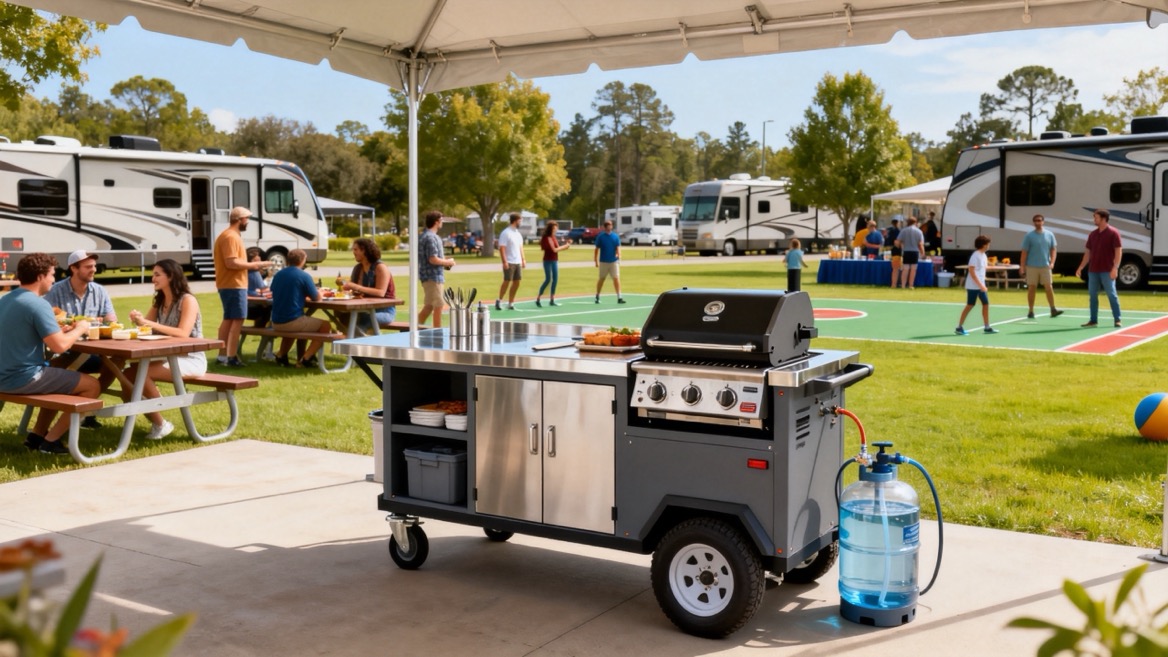
From a guest perspective, a fixed outdoor kitchen usually creates a stronger emotional impression. It can communicate that the RV park has invested in comfort, community, and hospitality.
A professionally built shared kitchen can support:
- Family cookouts
- Potluck dinners
- Group tours
- RV club gatherings
- Birthday events
- Corporate retreats
- Long-term guest social activities
- Cooking demonstrations
- Outdoor dining experiences
The permanent setting also allows better integration with landscape design. A kitchen can sit beside a fire pit, lawn, dining pavilion, outdoor cinema, dog park, playground, pool area, or event terrace.
A portable outdoor kitchen delivers a different kind of value. Its appeal is operational responsiveness. Rather than committing to one location, the operator can create a cooking zone where it is needed.
For example, an RV park hosting a three-day owners' rally could place several portable kitchen stations near the activity field. After the event, the units can be relocated, cleaned, secured, and stored. This prevents underused permanent structures from occupying valuable land all year.
The purchase price alone can lead to the wrong decision. RV park developers should compare the full lifecycle cost of each solution.
A fixed outdoor kitchen may require:
- Site grading
- Concrete foundations
- Plumbing installation
- Electrical service
- Drainage planning
- Gas connection
- Roof or canopy construction
- Permits and local approvals
- Fire-safety planning
- Landscaping restoration
- Ongoing cleaning and repair
The upfront investment can be higher, but a durable permanent facility may offer stronger long-term value when it is heavily used.
For a new RV park development, integrating the outdoor kitchen into the original site plan can reduce disruption and make utility routing more efficient. For an existing park, a prefab modular building can reduce on-site construction time compared with conventional building methods.
A portable outdoor kitchen can reduce permanent infrastructure needs, but it introduces other costs:
- Storage space
- Transportation or towing
- Wheel and chassis maintenance
- Appliance replacement
- Setup labor
- Security during use
- Portable water or waste management
- Propane cylinder handling
- Seasonal inspection
The economic advantage is strongest when the kitchen is used in several locations or for multiple business purposes. A mobile kitchen that only appears twice per year may not justify an advanced specification. However, a portable unit used for weekend events, premium rentals, group bookings, and temporary staff dining can provide better utilization.
Utilities often determine whether an outdoor kitchen becomes an asset or a maintenance problem.
A fixed outdoor kitchen can include direct connections for water, drainage, electrical power, lighting, refrigeration, and cooking equipment. This creates a more complete and comfortable user experience, especially for guests preparing full meals.
A portable outdoor kitchen may rely on:
- Fresh-water tanks
- Portable handwashing stations
- Temporary water connections
- Wastewater collection tanks
- Plug-in electrical cords
- Battery-powered systems
- Solar-supported lighting
- Propane cylinders
- Quick-connect utility points
The best solution is often a hybrid infrastructure model. The RV park installs prepared utility points in several locations, while the portable kitchen modules connect only when needed. This approach gives the operator flexibility without sacrificing basic convenience.
For example, a modular outdoor kitchen can be positioned beside a paved event pad with protected electrical access, water connection, drainage point, lighting, and waste bins. When the park is not using the kitchen, the module can be moved away while the site remains available for other activities.
Cooking areas must be planned around local building rules, fire codes, fuel requirements, sanitation practices, and park-specific operating policies. Requirements vary by country, state, municipality, and site condition, so every project should be reviewed by qualified local professionals before construction or operation.
For RV-oriented cooking equipment, fire and life-safety requirements cover areas such as fuel systems, appliances, plumbing, and electrical installations. Outdoor LP-gas cooking appliances and RV cooking appliances are also subject to relevant product standards.
Whether the kitchen is fixed or portable, operators should plan for:
- Clear separation between active cooking equipment and combustible materials
- Stable, level flooring
- Controlled propane storage
- Accessible fire extinguishers
- Grease-management procedures
- Proper ventilation
- Safe electrical connections
- Slip-resistant surfaces
- Cleaning schedules
- Child-safety considerations
- Lockable appliance and storage areas
- Emergency shutoff access
- Clear operating instructions
Portable propane cylinders should remain upright, secured, and outside enclosed living spaces during transport and storage. Operators should inspect hoses, fittings, regulators, burner areas, and connections before use. Cooking equipment should also be placed away from RV sidewalls, awnings, dry grass, furniture, spare cylinders, and other combustibles.
Accessible design is not an afterthought. A kitchen or grill zone should provide stable surfaces, clear circulation routes, usable approach space, and comfortable access for guests using mobility devices.
U.S. outdoor recreation guidance identifies a clear ground space of at least 48 by 48 inches on usable sides of grills, fire rings, fireplaces, and woodstoves. It also calls for accessible clear space around picnic tables and usable wheelchair seating spaces.
For an RV park developer, this has a practical implication: do not place the grill, prep counter, dining table, waste bin, and circulation route too close together. A well-planned layout is safer, easier to clean, and more welcoming to a wider range of guests.
A fixed outdoor kitchen is usually the better choice when an RV park wants to create a long-term hospitality feature.
- Higher perceived property value: A permanent kitchen area can strengthen the visual identity of the park.
- Better guest comfort: Fixed water, power, drainage, lighting, and refrigeration support longer and more convenient use.
- Stronger event capability: The area can host group meals, cooking programs, seasonal celebrations, and club gatherings.
- Premium-site differentiation: A private kitchen or covered cooking pavilion can support premium pricing strategies.
- Improved durability: Commercial-grade materials and permanently installed utilities are more resilient under frequent use.
- Better weather protection: Roofs, walls, wind screens, awnings, and drainage can be integrated from the beginning.
- Brand-building opportunity: A branded communal kitchen can become part of the park's visual signature.
- Higher upfront construction cost
- More permit and utility coordination
- Limited ability to relocate
- Potentially lower utilization in off-season locations
- Ongoing cleaning and maintenance responsibility
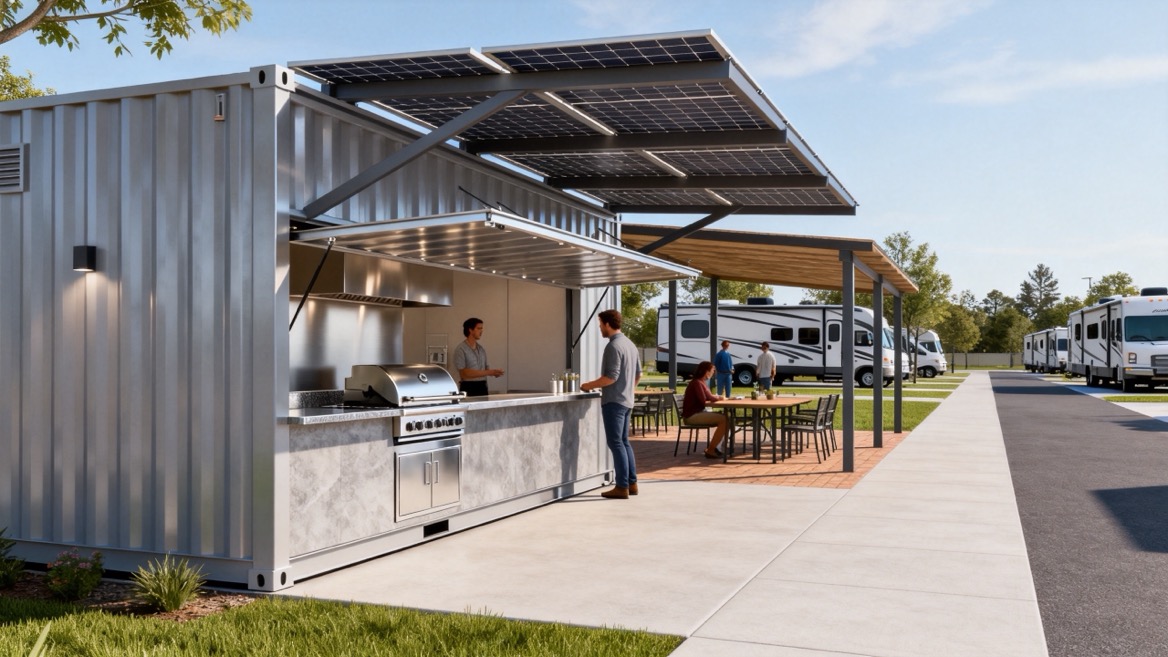
Portable outdoor kitchens are especially useful for operators who need agility.
- Fast deployment: Units can support a new event zone, temporary campsite, or seasonal activity area quickly.
- Flexible layout: The park can test locations before committing to permanent construction.
- Lower site disruption: Less excavation and fewer permanent changes may be required.
- Scalable investment: Operators can add units as demand grows.
- Seasonal storage: Equipment can be protected during low-occupancy periods or severe weather.
- Multiple revenue uses: Portable kitchens can support rentals, events, staff meals, pop-up food programs, and group packages.
- Suitable for remote sites: Containerized or trailer-based solutions can be useful where conventional construction is difficult.
- Less polished guest experience without thoughtful design
- Possible dependence on tanks, cords, temporary utilities, or propane cylinders
- More setup and takedown work
- Storage and transport requirements
- Greater risk of damage if units are not secured properly
- Limited capacity for large groups unless several units are deployed
The most useful question is not "Which kitchen is better?" It is "Which operational model creates the strongest return for this site?"
Use the following decision framework before selecting a solution.
| Your RV Park Situation | Recommended Direction |
|---|---|
| New destination RV resort with clubhouse and event lawn | Fixed outdoor kitchen or container-based pavilion |
| Small park with changing seasonal demand | Portable outdoor kitchen |
| Park hosting frequent rallies and group events | Hybrid system with a fixed central kitchen plus mobile units |
| Remote camping or off-grid destination | Containerized portable kitchen with independent utility options |
| Premium waterfront or scenic sites | Fixed private or shared outdoor kitchen with weather protection |
| Existing park testing a new amenity concept | Portable kitchen first, then permanent investment after demand validation |
| Workforce accommodation or long-stay project | Durable modular kitchen building with centralized service infrastructure |
| Multi-location park operator | Standardized portable or containerized units for consistent deployment |
1. Measure actual demand. Review occupancy patterns, average length of stay, group-booking frequency, guest reviews, event calendars, and unused common areas.
2. Map the utility reality. Identify existing water, drainage, electricity, gas options, pavement, storage areas, vehicle access, and service routes.
3. Choose the right level of permanence. Build permanently only where demand is consistent. Use portable or modular systems where the site, season, or guest mix changes frequently.
This process helps prevent a common mistake: investing in an attractive outdoor kitchen that is difficult to maintain or located too far from where guests naturally gather.
Prefab construction is particularly suited to RV park auxiliary facilities because it can balance durability with speed and customization.
A container-based outdoor kitchen, kitchen pavilion, dining room, event kiosk, storage room, staff canteen, washroom, or service building can be manufactured under controlled factory conditions and delivered for efficient on-site installation.
For RV park applications, a modular outdoor kitchen building can be customized with:
- Insulated wall and roof panels
- Galvanized steel frames
- Corrosion-resistant finishes
- Food-grade worktops
- Stainless-steel sinks
- Lockable cabinets
- Electrical systems
- Plumbing-ready connections
- Ventilation openings
- Service windows
- Fold-out counters
- Exterior signage
- Solar-ready roof structures
- Covered dining extensions
- Integrated storage rooms
At Welons Prefab, our manufacturing capability supports OEM, wholesale, customized layout planning, and one-stop modular building solutions. Rather than forcing every project into a standard room size, we can help customers consider the actual site function: how many people will use the kitchen, whether food is prepared or only reheated, which utilities are available, whether the building must move, and how the facility will perform in local weather conditions.
For many operators, the best answer is not fixed versus portable. It is a hybrid outdoor kitchen strategy.
A practical hybrid setup could include:
- One permanent central outdoor kitchen near the clubhouse or gathering lawn
- Several mobile grilling or preparation stations for weekend events
- Utility-ready pads in two or three high-traffic areas
- Lockable dry-storage modules for equipment and cleaning supplies
- A modular covered dining zone that can be expanded over time
- Clear operating procedures for propane, cleaning, waste, and equipment storage
This model gives the park a recognizable central amenity while preserving flexibility for peak-season demand.
It also allows staged investment. The owner can begin with a portable modular kitchen, monitor usage, gather guest feedback, and then expand toward a permanent kitchen pavilion once demand is proven.
Choose a fixed outdoor kitchen when your RV park needs a durable guest amenity, a premium social space, stronger branding, and year-round operational value. It is ideal for resorts, long-stay parks, large campgrounds, and properties that regularly host groups.
Choose a portable outdoor kitchen when flexibility, rapid deployment, seasonal use, site testing, or lower initial commitment is more important. It is ideal for event-based parks, temporary sites, changing occupancy patterns, and operators who need equipment to serve multiple locations.
For ambitious RV park projects, a modular hybrid system often delivers the best balance. A well-built central kitchen provides a long-term guest experience, while portable units create the flexibility needed for events, growth, and seasonal operations.
If you are planning an RV park kitchen, campground dining pavilion, container-based service building, staff canteen, or mobile food-preparation unit, contact Welons Prefab to discuss a custom layout, material specification, OEM requirement, and modular delivery plan tailored to your market.
Yes. A well-designed outdoor kitchen can improve the guest experience, support social activities, and make an RV park more distinctive. It is especially valuable for parks that attract families, groups, long-stay guests, RV clubs, and event bookings.
An outdoor kitchen is normally built in a fixed location with permanent utilities and weather protection. A portable outdoor kitchen is movable and may use wheels, a trailer, fold-out components, a mobile module, or a containerized structure.
Yes. It can use onboard tanks, temporary utility hookups, plug-in electrical connections, battery systems, or prepared utility pads. The correct system depends on the kitchen size, intended use, local requirements, and site infrastructure.
A portable outdoor kitchen is often more cost-effective for a small park with seasonal demand or limited capital. However, a fixed kitchen may provide better value if the park has consistent occupancy and frequent group use.
For commercial or shared use, practical materials include galvanized steel structures, stainless-steel work surfaces, weather-resistant panels, non-slip flooring, corrosion-resistant hardware, and durable roofing systems. Materials should be selected based on climate, maintenance capacity, guest volume, and local safety requirements.
Yes. A prefab container building can be adapted into a kitchen, dining space, snack bar, grill pavilion, event-service station, staff canteen, storage room, or combination unit. It can also be designed with service windows, covered seating, storage, plumbing connections, and electrical systems.
RV parks should establish clear rules for cylinder storage, appliance inspection, cooking locations, fire extinguishers, cleaning, and emergency response. Portable cylinders should be secured upright, kept away from enclosed spaces and heat sources, and inspected before cooking.
1. [U.S. Access Board — Chapter 10: Recreation Facilities]
2. [U.S. Access Board — Chapter 10: Outdoor Developed Areas]
3. [RVIA — 2021 NFPA 1192 RV Standard Announcement]
4. [National Fire Protection Association — NFPA 1192 Report]
5. [RV Life — RV Propane Safety for Outdoor Cookouts]
6. [RV Life — RV Exterior Kitchen Features and Models]
7. [U.S. Access Board — Outdoor Recreation Accessibility Guidance]


